Complete Guide to Japanese Sword Registration Certificates: How to Obtain One, What to Do If Lost, and Transfer Procedures
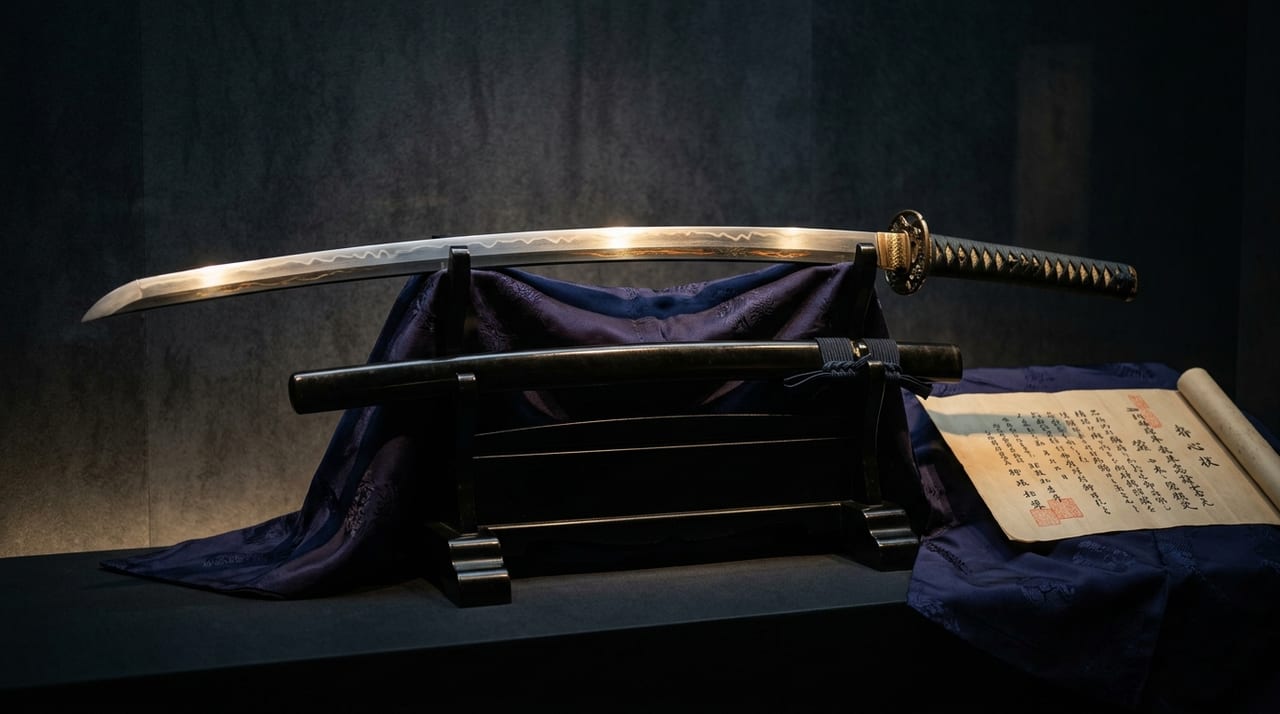 * Image is for illustrative purposes only.
Table of Contents
What is the Registration Certificate — A Document that Protects the Legal Status of Japanese Swords
In Japan, a "jūhō tōken rui tōrokushō (Firearms and Swords Registration Certificate)" is required to legally possess a Japanese sword. This is an official document issued by the prefectural Board of Education under the Act for Controlling the Possession of Firearms or Swords and Other Such Weapons (hereafter the Firearms and Swords Control Act (Jūtōhō)), and one certificate is issued per sword.
A Japanese sword without registration is, if the blade length is 15 cm or more, subject to the provision prohibiting the possession of sword-type weapons (Article 3 of the Firearms and Swords Control Act (Jūtōhō)), and may be subject to penalties (Act for Controlling the Possession of Firearms or Swords and Other Such Weapons (e-Gov Law Search)). On the other hand, a Japanese sword with a registration certificate can be legally possessed as "a sword as an art object or antique."
Information Recorded on the Registration Certificate
The following information is recorded on the registration certificate:
| Field | Example Content |
|---|---|
| Type | katana, wakizashi, tantō, naginata, etc. |
| Mei | mumei / made by ○○ of Osafune, Bizen Province, etc. |
| Blade length | ○○ cm |
| Sori | ○○ cm |
| Mekugi-ana | ○ holes |
| Registration number | Prefecture + number |
| Issuing authority | Board of Education of ○○ Prefecture |
| Date of registration | ―――― |
The information on the registration certificate must match the actual sword. When reselling or transferring ownership, the certificate must always accompany the sword.
How to Register a New Sword — Procedure for Legitimizing Unregistered Blades
If you wish to legally possess a sword brought from abroad or a sword that has not been registered (or whose registration cannot be confirmed), you must complete the procedure for new registration. If a registered sword simply had its certificate lost, you should apply for a reissuance rather than new registration (see "What to Do When the Registration Certificate is Lost," below).
Step 1: Contact the Board of Education
First, contact the Board of Education (cultural property division) of the prefecture where you currently reside by phone or email to state that you "wish to newly register a sword," and confirm the examination date and procedure.
Step 2: Bring the Sword to the Registration Examination
Registration is conducted based on the appraisal of registration examiners at an examination held by the prefectural Board of Education (Article 14, Paragraph 3 of the Firearms and Swords Control Act (Jūtōhō)). The applicant must bring the sword to the examination. Examination schedules differ by prefecture; Tokyo, in principle, holds examinations on the third Saturday of every month (Tokyo Metropolitan Board of Education, "Procedures for Reissuance of Registration Certificates").
Step 3: The Examination
The examination confirms the following:
- Whether the sword meets the appropriate requirements as a Japanese sword (whether it was forged using traditional Japanese techniques)
- Whether it is a reproduction sword or replica sword
- Measurement and recording of blade length, sori, mei, and other details
Step 4: Issuance of the Registration Certificate
If the appraisers determine that the sword meets the criteria for registration, the Board of Education will issue the registration certificate. Fees differ by prefecture; Tokyo's registration examination fee is 6,300 yen per sword, and is non-refundable even if registration is not granted. Fees for other prefectures can be confirmed on each Board of Education's website (Tokyo Metropolitan Board of Education, "When a Firearm or Sword is Discovered").
Points to Note
- Swords of foreign manufacture (e.g., imitation swords of Korean or Chinese origin) may not be eligible for registration.
- Reproductions and replica swords are not subject to registration.
- Swords whose materials and manufacturing methods do not meet the requirements for Japanese swords (tamahagane, forging, etc.) may fail the examination.
What to Do When the Registration Certificate is Lost
If a registration certificate is lost, stolen, or damaged to the point of being illegible, the sword owner must report the matter to the Board of Education of the prefecture that issued the certificate and obtain a reissuance (Act for Controlling the Possession of Firearms or Swords and Other Such Weapons (e-Gov Law Search), Article 15, Paragraph 2). The following procedure is for Tokyo; details differ by prefecture, so confirm with the Board of Education that issued the certificate.
Procedure 1: Confirming Registration and Filing a Lost Property Report with the Police
First, contact the Board of Education that issued the certificate by phone to confirm that the registration for the sword in your possession is still on record. Swords whose registration cannot be confirmed are not eligible for reissuance. In the case of loss, file a lost property report with the nearest police station and note the reference number.
Procedure 2: Submitting a Reissuance Application to the Board of Education
Submit the following documents in advance to the Board of Education of the prefecture that issued the certificate (for Tokyo):
- Application for Reissuance of Registration Certificate
- Notification of Loss/Theft/Destruction of Firearms and Swords Registration Certificate (for cases of loss, enter the lost property report reference number)
Procedure 3: Physical Inspection at the Examination
To receive a reissuance, you must bring the sword to the examination and undergo a physical inspection. If the data recorded by the examiners matches the registration record (tōroku genpyō), the certificate will be reissued. If it does not match, inquiries will be made to Boards of Education nationwide; if no match is found anywhere, the sword will be treated as a new registration case at the Board of Education of the owner's place of residence.
Cost and Time Required for Reissuance
The cost is the prefectural fee; Tokyo's reissuance fee is 3,500 yen. Since reissuance requires a physical inspection at the examination, the time required depends on the examination schedule (Tokyo Metropolitan Board of Education, "Procedures for Reissuance of Registration Certificates").
Procedures for Transfer and Sale
When selling, gifting, or inheriting a Japanese sword, it is important to correctly understand the notification obligations regarding changes of ownership.
Notification Obligation for Change of Ownership
Under Article 17, Paragraph 1 of the Act for Controlling the Possession of Firearms or Swords and Other Such Weapons (Jūtōhō) (Act for Controlling the Possession of Firearms or Swords and Other Such Weapons (e-Gov Law Search)), when the ownership of a sword changes through transfer or inheritance, there is an obligation to notify the Board of Education of the prefecture that issued the registration of the change of ownership within 20 days. Note that simply keeping the registration certificate attached to the sword does not fulfill the notification obligation.
Practical Notes
The following situations in particular require that procedures be completed reliably:
- Inheritance: When a sword is inherited, the heir must notify the Board of Education within 20 days of the commencement of inheritance.
- Sale or gift: The new owner must file a notification within 20 days from the date ownership transfers.
- Legal entity to individual: The notification obligation also applies when a sword is transferred from a museum or corporation to an individual.
- Transfer across prefectural boundaries: When the prefecture listed on the registration certificate differs from the sword's location, confirm which Board of Education to notify.
Procedures for Taking Swords Abroad and Exporting Them
To take a Japanese sword abroad or to export one, you must obtain an "Export Inspection Certificate for Antique Art Objects" from the Agency for Cultural Affairs. Items designated as kokuhō (National Treasure) or jūyō bunkazai (Important Cultural Property), as well as items designated as jūyō bijutsuhin (Important Art Object) or equivalent, generally cannot be exported; customs may therefore ask you to confirm that the sword being exported does not fall into any of these categories. This certificate is issued by the Agency for Cultural Affairs upon application by the owner or other party for the purpose of that confirmation (Agency for Cultural Affairs, "Export Inspection Certificate for Antique Art Objects"). Prefectural Boards of Education advise applicants to obtain this certificate when exporting a registered sword, and short-term removal from Japan for overseas martial arts demonstrations or exhibitions is also considered "export" (Tokyo Metropolitan Board of Education, "When Exporting Firearms or Swords"). The practical details of preparing documents, packaging, and selecting a shipping carrier for individuals handling the process and sending swords abroad on their own are explained in detail in Guide to Exporting Japanese Swords Abroad for Individuals.
Cases Requiring an Export Inspection Certificate
- When exporting a registered sword (regardless of year of manufacture)
- Items designated as kokuhō (National Treasure), jūyō bunkazai (Important Cultural Property), or jūyō bijutsuhin (Important Art Object) or equivalent generally cannot be exported.
Where to Apply and the Procedure
Applications are submitted to the Agency for Cultural Affairs by postal mail (no other submission method is accepted). Documents to attach:
- Application form (Agency for Cultural Affairs format; there is also a format for the attached inventory for registered swords)
- Photographs of the entire blade (obverse and reverse) and close-up photographs of the nakago (obverse and reverse), or oshigata
- A copy of the front face of the registration certificate
- A return envelope for the certificate
Time to Issue and Handling of the Certificate
In principle, issuance takes 10 business days from the date the documents are received in full, but the Agency for Cultural Affairs advises that the number of applications has increased significantly and that additional time may be required before issuance. The original certificate must be submitted to customs at the time of the export declaration, and an application must be made for each export declaration. The certificate is valid for one year and is valid for a single export (Agency for Cultural Affairs, "Export Inspection Certificate for Antique Art Objects").
Return of the Registration Certificate
The registration certificate becomes invalid as soon as the sword is taken out of Japan and must be returned to the Board of Education of the prefecture that issued it. A sword brought back to Japan must be re-registered with the Board of Education of the owner's place of residence (Tokyo Metropolitan Board of Education, "When Exporting Firearms or Swords").
Procedures in the Destination Country
It is also necessary to check the laws of the destination country. Some European countries have strict weapons regulations, and a local permit may be required for possession after arrival.
Conclusion — The Registration Certificate: the "Family Register" of Japanese Swords
The registration certificate for a Japanese sword is something like a "family register" that certifies the legal existence of each individual sword. The correct functioning of the registration certificate at every stage — acquisition, storage, and transfer — is the foundation for the legal possession and trade of Japanese swords.
By completing the appropriate procedures for each situation — new purchase, inheritance, or taking the sword abroad — Japanese swords will be passed on to future generations as cultural heritage.