Decoding the Japanese Sword Market — Official Statistics' Limitations and Industry Alternative Indicators
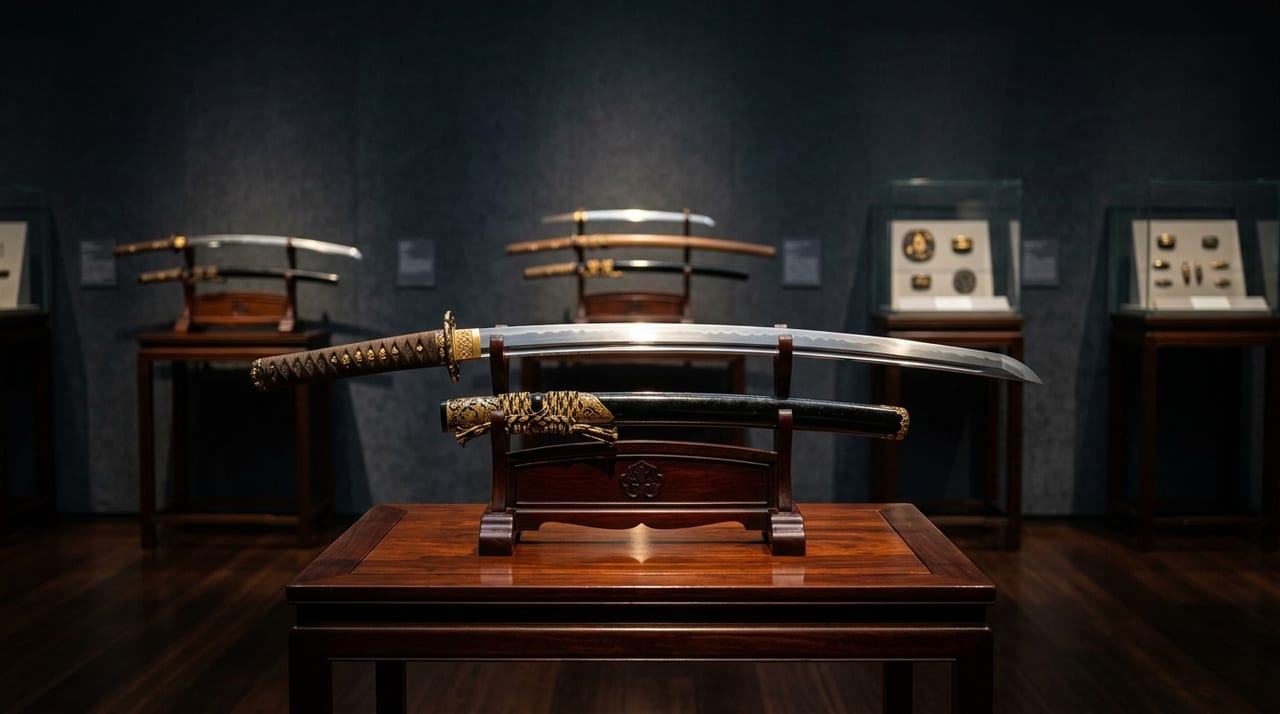 * Image is for illustrative purposes only.
Table of Contents
Everyone involved in the Japanese sword industry has wondered this at least once——what is the actual size of this market? Yet, regarding the Japanese sword market as a field of fine art and antiques, there is no official market size statistics calculated by government agencies or industry organizations. This is because there is no exchange like the stock market, nor any mechanism to aggregate all transactions. Still, by combining multiple indirect indicators, we can sketch out the market's contours to some extent.
Why Don't We Know the 'Exact Size' of the Japanese Sword Market?
Trading in Japanese swords is distributed across multiple channels.
- Specialized sword dealers
- Antique dealers
- Auctions
- Private transactions between individuals
- Online platforms in recent years
Each channel manages transactions independently, and there is no unified system to aggregate transaction amounts across the industry. Additionally, exports to overseas and private transfers between collectors are also elements that constitute market size, but it is difficult to capture these comprehensively. As a result, the reality is that the size of the Japanese sword market remains in the realm of 'estimation'.
Clues from Public Statistics——Registration Certificates as an Indicator
One of the few pieces of public data is the registration certificate for fine art swords based on the Firearms and Swords Control Law. To possess a Japanese sword within Japan, a registration certificate issued by the prefectural board of education is required, and registration certificates are issued for newly discovered or reported swords. The number of new registration certificates issued can sometimes be found in materials compiled by prefectural boards of education and the Agency for Cultural Affairs, serving as one clue to estimate the supply of newly appearing swords in the market. However, it should be noted that registration certificate issuance shows 'the number of newly registered swords' and does not indicate the actual number of transactions of already registered swords. Since previously owned pieces are often sold upon succession or inheritance and circulate under existing registration certificates, market transaction volume as a whole cannot be measured solely by the number of certificates issued.
Estimation from the Activity Scale of Industry Organizations and Appraisal Institutions
Another clue is the number of appraisal certificates issued by appraisal institutions such as the NBTHK, as well as the number of members and affiliated shops of industry organizations to which sword dealers nationwide belong. The number of appraisal certificate applications serves as at least a measure of how much activity occurred in a given year——how many swords circulated in the market and required appraisal evaluation. Additionally, the scale and frequency of sword fairs, auctions, and exhibitions held in various locations are sometimes referenced as supplementary indicators for measuring the activity level of the industry. While none of these directly show market size itself, by layering multiple indicators together, it becomes easier to grasp rough trends such as industry prosperity or stagnation.
The Impact of Digitalization on Market Visibility
In recent years, the expansion of Japanese sword trading to online platforms has held certain significance in terms of market visibility. This is because information that previously relied on face-to-face transactions at sword dealers' shops or sword fairs can now be viewed as a list of online listings and price ranges. That said, it should be noted that this has not made it possible to grasp the total transaction amount of the entire market, but rather only made a portion of transactions visible online. Nevertheless, the fact that we can now continuously track the number of listings and changes in price ranges represents a major shift compared to the previous era when face-to-face transactions dominated.
The Expansion of Overseas Demand and Its Impact on Market Size
What has been frequently discussed in recent years is the expansion of demand from overseas Japanese sword enthusiasts and collectors. Against the backdrop of yen exchange rate trends and growing interest in Japanese culture, the presence of overseas buyers is said to be increasing. However, on this point as well, there are no statistics showing the exact total amount including overseas transactions, and the reality is that discussions remain qualitative, based on the impressions of industry insiders and individual transaction cases. When discussing market size, how we combine and interpret these fragmented pieces of information becomes important in itself. While domestic demand changes gradually, the addition of overseas demand as a new variable makes market size estimates increasingly complex——this understanding is likely closer to reality.
Facing the Market While Acknowledging the Limits of Statistics
As outlined above, the size of the Japanese sword market cannot be expressed as a single fixed number. However, by looking at multiple alternative indicators side by side, we can grasp rough trends about which direction the market is moving.
- Registration certificate issuance trends
- Activity volume of appraisal institutions
- Scale of industry organizations
- Online listing data
Rather than taking a single statistic at face value, the approach of combining and interpreting multiple fragmented pieces of information is an essential perspective for understanding this market.
Continuously tracking these multiple alternative indicators is useful not only for industry insiders but also for those considering purchasing or collecting Japanese swords in the future. By looking at multiple angles side by side——such as registration certificate trends and changes in the number of listings——rather than reacting with elation or despair to increases or decreases in specific statistics, one can develop a market perspective that is not swayed by excessive optimism or pessimism.
On TOUKENZA, swords listed for sale can be viewed from the online catalog, allowing you to touch upon one aspect of the market through price ranges and listing status. If you find a work of interest, you can also contact us through the inquiry form.