International Shipping and Export Procedures for Nihontō — Packaging, Customs Declarations, Destination-Country Regulations, and Safe Dispatch Know-How
 * Image is for illustrative purposes only.
Table of Contents
Why International Shipping of Nihontō Is Complex
Shipping nihontō to overseas collectors or museums involves inherently different legal and practical complexities from ordinary international shipment of fine art. Many countries classify swords as "weapons," and a significant number impose import restrictions, prohibitions, or requirements for special permits. Within Japan as well, the export of swords registered as works of art (i.e., bearing a registration certificate) requires consideration of both the Act on Protection of Cultural Properties and the Act for Controlling the Possession of Firearms or Swords and Other Such Weapons (Jūtōhō).
This article systematically explains the knowledge required when undertaking international shipment of nihontō — Japan's export regulations, import regulations in major destination countries, practical packaging, preparation of customs declaration documents, and how to handle problems when they arise.
Japan's Export Regulations: The Act on Protection of Cultural Properties and the Firearms and Swords Control Act (Jūtōhō)
When exporting swords from Japan, the first thing to confirm is their treatment under the Act on Protection of Cultural Properties. The export of swords designated as kokuhō (National Treasures) or jūyō bunkazai (Important Cultural Properties), or recognized as jūyō bijutsuhin (Important Art Objects), is in principle prohibited; even for swords that have not received such designation or recognition, customs may require confirmation at the time of export that they do not fall under these categories (Agency for Cultural Affairs, "Kobijutsuhin Export Inspection Certificate").
From the perspective of the Firearms and Swords Control Act (Jūtōhō), a sword accompanied by a registration certificate (the sword registration certificate issued by a prefectural Board of Education) is treated as a "sword recognized as a work of art." When exporting a registered sword, the most critical procedural step is obtaining the "Kobijutsuhin Export Inspection Certificate" issued by the Agency for Cultural Affairs. The original kobijutsuhin export inspection certificate must be submitted to customs at the time of export declaration. A copy of the registration certificate should be included in the shipment. Note that the original registration certificate must not be included in the shipment — it becomes invalid the moment it is taken outside Japan, and it must therefore be returned to the issuing prefectural Board of Education after export (Tokyo Metropolitan Board of Education, "When Exporting Firearms and Swords").
Regarding export declarations, registered art swords are normally treated as "works of art," and the export permit from the Minister of Economy, Trade and Industry (the weapons export route under the Foreign Exchange and Foreign Trade Act) does not normally apply to ordinary registered art swords. However, since regulations may differ for unregistered swords or special types of swords, it is advisable to confirm with customs in advance before exporting.
Import Regulations in Major Destination Countries
The import regulations for representative countries and regions as destinations for nihontō exports are as follows.
| Country/Region | Overview of Import Regulations |
|---|---|
| United States (USA) | Import takes place under relatively lenient regulations. Long-bladed swords are classified as "weapons," and possession regulations vary by state (some states, such as California, impose additional restrictions on carrying or selling certain types of swords). At the federal level, tariff rates are often zero or low when importing as art or collectibles. |
| EU member states | The EU weapons directive (Directive (EU) 2021/555) separately regulates firearms; non-firearm weapons such as swords are governed by the domestic law of each member state (EUR-Lex "Directive (EU) 2021/555" Annex I). |
| Germany | There are strict regulations on sword possession, and importing or possessing swords considered "offensive weapons" may require a permit. |
| United Kingdom | Carrying a bladed article in a public place without good reason is prohibited (excluding folding knives with a blade of 3 inches or less; legislation.gov.uk "Criminal Justice Act 1988 section 139"). Curved blades 50 cm or longer are subject to restrictions on manufacture, sale, import, and similar activities; antiques made more than 100 years ago are exempt, and it is a defense to show that the sword was made before 1954 or was hand-made by a traditional method (legislation.gov.uk "The Criminal Justice Act 1988 (Offensive Weapons) Order 1988" Schedule). |
| Mainland China | Import is effectively prohibited or extremely difficult, making it unsuitable as a practical export destination. |
| Taiwan | Relatively open, but an import permit procedure is required. |
| Hong Kong | Has its own regulations; a permit is required to import swords classified as "weapons." |
Practical Packaging: Safe and Reliable Packaging Methods
In the international shipment of swords, packaging is critically important from the standpoint of both safety and customs inspection. The procedure is as follows.
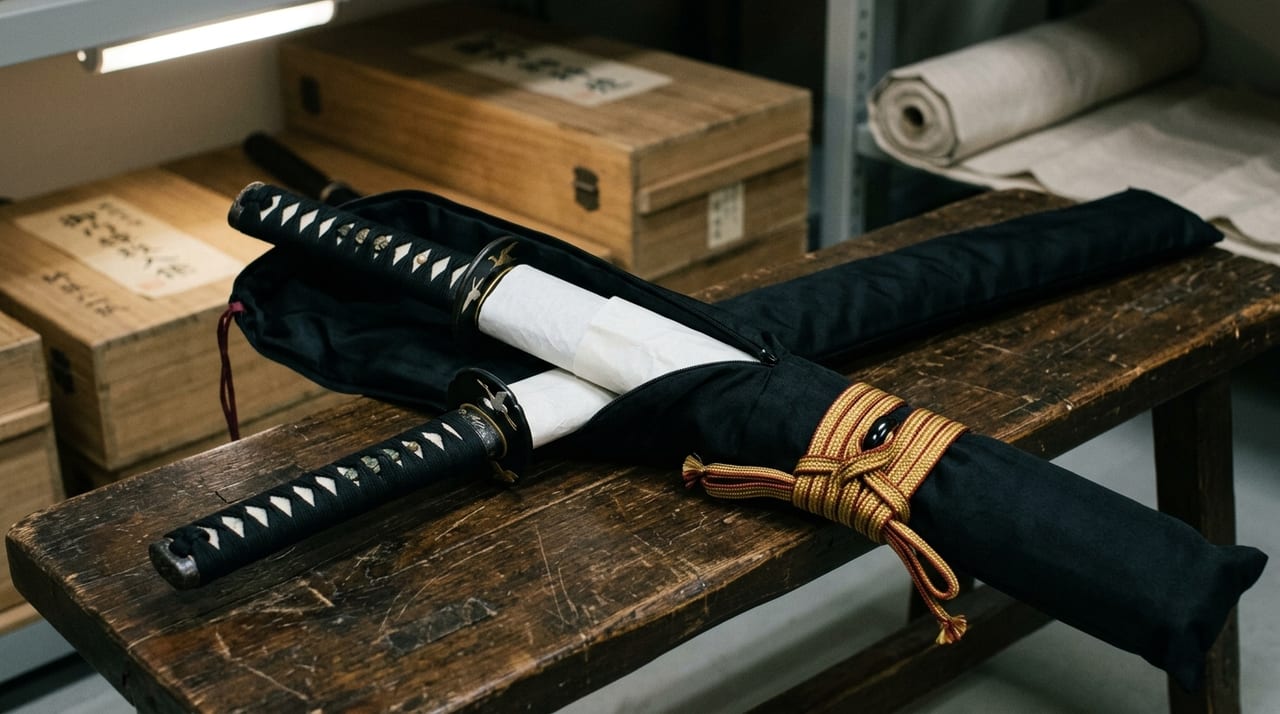
- Place the sword in a shirasaya (plain storage scabbard) or wrap the blade in protective material (cloth, foam sponge, etc.) to prevent edge damage.
- Place it in a wooden storage box (paulownia or cedar box) and secure it with cushioning material so it cannot move.
- Use a sturdy cardboard outer box and fill the inside with sufficient cushioning material.
To enable customs inspectors to handle the package safely when it is opened, it is advisable to include the following.
- A label indicating the direction of the blade (affixed inside the box)
- Instructions for opening the package (in English or the language of the destination country)
- A copy of the registration certificate
- Proof of purchase / provenance certificate
- Valuation document
Customs Declaration Documents and Choice of Carrier
For customs declaration, prepare the following documents.
- Commercial invoice (description: "Japanese Sword / Nihonto" or "Antique Sword"; the HS number differs by age of manufacture — swords made within 100 years use 9307.00, swords over 100 years old use a heading 97.06 number as antiques; see below)
- Kobijutsuhin Export Inspection Certificate (issued by the Agency for Cultural Affairs)
- Packing list
- Certificate of origin (when required)
- Copy of the sword registration certificate
In the Harmonized System (HS) tariff schedule, swords fall under Chapter 93, heading 9307.00 (swords, cutlasses, bayonets, lances, and similar arms). However, the Chapter 93 notes exclude collectibles and antiques, so swords made more than 100 years ago are classified under heading 97.06 (9706.10 for those made more than 250 years ago, and 9706.90 for the remainder) (Japan Customs, "Tariff Schedule Commentary," Chapter 93 / Chapter 97). Heading 97.05 (9705.10) covers collections of archaeological, ethnographic, or historical interest and is limited to items associated with historically significant events or persons; it is not the appropriate heading for ordinary art swords.
International couriers such as DHL, FedEx, and UPS may refuse to transport swords. For this reason, it is advisable to consider using fine art transport companies that specialize in swords, or international freight carriers with a track record in sword transport.
Typical Problems and How to Handle Them
Typical problems and how to handle them are as follows.
| Problem | How to Handle It |
|---|---|
| Seizure at customs (caused by deficiencies in import documentation or overlooked import-country regulations) | Confirm regulatory details with the destination country's embassy or consulate in advance, and make use of specialist customs brokers. |
| Blade damage during packaging | Using dedicated shock-absorbing packaging materials and having a professional handle packing on behalf of the owner for important swords is effective. |
| Transportation insurance issues (swords may be excluded from coverage as "weapons") | For the transport of high-value nihontō, taking out dedicated fine-art transport insurance is essential; confirm the terms with the insurer in advance. |
International shipment of nihontō can only be carried out safely by balancing three elements: legal compliance, practical preparation, and cultural consideration. We strongly recommend making use of expert advice and proceeding with the utmost care.