Nihontō Inheritance and End-of-Life Planning — Legal Procedures, Appraisal, and Sale Practices for Transferring Nihontō in Estate Settlement
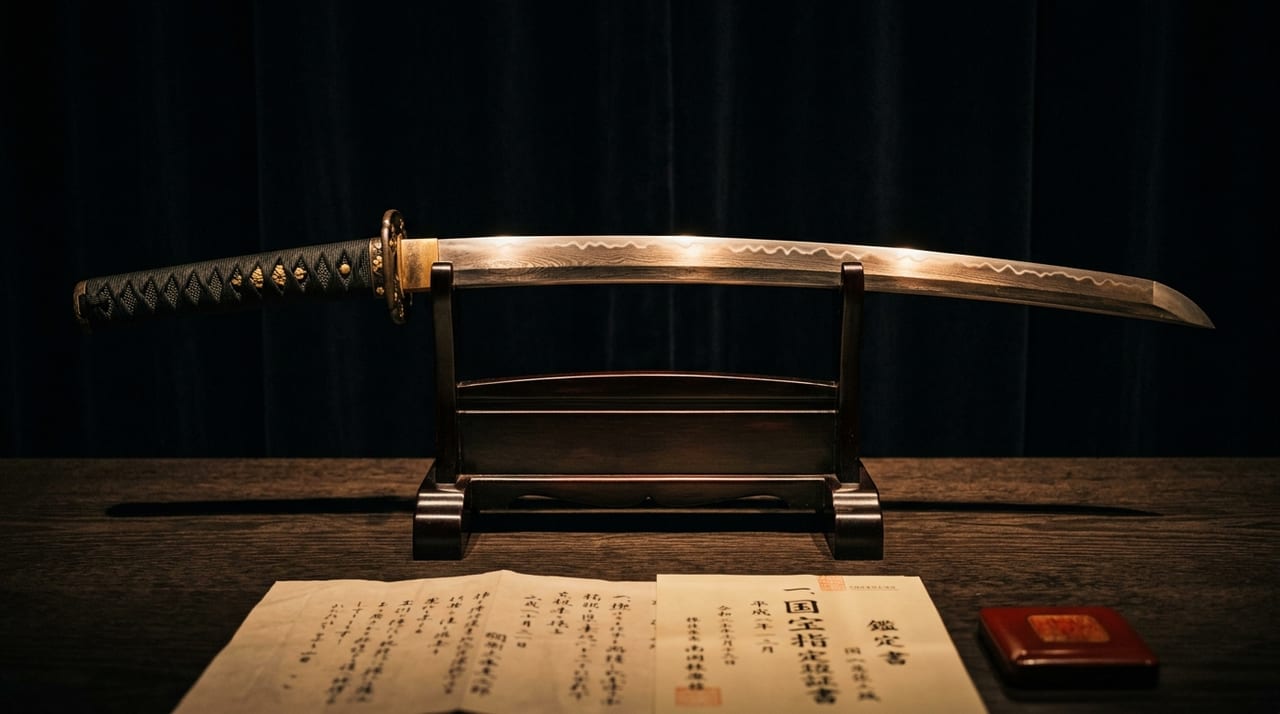 * Image is for illustrative purposes only.
Table of Contents
What Makes Nihontō Different from "Ordinary" Inherited Property
When a person who owns a nihontō passes away, the sword becomes part of the estate. However, unlike ordinary antiques or works of art, nihontō are subject to a registration system under the Act for Controlling the Possession of Firearms or Swords and Other Such Weapons (Jūtōhō), and a legal procedure is required each time ownership changes hands. This is what sets nihontō inheritance apart from other estate transfers.
The first thing to confirm when inheriting a nihontō is the existence of a "registration certificate." Formally known as a "Certificate of Registration for Firearms and Swords," it is issued by the prefectural Board of Education. A sword bearing this registration certificate may be legally possessed and inherited; if the certificate cannot be found, the process becomes considerably more complex.
When the deceased owned multiple swords, a separate registration certificate exists for each sword. If there are multiple heirs, they need to discuss carefully among themselves whether each sword should be passed to a specific heir, or whether all swords should be sold collectively and the proceeds divided. Since nihontō are physical assets that are difficult to divide, it is advisable to reach an agreement on how to handle them early in the estate distribution discussions.
Transfer Notification After Inheritance — Deadlines and Procedures
When a nihontō is inherited, the heir must carry out the prescribed procedure to record the change of ownership. Since the registration certificate has no field for the owner's name (Rules on the Registration of Firearms and Swords (e-Gov Legal Search) Form No. 3), rather than amending the certificate, the change of ownership through inheritance is reported via a "change of ownership notification." The notification must be submitted to the Board of Education of the prefecture that registered the sword, within 20 days of acquisition (Act for Controlling the Possession of Firearms or Swords and Other Such Weapons (e-Gov Legal Search) Article 17, Paragraph 1).
The required documents vary somewhat by prefecture, but in general the following are needed.
- Registration certificate for firearms and swords (original)
- Family register transcript or removed-entry transcript (to establish the inheritance relationship)
- Heir's certificate of residence
- Change of ownership notification form (the form used by the prefectural Board of Education)
Note that the notification must be submitted to the Board of Education of the prefecture stated on the registration certificate (i.e., the prefecture that issued it) — not the prefecture where the sword is currently kept.
If multiple swords have been inherited, since a separate registration certificate is issued for each sword, a separate change of ownership notification must be submitted for each one. Since the processing of notifications and the details of required documents can vary by prefecture, it is advisable to contact the relevant office in advance so that the process proceeds smoothly.
What to Do When No Registration Certificate Can Be Found
Occasionally, no registration certificate can be found for a sword owned by the deceased. In this case, contact the Board of Education of the prefecture in which the sword was registered to inquire whether a record of the registration remains. If the registration can be confirmed, a replacement certificate can be obtained after an on-site examination by the review committee (Tokyo Metropolitan Board of Education, "Procedure for Reissuance of a Registration Certificate").
If it turns out that the sword is genuinely unregistered, possessing it may be unlawful. In this case, it is necessary to promptly report the matter to the police or the Board of Education and undergo an examination to determine whether registration is possible. In the examination, having documentation of the sword's provenance, period of manufacture, or maker is advantageous.
If the examination recognizes the sword's value as a work of art, a new registration certificate will be issued, and it can thereafter be handled in the same way as a sword going through normal inheritance procedures. Conversely, if the examination concludes that the sword does not meet the requirements, registration may be refused, in which case it is necessary to follow the instructions of the police and respond appropriately. In either case, consulting a sword dealer or specialist in advance will in many cases allow preparations for the examination to proceed more smoothly.
Appraisal of Nihontō and Inheritance Tax Assessment
For inheritance tax purposes, a nihontō is assessed as "personal property." The basis for valuation is "current market value," but it is difficult for an ordinary person to determine the current market value of nihontō accurately. For this reason, the common approach is to have a written appraisal prepared by the NBTHK (Society for the Preservation of Japanese Art Swords) or a sword dealer.
In an appraisal, the key evaluation criteria are the condition of the sword itself (the state of togi, the presence or absence of flaws, and the soundness of the jigane), the rank of the tōkō, the period, and the school. The presence or absence of a kanteisho (Hozon Tōken, Jūyō Tōken, or Tokujū Tōken) also has a significant bearing on the price. Even among works by the same tōkō, there can be differences of several times to more than tenfold between a sword bearing the NBTHK's Tokujū kanteisho and one that has not been assessed.
It should also be noted that the assessed value used for inheritance tax purposes does not necessarily coincide with the market sale price. Even if you are not considering a sale, declaring an appropriate assessed value will prevent future problems.
When requesting an appraisal, it is reassuring to commission multiple sword dealers or specialists if possible and compare the basis for their assessments. An appraisal document generally includes the classification, the tōkō's name, the period, and observations on condition, and these can also be used as supporting documentation when filing an inheritance tax return.
The Process of Selling or Transferring Swords, and Choosing a Dealer
When selling or transferring an inherited sword, the standard approach is to consult a reputable sword dealer. Sword dealers have specialized knowledge of swords and can mediate transactions at appropriate prices. The main routes for sale or transfer are listed below.
Sale to a sword dealer: The most common route. Immediate payment is possible, and it is easy to receive support with the paperwork. It is important to compare estimates from multiple dealers.
Auction: The method of entering the sword in a specialized nihontō auction in Tokyo, Osaka, or elsewhere. Higher prices can be expected, but there is no guarantee of a sale, and consignment fees also apply.
Donation or sale to a museum: In the case of particularly important swords, a museum may accept them from the perspective of cultural property preservation. This becomes an option when the preservation of cultural value takes priority over price.
Whichever method is chosen, keeping the kanteisho and appraisal documents issued by sword dealers or assessment institutions on hand is useful for price negotiation and proof of authenticity at the time of sale. Also, if the sale proceeds are to be divided among multiple heirs, deciding in advance among the heirs how to divide them will make it easier to avoid subsequent disputes.
Points to Note When Renouncing an Inheritance
If you do not wish to take on an estate that includes nihontō, renouncing the inheritance is also an option. However, it should be noted that it is not possible to renounce the inheritance with respect to only specific assets; renunciation applies to the entire estate. If you wish to give up only the nihontō while still inheriting other assets, rather than renouncing the inheritance, you should consider an arrangement within the estate distribution discussions whereby the nihontō are assigned to other heirs.
Organizing Nihontō as Part of End-of-Life Planning
In recent years, there has been a growing trend toward organizing nihontō during one's lifetime as part of "end-of-life planning." The aim is to prevent problems such as surviving family members unknowingly discarding swords without realizing their value, or unintentionally keeping them in an unregistered state.
The first step in pre-death organization is to create a "list" of the swords you own. Simply compiling a list of each sword's name, tōkō, period, registration certificate number, and storage location and informing family members substantially reduces the burden on surviving relatives. Consulting a sword dealer and keeping a record of appraisals is also valuable.
It is also worth leaving a written record of storage conditions. Since nihontō are delicate works of craftsmanship that are susceptible to humidity and contamination, passing on information about maintenance methods and the contact details of a trusted togishi (polisher) or sword shop will ensure that surviving family members are not at a loss as to how to handle them.
For a distinctive asset like a nihontō to be properly passed on to the next generation, understanding the legal procedures and preparing early are above all essential.