The History of Japanese Sword Distribution — The Evolution of Sword Trade and Market Structure from the Edo Period to the Present
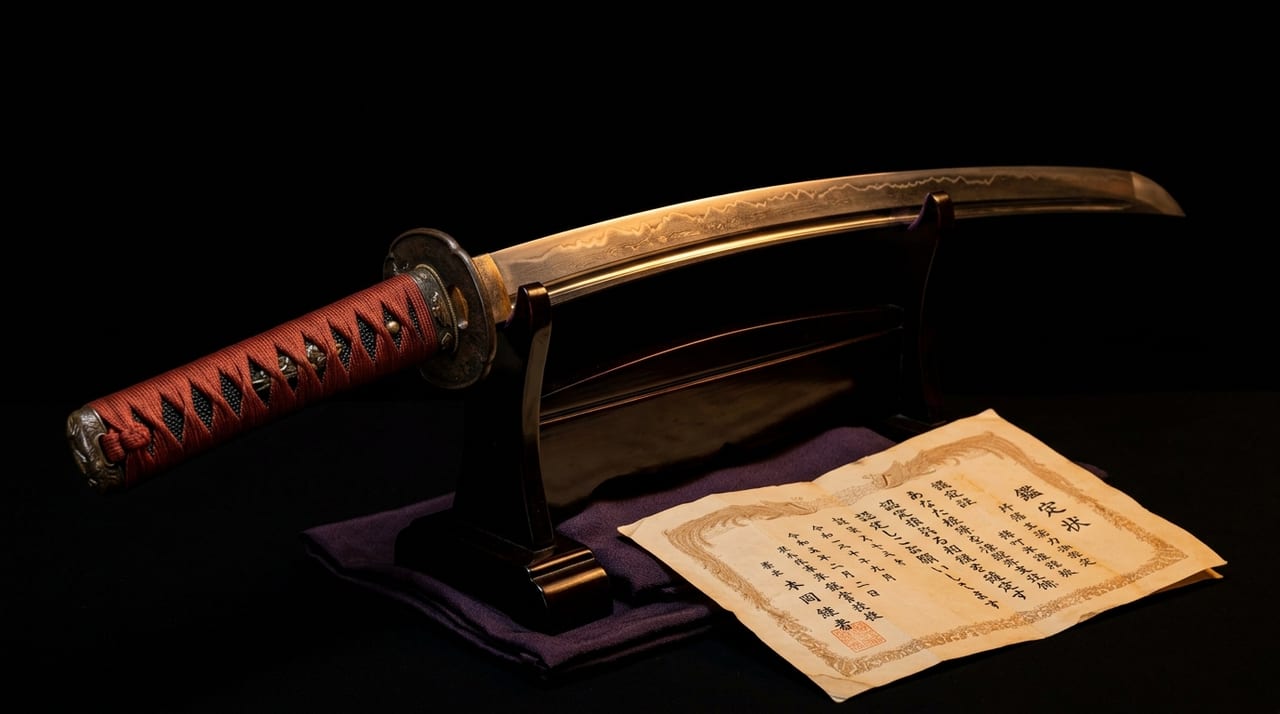 * Image is for illustrative purposes only.
Table of Contents
Sword Distribution in the Edo Period: A Specialist Market Born of Samurai Society
Japanese sword distribution underwent its own distinctive development during the Edo period. As the Sengoku period drew to a close and an era of peace arrived, swords were no longer weapons of the battlefield but had transformed into instruments of "status" symbolizing a samurai's rank. This shift brought fundamental change to sword distribution.
The Hon'ami Family: The Core of Appraisal and Distribution
At the core of sword distribution stood the Hon'ami family (hon'amike). Having practiced the polishing, appraisal, and cleaning of swords as a family profession since the Muromachi period, the Hon'ami family held great authority in the Edo period as official purveyors to the Tokugawa shogunate. The origami (appraisal certificate) issued by the Hon'ami family was highly regarded as a certificate of appraisal for swords.
The origami recorded the assessed value of the sword (daitsuke), and swords accompanied by an origami were also used as gifts between daimyo families.
The Establishment of Sword Dealers (Katanaya)
From the middle of the Edo period onward, specialist sword dealers appeared throughout the country. In the three great cities of Edo, Osaka, and Kyoto, katanaya specializing in swords lined the streets, fulfilling the following roles:
- Consignment sales from daimyo
- Service as official purveyors to samurai households
- Retail sales to ordinary samurai
Katanaya did not merely broker transactions; they also managed networks of associated craftsmen — polishers, saya makers, and tsuka wrapping artisans — and provided comprehensive services for swords.
Distribution through Pawnshops and Secondhand Dealers
When samurai fell into financial difficulty, swords were brought to pawnshops. A route was established whereby pawned swords became unclaimed goods and returned to the market via secondhand shops and antique dealers. This "pawn-flow route" is the prototype of distribution that connects to the modern sword market.
The Meiji Restoration and the Sword Abolishment Edict (Haitōrei): A Dramatic Upheaval in Distribution
The Sword Abolishment Edict (Haitōrei) of 1876 (Meiji 9) dealt a heavy blow to sword distribution. The wearing of swords was banned, and the "practical demand" for swords was lost.
Price Crash and Rediscovery as Art Objects
Immediately after the Sword Abolishment Edict (Haitōrei), vast quantities of swords flooded the market and prices collapsed. During this period, many swords flowed out of the country and passed into the hands of Western collectors.
On the other hand, the state moved to protect treasures. In Meiji 21 (1888), the Temporary Imperial National Treasure Investigation Bureau was established within the Imperial Household Ministry to survey treasures held by shrines, temples, and private individuals, and under the Old Shrines and Temples Preservation Act of Meiji 30 (1897), tachi handed down at shrines and temples also came to be designated as kokuhō (National Treasure).
Sword Enthusiast Societies
Societies of sword enthusiasts were also active in the early Showa period. For example, the Osaka Tōken-kai published in Showa 2 (1927) the oshigata collection Imamura Oshigata by Imamura Nagayoshi (1837–1910), with volumes 1 and 2 covering kotō and volume 3 covering shintō.
The Wartime Regime and the Sword Industry: The Resurgence of Demand
Under the militarist regime of the 1930s, the sword industry was revitalized. Demand for guntō from the army and navy surged, and an unusual era arrived in which demand for "genuine Japanese swords" made using traditional forging techniques ran in parallel with the mass industrial production of guntō.
After defeat in the war, however, Japanese swords were regarded as weapons and became subject to confiscation by the occupying forces.
Postwar Recovery and the Modern Sword Market
After World War II, the possession of Japanese swords was strictly restricted. Today, under the Act for Controlling the Possession of Firearms or Swords and Other Such Weapons (Jūtōhō) of Showa 33 (1958), swords of value as art objects are registered with prefectural Boards of Education and may be possessed and traded.
Establishment of the NBTHK Kanteisho System
The NBTHK (Society for the Preservation of Japanese Art Swords) was established in 1948 as a public interest incorporated foundation and put in place a graded kanteisho (appraisal certificate) system with the following levels:
- Hozon Tōken
- Tokubetsu Hozon Tōken
- Jūyō Tōken
- Tokubetsu Jūyō Tōken
This system has become the standard for value assessment in modern sword distribution.
The Development of the Auction Market
Swords are traded not only through specialist sword dealers but also at art auctions and similar venues.
The Distribution Revolution of the Internet Age
From the 2000s onward, the spread of the internet dramatically changed the distribution structure of swords. Listings on Yahoo Auctions increased, and ordinary people became able to enter a sword market that had previously been accessible only to specialist shops.
The game Touken Ranbu, which began in 2015, also led to an increase in the number of people taking an interest in swords.
The Structure of the Modern Sword Market
The current sword market is composed of the following multilayered distribution channels.
| Distribution Level | Items | Main Channels |
|---|---|---|
| Primary distribution | Gendaitō made by modern tōshō | Direct orders, specialist shops |
| Secondary distribution | Kotō and celebrated swords | Specialist sword dealers, auctions |
| Tertiary distribution | Privately traded items such as inherited pieces and long-stored items | Auction sites, etc. |
Primary Distribution: Direct Purchase from Tōkō
Gendaitō made by modern tōshō are sold through direct orders placed with the tōshō or through specialist shops.
Secondary Distribution: Specialist Shops and Auctions
Most kotō and celebrated swords are collected and sold by specialist sword dealers. They are also traded at art auctions.
Tertiary Distribution: Private Sales and the Internet
Private sales arising from inheritance, relocation, and similar circumstances take place through auction sites and other venues. In this tier, prices vary widely and many swords that are difficult for non-experts to authenticate circulate, so caution is required.
The Future of Distribution: Coexistence of Digitalization and Tradition
As of 2026, the use of the internet has been advancing in sword distribution as well.
The value of swords, however, is ultimately guaranteed by appraisal through expert eyes and by relationships of trust. From the origami of the Hon'ami family in the Edo period to the modern NBTHK kanteisho, the essence of distribution — "the assurance of an authoritative third party" — has not changed in 400 years. Digital technology is merely a tool that supplements and reinforces this mechanism of trust; human expertise and discernment will continue to be the foundation of sword distribution.