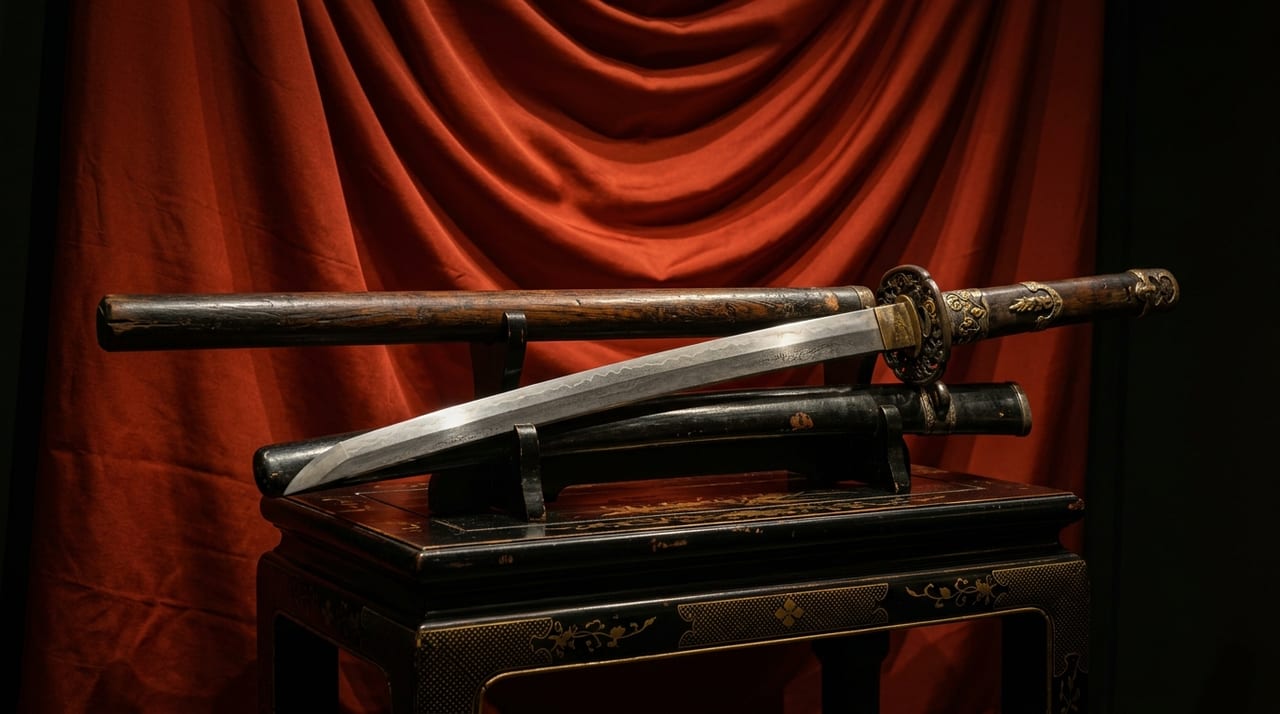
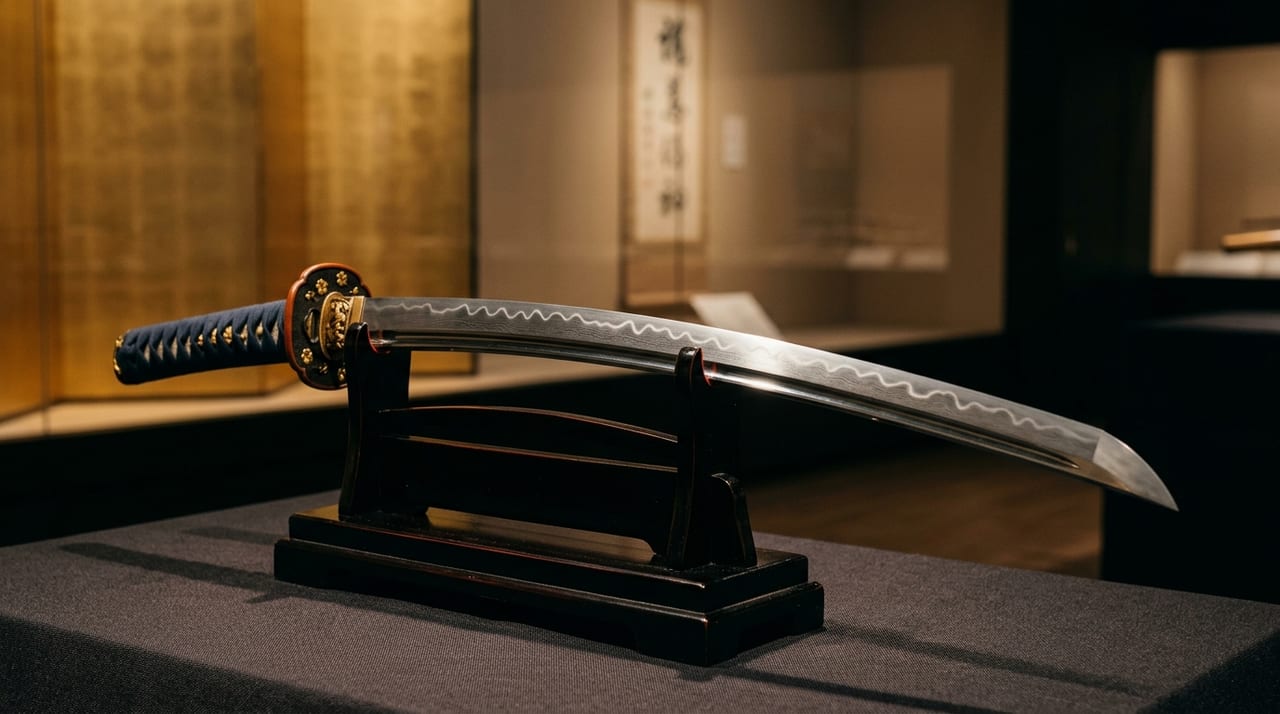
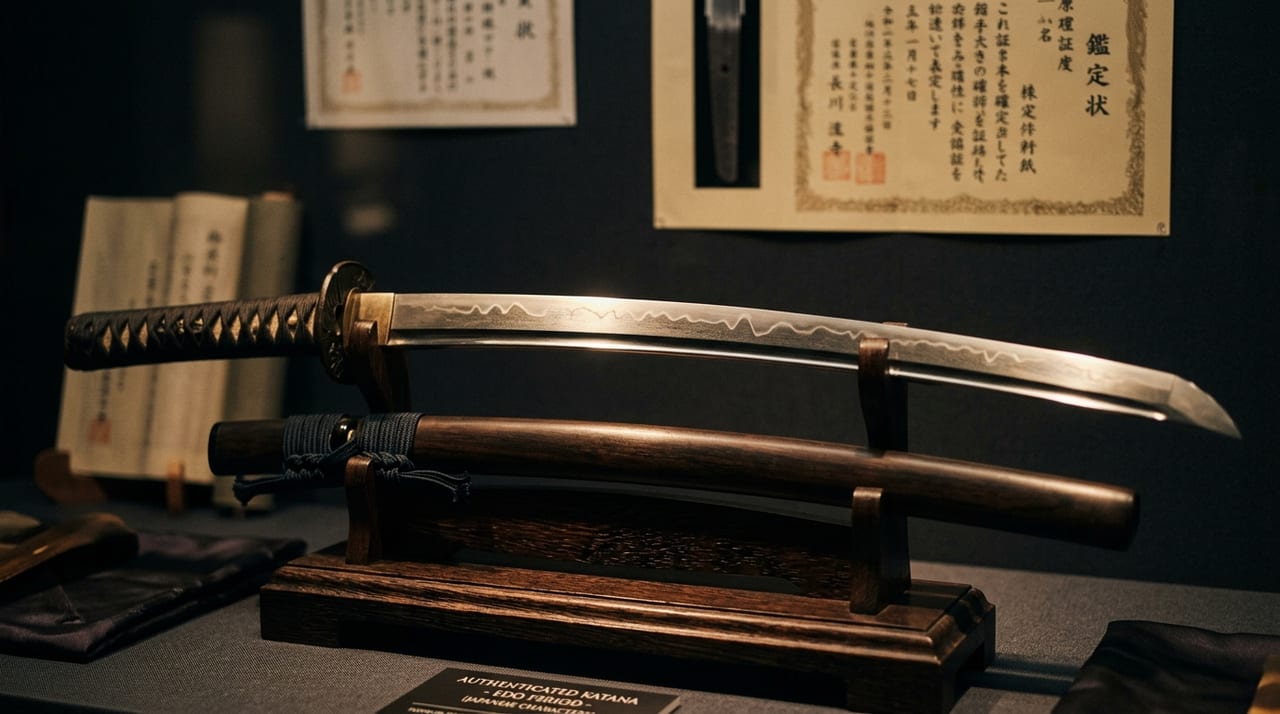
How NBTHK Appraisal Works: Reading the Kanteisho and Understanding the Grades
 * Image is for illustrative purposes only.
Table of Contents
What Is the NBTHK (Society for the Preservation of Japanese Art Swords)?
The most authoritative institution for certifying the authenticity and quality of Japanese swords is the NBTHK (Society for the Preservation of Japanese Art Swords), a public interest incorporated foundation. Formally established on 24 February 1948 (Shōwa 23), the organization has as its mission the preservation, study and promotion of the Japanese sword. Today it functions as an appraisal body recognized worldwide, and the kanteisho (the shinsa certificate) issued by the NBTHK is treated as the most trusted proof of authenticity in international sword transactions.
Every year the Society examines several thousand swords brought in from Japan and abroad, and assigns grades based on strict standards. It also contributes broadly to the continuation of sword culture, through publishing research works, holding exhibitions and supporting the training of young tōshō.
The Four Appraisal Grades: From Hozon to Tokubetsu Jūyō
NBTHK kanteisho come in four grades. The color of the certificate differs by grade, so the grade can be told at a glance just by looking at the physical document.
Hozon Tōken (Hozon / Yellow Certificate)
This is the entry-level grade given to swords judged "worthy of preservation." It includes many swords from the Edo period onward, and the prerequisites for certification are that the hamon can be clearly seen, that the jigane has no serious flaws or rust, and that the shape and construction are in good order. It is the grade collectors first aim to obtain, and it is also the category with the largest volume on the market. Prices depend on the type of sword, its nagasa and its quality, but it is quite possible to find a good Hozon Tōken-class piece in the range of 500,000–1,500,000 yen.
Tokubetsu Hozon Tōken (Tokubetsu Hozon / Blue Certificate)
This is a higher grade obtained, through a promotion examination, by swords of especially fine quality among the Hozon Tōken. A sword must show outstanding quality in the clarity and brightness of the hamon, the tightness of the jigane and the harmony of the overall shape, and the pass rate of the examination is by no means high. It also includes kotō from the Muromachi and Momoyama periods and earlier, and it is a grade in which the universality of quality across the ages is appreciated. Its market valuation is far above that of Hozon Tōken, and many advanced collectors recommend Tokubetsu Hozon or above as the minimum threshold when choosing a sword that could become the cornerstone of a serious collection.
Jūyō Tōken (Juyo Token / Red Certificate)
This is a high grade certified at an examination held once a year. The examination is conducted by consensus among several specialist committee members, and in addition to the outstanding quality of the sword itself, the historical significance, the clarity of its provenance (history of transmission) and its stylistic typicality for the period of manufacture are also important criteria. Masterpieces by great smiths of the Kamakura, Nanbokuchō and Muromachi periods, or representative masterworks of the Edo period, make up much of this grade, and they are highly regarded at overseas auctions as well. They are hard to obtain and expensive, but if you seek completeness as a collection and long-term stability of asset value, the Jūyō Tōken class is one goal to aim for.
Tokubetsu Jūyō Tōken (Tokubetsu Juyo Token)
This is the highest grade the NBTHK confers. Ranking next after kokuhō and jūyō bunkazai, it is known worldwide as the certification that marks the true pinnacle among surviving Japanese swords. The number of certified swords is very small, and almost none circulate on the market. Swords that were handed down in imperial families or shogunal houses, masterpieces that serve as reference works for sword research, and masterpieces regarded as landmarks in the history of the sword fall into this grade. Owning one in itself signifies the highest status as an international collector.
The Flow of the Examination: From Application to Receiving the Certificate
To have a sword examined (appraised) by the NBTHK, you go through the following process.
1. Application and Reception Hozon and Tokubetsu Hozon examinations are held twice a year (spring and autumn), and Jūyō Tōken examinations once a year. The application period is announced about 2 to 3 months before the examination, and can be checked on the Society's website and in guidance for members. At the time of application, you submit an application form filled out with basic information such as the sword's nagasa, mei and registration certificate number.
2. Bringing the Sword and the Day of the Examination On the day of the examination, you bring the sword to the designated venue (the main venue is the Japanese Sword Museum in Tokyo). An examination number is assigned at reception, and the sword is carried to the examiners. In the examination, several specialist committee members take each sword in hand and judge it comprehensively on the hamon, jigane, shape, mei, flaws, rust, condition of the togi and so on. The applicant does not attend the examination in person; only the sword is examined.
3. Notification of Results and Issuance of the Certificate The results of the examination are notified in writing after several weeks. If the sword is certified, a certificate (shinsa certificate) is issued and returned together with the sword. A sword may also fail, in which case there is no detailed explanation of the reasons and only a notice of "failure" is given.
4. Promotion Examination (Hozon → Tokubetsu Hozon, etc.) If you want to raise a sword holding a lower-grade certificate to a higher grade, you can apply for a "promotion examination." Applications are accepted at every examination session, and the examination fee is the same as for a new application.
Reading the Kanteisho: What to Look At
An NBTHK kanteisho contains the following information.
- Category: the type of sword, such as katana, wakizashi, tantō, spear or naginata
- Mei (signature): the name of the tōkō (often "mumei")
- Period: the estimated period of manufacture (Kamakura, Muromachi, Edo, etc.)
- Province (place of origin): the place of manufacture (Bizen, Sōshū, Yamashiro, etc.)
- Nagasa and sori: dimensions in centimeters
- Characteristics of the hamon: description of the type of midareba, the state of the nie, the degree of nioi and so on
- Characteristics of the jigane: the type of grain, the presence or absence of utsuri and so on
- Classification (grade): Hozon / Tokubetsu Hozon / Jūyō / Tokubetsu Jūyō
By checking the color of the certificate (yellow = Hozon, blue = Tokubetsu Hozon, red = Jūyō), you can tell the grade immediately. In addition, each certificate is printed with a unique examination number, and authenticity can be confirmed by inquiring with the Society.
Frequently Asked Questions (FAQ)
Q: Can I sell a sword without having it appraised by the NBTHK? A: There is no legal problem, but a sword without a kanteisho generally fetches a much lower purchase price. Especially if you are buying for the first time, or if you have a future sale in mind, we strongly recommend choosing a sword that comes with a kanteisho.
Q: Which is higher, Honami appraisal or NBTHK appraisal? A: Appraisal by the Honami family is a traditional family-transmitted appraisal that has continued since the Edo period, and it carries particularly high authority in certifying provenance. The NBTHK uses a public examination committee format with high transparency, and is widely recognized as an international standard certificate. Neither is "higher" than the other, and a sword that carries both certificates shows especially high reliability.
Q: Can I have a Japanese sword purchased overseas appraised by the NBTHK? A: Yes, it is possible. However, when bringing the sword into Japan, import procedures and registration under the Firearms and Swords Control Act (Jūtōhō) are required. Because the procedures are complicated, we recommend consulting a specialist sword dealer or an import/export agent.
Q: Does having a kanteisho guarantee that a sword is genuine? A: An NBTHK kanteisho is highly reliable proof of authenticity, but there are rare cases in which the certificate itself has been forged. When purchasing, make a habit of confirming the certificate's unique number by inquiring with the NBTHK. The paper quality, printing and condition of the tally seal on the certificate can also serve as references in judging authenticity.
Q: How much does the examination fee cost? A: The examination fee is determined by the type of examination (Hozon, Tokubetsu Hozon, Jūyō Tōken, etc.), the examination result, whether the item is a sword or tōsōgu, and whether the applicant is a member or non-member; it does not vary with the type of sword or its nagasa. For example, for a sword that passes the Hozon Tōken examination, the fee is 35,200 yen for members and 40,700 yen for non-members (for applications received from the November examination of Reiwa 8, tax included; free in the case of "hold"). For details, please check the official website of the Society for the Preservation of Japanese Art Swords (Examination fees).
The Kanteisho as the Foundation of a Collection
Choosing a sword that comes with a kanteisho is the foundation of a sword collection. Beyond guaranteeing authenticity, the presence or absence of a kanteisho makes a decisive difference in future sales, insurance valuation and proof of assets at inheritance. Using the grade filter function, please search for a sword that suits your budget and target grade.