Nakago Design and Finishing — The Meaning of Shape, Length, and Rust, and the Functional Beauty Tōkō Built Into It
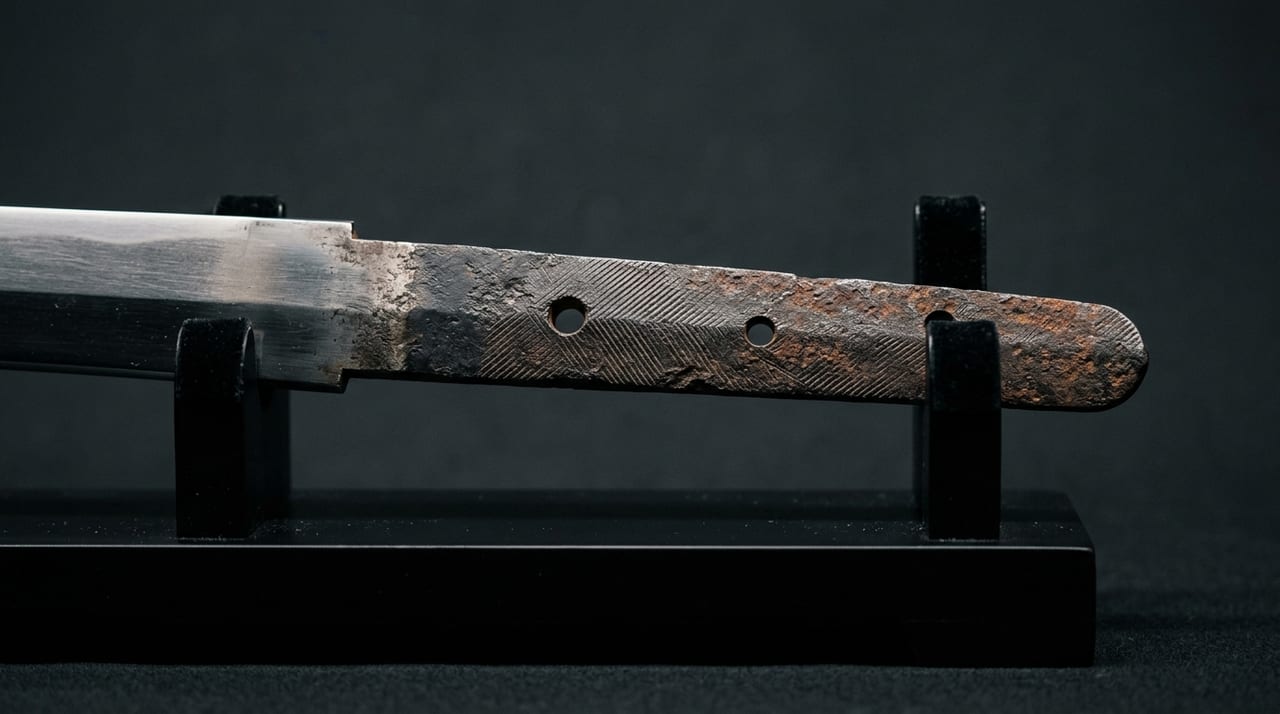 * Image is for illustrative purposes only.
Table of Contents
What Is the Nakago — The Structure of the Blade's "Root"
The blade of a Japanese sword is broadly divided into the "blade section (habu)" and the nakago. While the blade section is the part that actually does the cutting, the nakago is housed within the tsuka and serves as the "root" that anchors the blade to the tsuka. The boundary between the blade section and the nakago is called the "machi," formed by the hamachi (blade-side machi) and the munemachi (mune-side machi).
Because the nakago is hidden from view, it tends to be overlooked in appreciation, but it is in fact an extremely important part in assessing a sword's value and authenticating it. The condition of the mei, yasurime, and mekugi holes inscribed on the nakago, as well as the quality of the rust that has formed on it, are primary clues for reading a sword's provenance, period of manufacture, and authenticity.
Nakago design is also important functionally. The method of fixing within the tsuka, the balance, and the feel in the hand all depend on the shape and length of the nakago, and tōkō design the nakago with all of these calculated in mind.
Types of Nakago Shape — A Classification as Described by Tōkō
Nakago shapes are broadly classified as follows.
- Ha-agari kurijiri: A shape in which the tip of the nakago (nakagojiri) is cut diagonally toward the blade side. Commonly seen on tachi of the Kamakura period, it is considered a typical style of kotō.
- Kurijiri: A shape in which the nakagojiri is rounded. Common on tachi of the Heian and Kamakura periods, it gives an elegant and archaic impression.
- Kiri: A shape in which the nakagojiri is cut at a right angle. Commonly seen on uchigatana, it became widespread in the shintō period of the Edo era.
- Kengata: A shape in which the nakagojiri tapers to a point like a sword. Seen in certain types of tachi.
- Asa no kogata: A shape in which the tip traces a gentle curve.
- Kaku: A shape with a squared tip, more common in relatively recent periods.
These shapes are not mere aesthetic preferences; they carry important information indicating the period, school, and habits of the tōkō, and in authentication the technique of "determining the period from the shape of the nakagojiri" is well established.
Nakago Length and Functional Design
The length of the nakago is directly related to the intended use of the sword. As a basic rule, the nakago length is standardly about one-third of the nagasa. For an uchigatana with a nagasa of 2 shaku 3 sun (approximately 70 cm), a nakago of around 7 sun is the average design.
However, nakago length varied with the period. Tachi of the Kamakura period had relatively long nakago, allowing a longer tsuka to improve stability in two-handed use. In contrast, uchigatana of the Edo period tended to have somewhat shorter nakago even for the same nagasa, reflecting the reduced need for actual combat in a peaceful era and changes in the formal aesthetics of sword mounting (koshirae).
The width of the nakago is also an important design element. How much narrower the nakago width becomes compared to the width at the base of the blade (hamoto) is called the "descent of the nakago," and tachi often have a shape that tapers considerably, while uchigatana often maintain a relatively uniform width. Because this change also affects the appearance of the blade below the machi, tōkō pay close attention to the design of the nakago width.
Yasurime — The Tōkō's "Seal"
The yasurime applied to the surface of the nakago are not mere anti-slip treatment; they carry important information identifying the school, tōkō, and period. The types of yasurime include the following.
- Kesho yasurime: Fine and uniform yasurime applied with emphasis on aesthetic beauty. Commonly seen on high-grade swords.
- Kiri yasurime: A form in which the yasurime run perpendicular (horizontal) to the nakago. Common on tachi of the Kamakura and Nanbokuchō periods.
- Sujikaiyasurime: A form in which the yasurime run diagonally. Particularly common on uchigatana of the Edo period, and multiple schools used sujikaiyasurime at a specific angle as "proof of the school."
- Osujikaiyasurime: Sujikaiyasurime with a steeper angle.
- Baika yasurime: A special yasurime that traces curves in the shape of plum blossom petals. Used on high-grade and ceremonial swords.
The method of applying yasurime is a technique passed down orally from master to student through generations; it expresses the distinctive character of the school, and the habitual application pattern of the individual tōkō becomes a clue in authentication. Because works by the same tōkō show a certain consistency in the yasurime pattern, it is one of the first areas that experts examine in authenticating a sword.
Reading the Rust — Witness to the Age
The rust that has formed on the nakago is a "witness to the age," telling the story of the sword's age and provenance. A nakago with high-quality rust is said to be "well rusted" (sabi ga noru), indicating that it is an oxide film the sword has naturally formed over a long period of time. Generally, rust is evaluated as follows.
- Furusabi: A uniform, dense, blackish rust that is proof of natural oxidation over several centuries. The fine texture is uniformly distributed, and to an untrained eye it appears nearly a uniform black. Commonly seen on kotō of the Kamakura and Muromachi periods.
- Shusabi: A reddish rust that indicates advanced oxidation of the iron content. Generally not as highly regarded as furusabi, but when certain jigane (such as tamahagane derived from sand iron) is used, a distinctive rust color can appear.
- Shinsabi: A relatively shallow rust, seen on swords of relatively recent periods and on swords that have been polished or maintained in modern times.
A technique of artificially applying rust — "false rust" (nisesabi) — also exists and is known as a fraudulent method of aging newly made swords to make them look like kotō. Expert authenticators possess the skill to distinguish natural rust from artificial rust based on the uniformity, depth, and attachment pattern of the rust.
The Philosophy Tōkō Invest in Nakago Design
Even for tōkō today, nakago design is not mere technical processing but an important step that represents the "completion" of the sword as a whole. The shape of the nakago, the yasurime, the position of the mekugi holes, and the style of the mei — all of these function as the tōkō's "signature."
In particular, the act of engraving the mei is an act by which the tōkō demonstrates their skill and pride to the future, and is also a declaration that "I made this sword." For this reason, the movement of the chisel (tagane) when engraving the mei must be careful and powerful, and each school and each tōkō has a traditional style for the calligraphic form, size, and placement of the mei.
The design and finishing of the nakago takes place after the main processes of sword-making — forging the blade, yaki-ire, and polishing — are complete. It is, so to speak, the final finishing of the sword, and it also carries the ritual significance of the tōkō responsibly declaring "complete" for their own work. In this respect, the nakago is a special part where the technical completion of the Japanese sword as a craft object and the tōkō's spiritual commitment intersect.