Nouveautés — Découvrez les dernières arrivées dans notre catalogue. Voir →
13e jour du 3e mois, Tenshō 6 (19 avril 1578)
Château de Kasugayama (actuelle Ville de Jōetsu, Préfecture de Niigata)
Forces
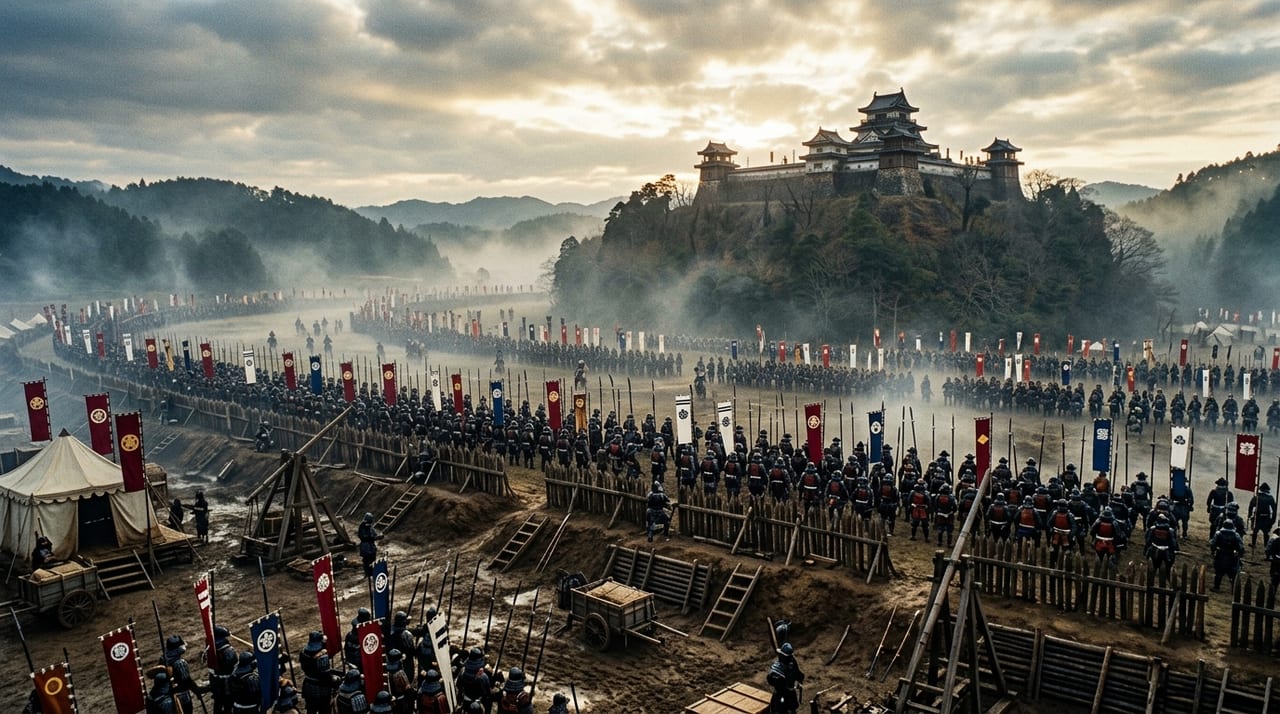
Forces Uesugi (rassemblement pour la campagne)
Guerre d'Otate – factions rivales
Environ 9 min de lecture
Au neuvième mois de 1577 (Tenshō 5), Uesugi Kenshin, daimyo d'Echigo, vainquit les forces du général d'Oda Nobunaga, Shibata Katsuie, à la Bataille de Tedorigawa dans la Province de Kaga. Révéré comme le « Dragon d'Echigo » et le « Dieu de la Guerre », et dévot de toute sa vie au dieu bouddhiste Bishamonten, Kenshin considéra cette victoire comme un point d'appui majeur dans son conflit avec Oda Nobunaga. Au premier mois de 1578 (Tenshō 6), Kenshin appela à une campagne vers la région du Kantō ; il aurait projeté de partir le quinzième jour du troisième mois. On suppose qu'il comptait marcher sur la capitale après l'invasion du Kantō, mais les détails restent inconnus.
Environ le neuvième jour du troisième mois, seulement quelques jours avant son départ prévu, Kenshin s'effondra soudainement dans une pièce privée (kansho) du château, interprétée plus tard comme les latrines, et sombra dans le coma. Il n'a jamais repris conscience, et décéda plusieurs jours plus tard, le treizième jour du troisième mois, Tenshō 6 (19 avril 1578), à l'âge de quarante-neuf ans. Le caractère soudain de sa mort, survenant à la veille d'une campagne militaire majeure, provoqua un choc profond dans tout son domaine.
La cause précise de la mort de Kenshin reste irrésolue. La vision traditionnelle longtemps acceptée attribue son effondrement à une hémorragie cérébrale hypertensive, provoquée par sa consommation d'alcool réputée et une alimentation riche en sel. Cependant, comme le poème d'adieu de Kenshin a été conservé, certains jugent peu probable qu'il se soit effondré d'une attaque cérébrale dans les latrines. Des théories d'assassinat circulent également, mais manquent de soutien documentaire solide ; le consensus savant dominant reste que Kenshin est mort de causes naturelles.
Kenshin ne s'est jamais marié et n'avait pas d'enfants biologiques, laissant deux de ses fils adoptifs comme successeurs potentiels : son neveu Uesugi Kagekatsu, et Uesugi Kagetora, qui était arrivé à Echigo du clan Hōjō ultérieur de la Province de Sagami dans des circonstances rappelant un échange d'otages. Kenshin n'avait jamais clairement désigné lequel des deux hériterait du clan, et cette question irrésolue enflamma un conflit interne grave presque immédiatement après sa mort.
Peu de temps après la mort de Kenshin, Kagekatsu s'empara de la citadelle intérieure du Château de Kasugayama tandis que Kagetora s'établit à la résidence d'Otate à proximité, et les deux rivaux plongèrent Echigo dans une guerre civile connue sous le nom d'Otate no Ran, qui fit rage du cinquième mois de 1578 au troisième mois de 1579 (Tenshō 7). Kagetora eut d'abord l'avantage, mais échoua à obtenir des renforts suffisants de sa famille d'origine, le clan Hōjō ultérieur, tandis que Kagekatsu conclut la paix avec Takeda Katsuyori, venu en Echigo pour soutenir Kagetora (alliance Kō-Etsu). Kagekatsu finit par prévaloir ; au troisième mois de 1579, Kagetora se donna la mort au Château de Same-ga-o, ce qui décida de l'issue du conflit (la soumission de ses derniers partisans se poursuivit jusqu'en 1580).
Un dévot dévoué de Bishamonten, Kenshin était aussi réputé comme collectionneur d'épées célèbres. Parmi les sabres transmis dans la famille Uesugi se trouvaient le tachi Trésor National connu sous le nom de Sanchōmō (également lu Yamatorige), attribué à l'école Fukuoka Ichimonji de la Province de Bizen, et le tantō Trésor National connu sous le nom de Kenshin Kagemitsu, forgé par le maître de Bizen Osafune Kagemitsu et gravé des caractères « Chichibu Daibosatsu » et d'une syllabe-germe sanskrite. Aujourd'hui, Sanchōmō appartient à la ville de Setouchi (préfecture d'Okayama) et Kenshin Kagemitsu est conservé au Musée préfectoral d'histoire et de folklore de Saitama.
Le conflit interne de l'Otate no Ran draina gravement la force militaire et la cohésion administrative d'Echigo. Bien que Kagekatsu soit sorti victorieux et ait hérité de la direction du clan Uesugi, le domaine affaibli par la guerre n'était plus en position de contester indépendamment le pouvoir croissant d'Oda Nobunaga. L'ambition de Kenshin de marcher vers la capitale mourut avec lui, et le clan Uesugi fut par la suite relégué au statut de puissance régionale au sein des hégémonies successives d'Oda, Toyotomi et Tokugawa. La mort soudaine de l'un des commandants les plus célèbres de la période Sengoku, et la crise de succession qui s'ensuivit, marquèrent un tournant décisif dans l'équilibre des pouvoirs dans l'est du Japon.