Nouveautés — Découvrez les dernières arrivées dans notre catalogue. Voir →
9e–11e jour du 9e mois, Tenshō 12 (12–14 octobre 1584)
Château de Suemori, province de Noto (actuel Hōdatsushimizu, Ishikawa)
Forces
Forces Maeda
Forces Sassa
Environ 7 min de lecture
La bataille de Suemori, livrée au château de Suemori dans la province de Noto du 9e au 11e jour du 9e mois de Tenshō 12 (1584) (du 12 au 14 octobre selon le calendrier grégorien), oppose Maeda Toshiie et Sassa Narimasa pour la domination sur Hokuriku, et constitue un combat important pour la maison Maeda.
En Tenshō 12 (1584), Hashiba Hideyoshi et la coalition d'Oda Nobukatsu et de Tokugawa Ieyasu se faisaient face à Komaki et Nagakute, dans la province d'Owari. Ce face-à-face au cœur du pouvoir a aussi ébranlé la position des daimyō de chaque région. Sassa Narimasa, qui gouvernait Etchū, était d'abord du côté de Hideyoshi, mais, voyant les forces Hashiba peiner à Nagakute, il décida de passer dans le camp d'Oda et de Tokugawa. Dès lors, l'affrontement avec Maeda Toshiie, qui gouvernait Kaga et Noto et soutenait Hideyoshi, devint inévitable. Narimasa et Toshiie avaient tous deux été vassaux d'Oda Nobunaga et s'étaient autrefois tenus côte à côte comme compagnons. Leur opposition plongea donc Hokuriku dans des troubles qui le divisèrent en deux.
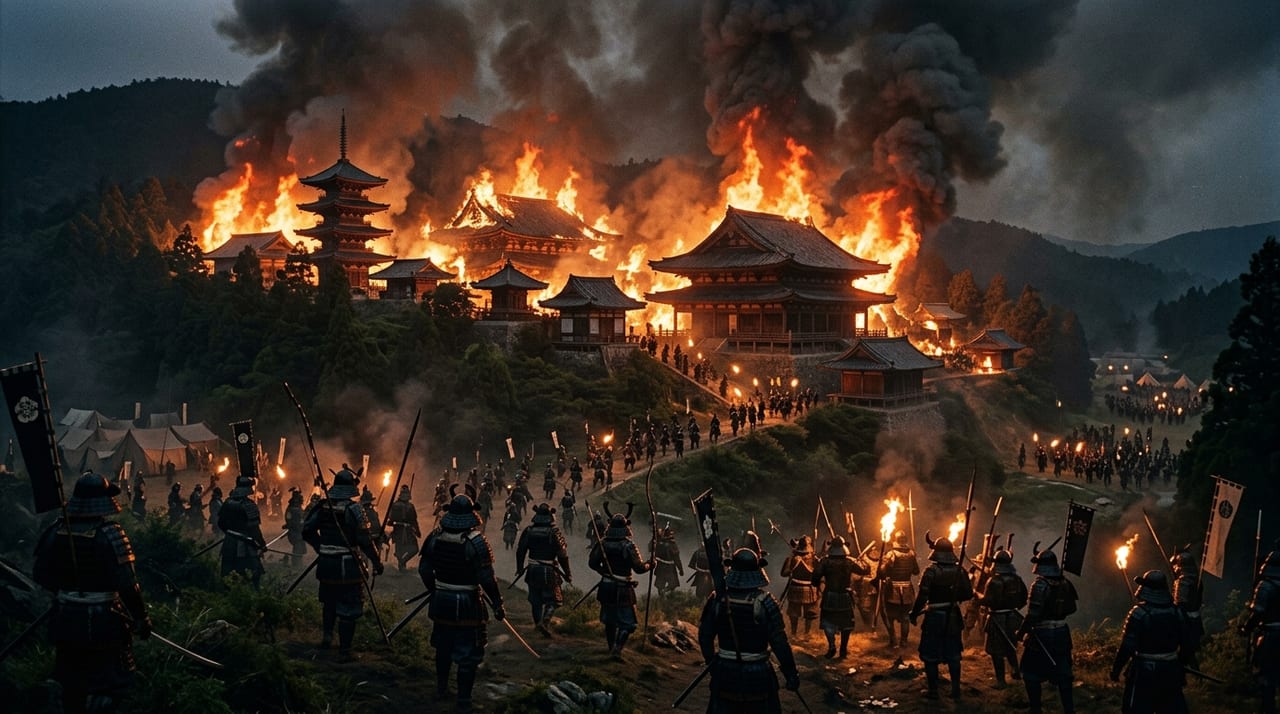
Narimasa lança d'abord une attaque surprise contre le château d'Asahiyama, tenu par les Maeda, vers la fin du 8e mois de Tenshō 12 (1584). Puis, le 9e jour du 9e mois de Tenshō 12 (1584), il encercla le château de Suemori dans la province de Noto avec une armée de 15 000 hommes. Le château de Suemori était une place forte située sur la route qui reliait Kaga et Noto. Si elle tombait, les terres des Maeda seraient coupées en deux du nord au sud, et les forces locales de Noto risquaient de se rallier au camp de Sassa. Pour Narimasa, c'était un coup stratégique destiné à démanteler le fief même de Toshiie.
Le château de Suemori était défendu par le commandant de la place, Okumura Nagatomi (Sukeemon), et par une garnison de 300 hommes environ seulement. Lorsque les combats commencèrent le 10e jour du 9e mois de Tenshō 12 (1584), le gouverneur du château (jōdai) du côté Maeda, Doi Tsugushige, tomba au combat, et le château fut poussé jusqu'au bord de la chute. On rapporte que Nagatomi, avec son épouse, encouragea les soldats et les habitants, et poursuivit une défense désespérée malgré le peu de forces dont il disposait.
Maeda Toshiie, informé de la nouvelle au château de Kanazawa, partit aussitôt avec 2 500 hommes. Après une marche forcée de nuit, guidé par le paysan Sakurai Saburōzaemon, il avança par un chemin détourné le long de la côte. À l'aube du 11e jour du 9e mois de Tenshō 12 (1584), il lança une attaque surprise par l'arrière contre les forces de Sassa qui se pressaient autour du château de Suemori. Pris en tenaille entre cette attaque et les défenseurs du château, les troupes de Sassa cédèrent, et Narimasa se retira vers Etchū. On rapporte que plus de 750 hommes périrent de chaque côté.
La défense réussie du château de Suemori fut un tournant qui permit à Maeda Toshiie de devenir le daimyō gouvernant Kaga, Noto et Etchū. Après cette bataille, Narimasa passa sur la défensive. L'année suivante, Tenshō 13 (1585), il se soumit après la campagne contre Etchū menée par Hideyoshi en personne. Toshiie, quant à lui, prit de l'importance sous le pouvoir de Hideyoshi. En tant que membre du Conseil des cinq anciens, il posa les fondations du domaine de Kaga, qui valait un million de koku.
La défense du château de Suemori, où une petite garnison a tenu tête à une grande armée, est racontée dans la région de Kaga comme un épisode de secours, grâce à la bravoure d'Okumura Nagatomi et à la décision rapide de Toshiie. La maison Maeda, par la suite, s'attacha sous le domaine de Kaga à protéger la culture des sabres et de leurs montures. Elle prépara ainsi le terrain où se développèrent le travail des métaux de Kaga (Kaga kinkō) et l'art de l'incrustation (zōgan). La tradition martiale enracinée dans Hokuriku au fil des guerres successives se prolongea dans la riche culture artisanale de Kaga à l'époque d'Edo.