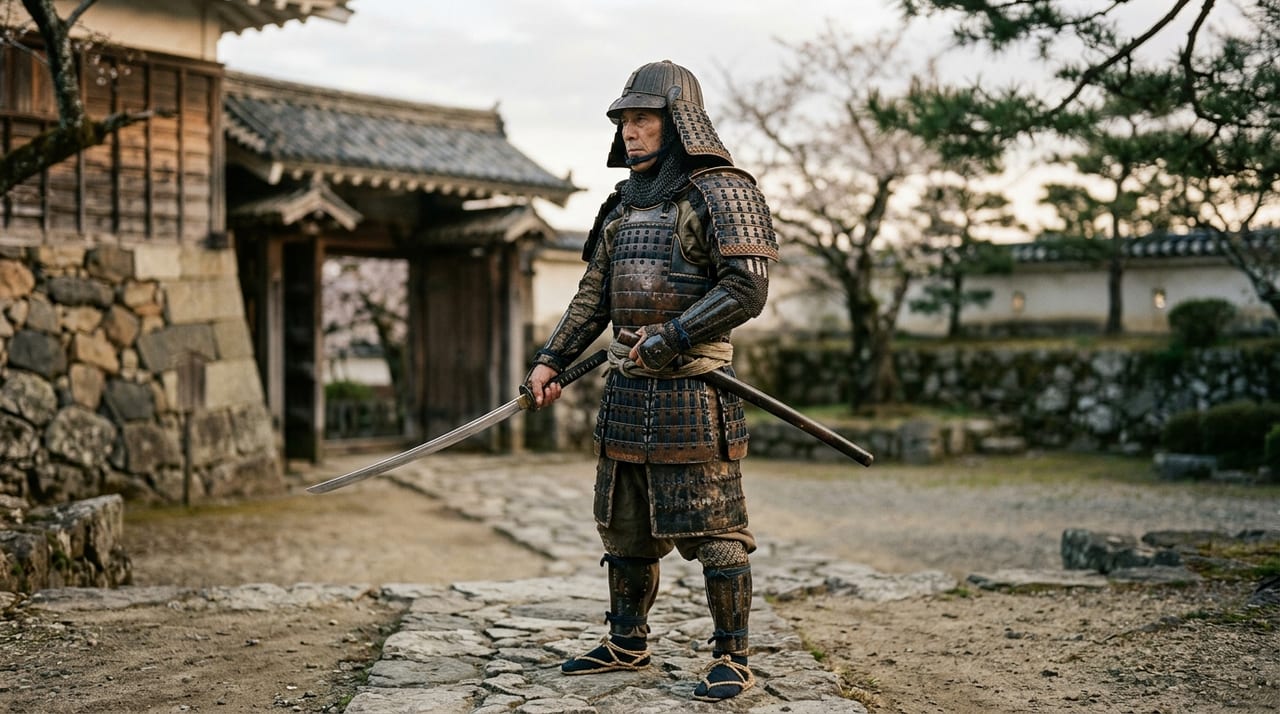
 * Image is for illustrative purposes only.
Chiba Shūsaku
千葉周作
Founder of Hokushin Ittō-ryū — The Father of Modern Kenjutsu Who Trained the Patriots of the Meiji Restoration
Description
The Birth of Hokushin Ittō-ryū
Chiba Shūsaku Narimasa, said to have been born in Kansei 5 (1793) in Kesennuma village, Motoyoshi District, Mutsu Province (present-day Kesennuma, Miyagi Prefecture), mastered the secrets of swordsmanship as a leading disciple of the Nakanishi-ha Ittō-ryū. He founded the “Hokushin Ittō-ryū” by adding his own innovations. “Hokushin” means the North Star, symbolizing that the essence of the sword lies at a fixed center, like the North Star. Shūsaku's dojo, the Genbukan, was opened in Shinagawa-chō, Nihonbashi (later in Kanda Otamagaike), and became the largest swordsmanship dojo of the late Edo period, with many disciples.
Innovation and Rationalization of Swordsmanship
Shūsaku's greatest contribution lay in the rational systematization of swordsmanship. Before him, each school tended to keep its techniques hidden as secret transmissions. Shūsaku systematically classified and organized sword techniques and rebuilt them as a universal system that anyone could learn. In particular, he created a training method centered on kakari-geiko and simplified the many license grades into three stages. This is said to have been so effective that training that took ten years in other schools could be completed in five, and it has had a major influence on modern kendo as well.
Sakamoto Ryōma and the Shishi of the Late Edo Period
One of the most famous disciples of the Genbukan was Sakamoto Ryōma. Ryōma, the son of a gōshi of the Tosa domain, went to Edo and studied Hokushin Ittō-ryū at the Okemachi Chiba dojo, run by Shūsaku's younger brother Sadakichi. Ryōma is said to have obtained the Hokushin Ittō-ryū Naginata Heihō Mokuroku, and he showed outstanding talent in swordsmanship as well. Besides Ryōma, many shishi of the late Edo period, including Kiyokawa Hachirō and Yamaoka Tesshū (then known as Tetsutarō), studied Hokushin Ittō-ryū at the Genbukan or related dojo. The Genbukan thus became a hub for exchange in thought and politics that went beyond an ordinary swordsmanship dojo.
Outstanding Skill as a Swordsman
Shūsaku's swordsmanship was not merely theoretical; he also had outstanding ability in actual combat. Through repeated tournaments with other schools in Musashi, Kōzuke, Shinano, and elsewhere, he gained disciples. The technique kiri-otoshi, a teaching of the Ittō-ryū, is an advanced method of deflecting an opponent's attack while countering at the same time, embodying the Ittō-ryū concept of go no sen. Shūsaku left the words “Sore ken wa shunsoku, kokoro, ki, chikara no itchi” (the sword is a matter of an instant: the unity of mind, ki, and strength). He taught the importance not only of acquiring technique but also of spiritual cultivation, pursuing the comprehensive perfection of mind, technique, and body.
One of the Three Great Dojo of Tenka
The Genbukan (Chiba Shūsaku), the Renpeikan of the Shintō Munen-ryū (Saitō Yakurō), and the Shigakukan of the Kyōshin Meichi-ryū (Momonoi Shunzō) were known as the “Three Great Dojo of Tenka,” the three major swordsmanship dojo of the late Edo period. In the era when these three dojo dominated Edo's swordsmanship world, the Genbukan was the largest, and Hokushin Ittō-ryū became one of the most widely spread swordsmanship schools of the late Edo period. Each dojo was praised respectively as “the technique of Chiba,” “the power of Saitō,” and “the dignity of Momonoi.” The refinement of the Genbukan's technique was the fruit of the rational swordsmanship system that Shūsaku had systematized.
Legacy and Influence on Modern Kendo
In January 1856 (the 12th month of Ansei 2), Shūsaku died at the age of sixty-three. His legacy, however, was carried on by his younger brother Sadakichi and his son Chiba Eijirō, and the Genbukan continued after the Meiji Restoration. The rational teaching methods of Hokushin Ittō-ryū had a major influence on modern kendo, and in Heisei 15 (2003), Shūsaku was honored in the Kendo Hall of Fame of the All Japan Kendo Federation. In that sense, Chiba Shūsaku is a figure who can be called the distant master of all kendo practitioners living today.