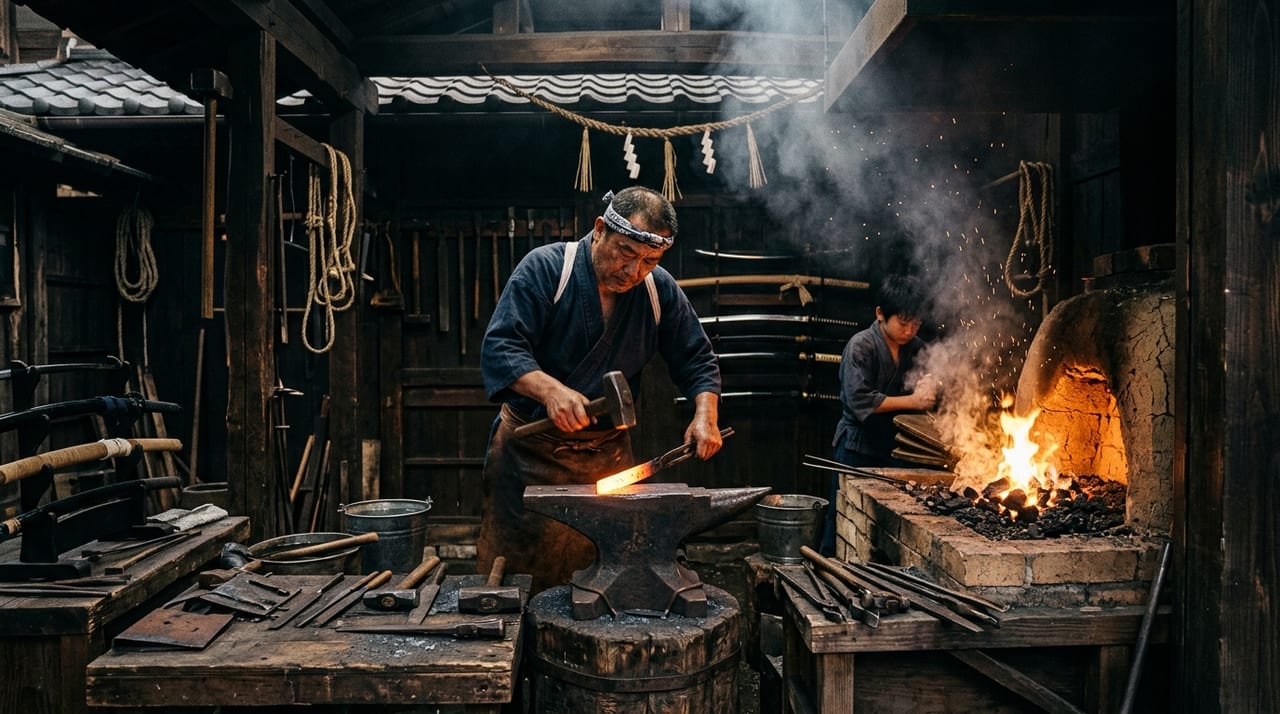
 * Image is for illustrative purposes only.
Tsuda Sukehiro
津田助廣
Description
Tsuda Sukehiro (1637–1682) was one of the foremost shintō swordsmiths active in Osaka in the early Edo period, and is highly regarded as a master smith representing the superb cutting ability that earned his blades the ō-wazamono rating and the innovation of hamon design in the shintō period. Two generations are known, the first and the second. In particular, the second-generation Sukehiro (1637–1682) established the reputation of “Tsuda Sukehiro” as its central figure, and when “Tsuda Sukehiro” is spoken of, it usually refers to the second generation. He was taken into service by the Osaka Castle deputy Aoyama Munetoshi and is positioned as the representative smith of Osaka shintō.
The most famous of Sukehiro's blades is the original hamon called tōranba. Tōranba is a form in which gunome and ō-gunome overlap greatly, expressing across the whole hamon a grand movement like great waves breaking on a shore. Along the habuchi, nie and nioi are evenly applied, and sunagashi and kinsuji work with great precision. As the creator of the “wave-like hamon,” Sukehiro had a great influence on later smiths, and many Osaka shintō blades with the same design were produced.
The jigane is a uniform surface of finely packed ko-itame, and shows a bright, lustrous finish with fine, evenly distributed ji-nie. The combination of this precise jigane with the bold tōranba is the greatest visual appeal of Sukehiro's blades. Although they are practical weapons, they also boast a level of finish that places them among the highest-grade art crafts.
Sukehiro's blades bear signatures such as “Tsuda Echizen no kami Sukehiro.” Earlier works, in which the character ta of Tsuda is cut in square regular script (kaisho), are called kaku-Tsuda, while works of his last years, in which it is cut round in cursive script (sōsho), are called maru-Tsuda. Many works with a dated inscription survive. Some works have now been certified as Important Art Objects, and they are held by the Tokyo National Museum and the Japanese Sword Museum. As for cutting ability, he is one of the few smiths to have been given the ō-wazamono rating, and he is still highly regarded today as one who embodied the peak of the shintō period in both practicality and beauty.
Famous Works
- katana, signed Tsuda Echizen no Kami Sukehiro, dated Enpō 5, 8th month (Important Art Object; collection of Tokyo National Museum)
- katana, signed Tsuda Echizen no Kami Sukehiro, dated Enpō 7, 2nd month (Important Art Object; collection of Japanese Sword Museum)