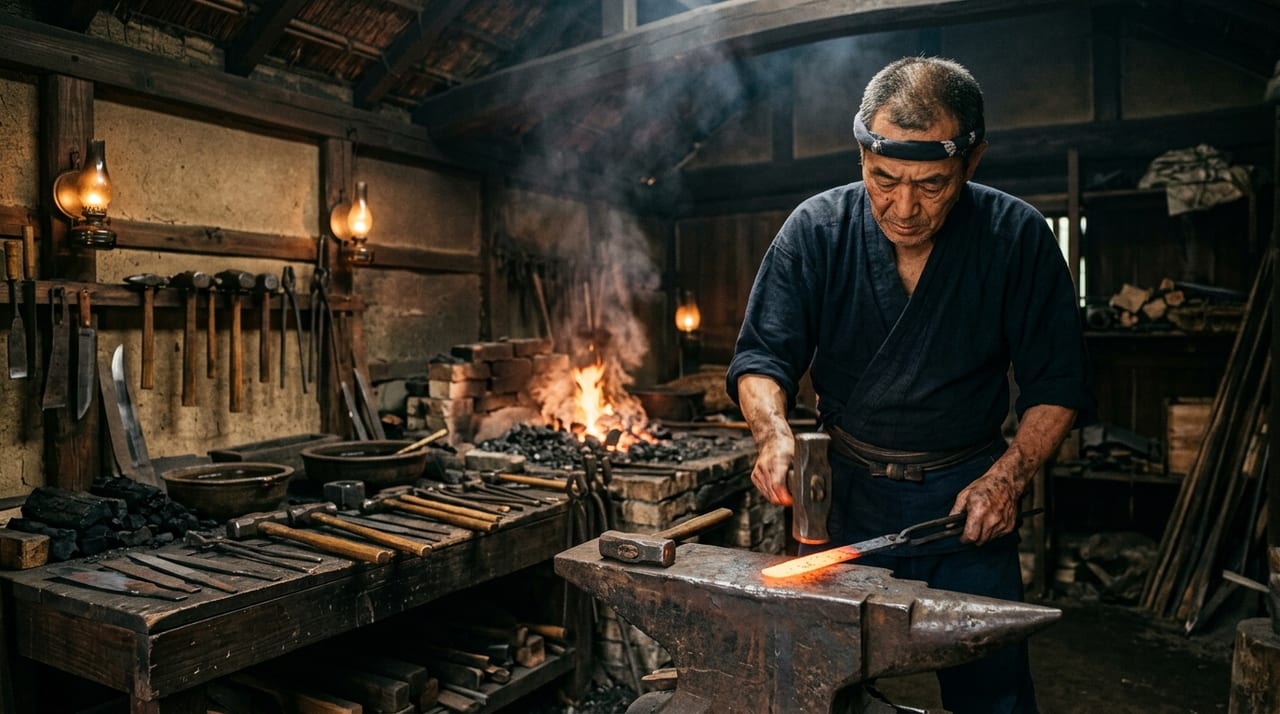
 * Image is for illustrative purposes only.
Tegarayama Masashige
手柄山正繁
Description
The Harima Prodigy——Tegarayama Masashige
Tegarayama Masashige (Hōreki 10 [1760] to Bunsei 13 [1830]) was a master smith of the late Edo period's shinshintō era. Born in Harima, he was taken into service by Matsudaira Sadanobu, lord of the Shirakawa Domain, and in Kyōwa 3 (1803) he received the title Kai no Kami. He is a representative smith from Banshū whose blades rivaled those of the central smith groups in Edo and Ōsaka. His original family name was Miki, and his initial name was Ujishige. The surname "Tegarayama" was given after Tegarayama in Harima (present-day Himeji City), his home region.
Masashige looked to Suishinshi Masahide of Edo and to the master smiths of Ōsaka as models. However, drawing on the character of Harima as a region and on his own research, he established an individual style that resembled no one else's. His forceful hamon, built mainly on gunome-midare, and his rich nie-based activity are widely known as hallmarks of his work. He is highly regarded as an outstanding figure even among the shinshintō smiths of the Kansai and western regions.
The Region of Harima and Masashige's Smithing Activity
Harima has long been an important region centered on Himeji. In the Edo period, as the castle town of the Himeji Domain, it was a major center of politics, economy, and culture in western Japan. Masashige was born in Harima. He later entered the service of Matsudaira Sadanobu, lord of the Shirakawa Domain, and made swords in Edo. There he refined his skill to a high level while meeting the demand of samurai and merchant households.
Born in Harima, Masashige actively studied and absorbed the latest sword trends of the central regions, Edo and Ōsaka. He drew on Suishinshi Masahide's ideal of returning to kotō and on the technical refinement of Ōsaka's shinshintō, and he fused these with the cultural soil of Harima to form his own style. His path, born in Harima and matured in Edo, is a fine example of how the sword culture of the shinshintō era drew talent from many regions into the center while flourishing across the country.
Characteristics of His Work——Ō-gunome and Abundant Nie
The greatest feature of Masashige's work is its large, forceful gunome-midare and its rich, varied nie. His hamon is built mainly on ō-gunome. Continuous rows of large, mountain-shaped gunome with wide-opened hips give it great impact. Its boldness is said to be conscious of the Sōshū-den of the Nanboku-chō period. The ashi and yō function richly, and within the hamon a wealth of nie-derived activity unfolds, including kinsuji and sunagashi.
The jigane is a forceful forging, mainly itame and ō-itame. Some works with strong ji-nie show the atmosphere of Sōshū-den "nie jigane." Overall, the beauty is large, forceful, and martial. It gives priority to the solidity of structure and to power over ornateness. This style is interpreted as reflecting the strong martial character of Harima's regional culture.
In blade shape, reflecting the trends of the late Edo period, the silhouette has abundant, forceful width at both the moto-haba and the saki-haba. The curvature is moderate, and overall the blades have a high degree of practical completion as working swords. This balance of practicality and artistry shows the lasting value of Masashige's blades.
Surviving Works and Evaluation
Masashige's surviving signed works are relatively well known among provincial smiths of the shinshintō era. The Kyoto National Museum holds a sword and a yari, both dated Kyōwa 1 (1801) and signed "Ōshū Shirakawa shin Tegarayama Masashige."
In modern sword scholarship, Masashige is rated among the highest-level smiths of the provincial shinshintō smiths. He is positioned as an important smith who shows how Edo-period sword-making culture spread to the regions.
TOUKENZA and Tegarayama Masashige
TOUKENZA introduces Tegarayama Masashige as a master who was born in Harima, entered the service of Matsudaira Sadanobu, lord of the Shirakawa Domain, achieved mastery in Edo, and produced works of the highest standard of the shinshintō era. Masashige's works clearly show that outstanding smiths with their own aesthetic sense and techniques existed not only in the central sword cultures of Edo and Ōsaka but also in each region. His forceful and individual style is living proof that the beauty of the Japanese sword flowered across the country in many forms.
Famous Works
- katana, signed Ōshū Shirakawa-no-omi Tegarayama Masashige, dated Kyōwa 1, 2nd month (Kyoto National Museum)
- wakizashi, signed Masashige (various fine examples)