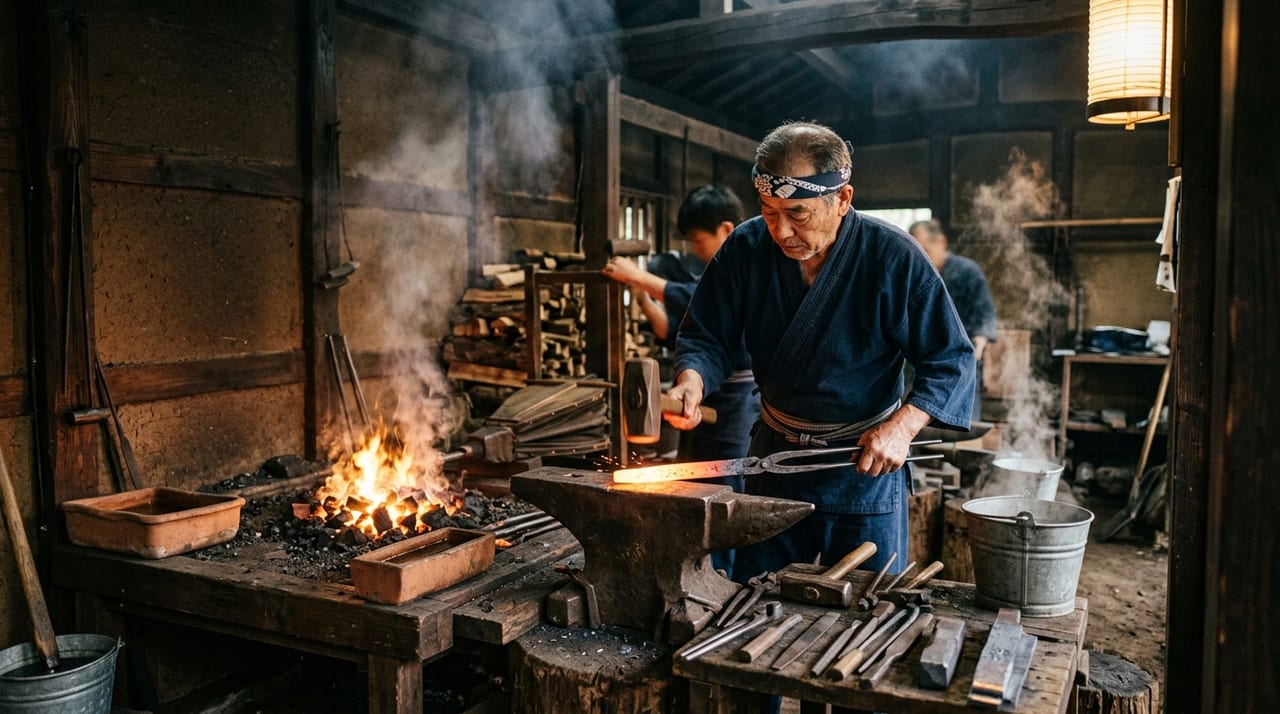
 * Image is for illustrative purposes only.
Tegai Kanekiyo
手掻包清
Description
Tegai Kanekiyo and the Tegai School of the Yamato Tradition
Tegai Kanekiyo is a swordsmith listed among the Tegai school of Yamato no kuni (present-day Nara Prefecture). The Tegai school traces its founding to Kanenaga around Shōō (1288–1293), and the smiths of this school used the character "kane" in their signatures. The name "Tegai" is said to derive from the smiths establishing their workshops in front of the Tegai-mon gate of Tōdai-ji, and the school is known as one formed by a group of swordsmiths with deep ties to the great temples of Nanto (Nara), such as Tōdai-ji and Kōfuku-ji.
The Yamato tradition has long been highly regarded as one of the oldest sword traditions in Japan. Unlike the elegance of the Yamashiro tradition, the refinement of the Bizen tradition, and the boldness of the Sōshū tradition, the "austere beauty" (shungen na bi) unique to the Yamato tradition has been valued as embodying the spirit of Buddhist and Shinto culture rooted in the ancient capital of Nara.
Kanekiyo's Style: The Pure Beauty of the Yamato Tradition
The jigane of the Tegai school is basically a densely forged ko-itame hada.
The hamon is mainly chū-suguha, with nie-based nijūba and uchinoke also seen. Hamon in the Yamato tradition are generally mostly of the suguha type, favoring a clear, limpid composition, unlike the chōji-midare of the Bizen tradition or the notare of the Sōshū tradition. However, it is not a simple suguha: fine nie gathers along the edge of the hamon, and depth and variation arise within its slight irregularity, making it a hamon whose appeal grows the more it is appreciated. The bōshi is mostly either straight and returns to a komaru, or is yakizume, showing a plain form typical of the Yamato tradition.
The nakago shows the yasurime form characteristic of the Yamato tradition, and the mei is inscribed "Kanekiyo."
The Tegai School and the Temple Culture of Nanto
The Tegai school's deep ties with Yamato's temples are an important background for understanding Yamato tradition swords. At the Seven Great Temples of Nanto, such as Tōdai-ji and Kōfuku-ji, there existed large armed groups (sōhei and jinin), and the demand for swords needed for their arms supported the sword-making industry of Yamato. Swords forged within such a religious context took on religious and spiritual meaning beyond that of mere weapons, giving Yamato tradition swords a distinctive solemnity.
The Significance of the Tegai School in the Yamato Tradition's Lineage
The five main schools of the Yamato tradition are known as Tegai, Taima, Shikkake, Hoshō, and Senjuin, each with its own style tied to temples and place names across Yamato. Tegai Kanekiyo is a smith belonging to the Tegai school among these.
TOUKENZA introduces Tegai Kanekiyo as a smith of the Yamato tradition rooted in the ancient capital of Nara, and aims to convey to contemporary enthusiasts the value unique to the Yamato tradition within the diverse aesthetic traditions of Japanese swords.