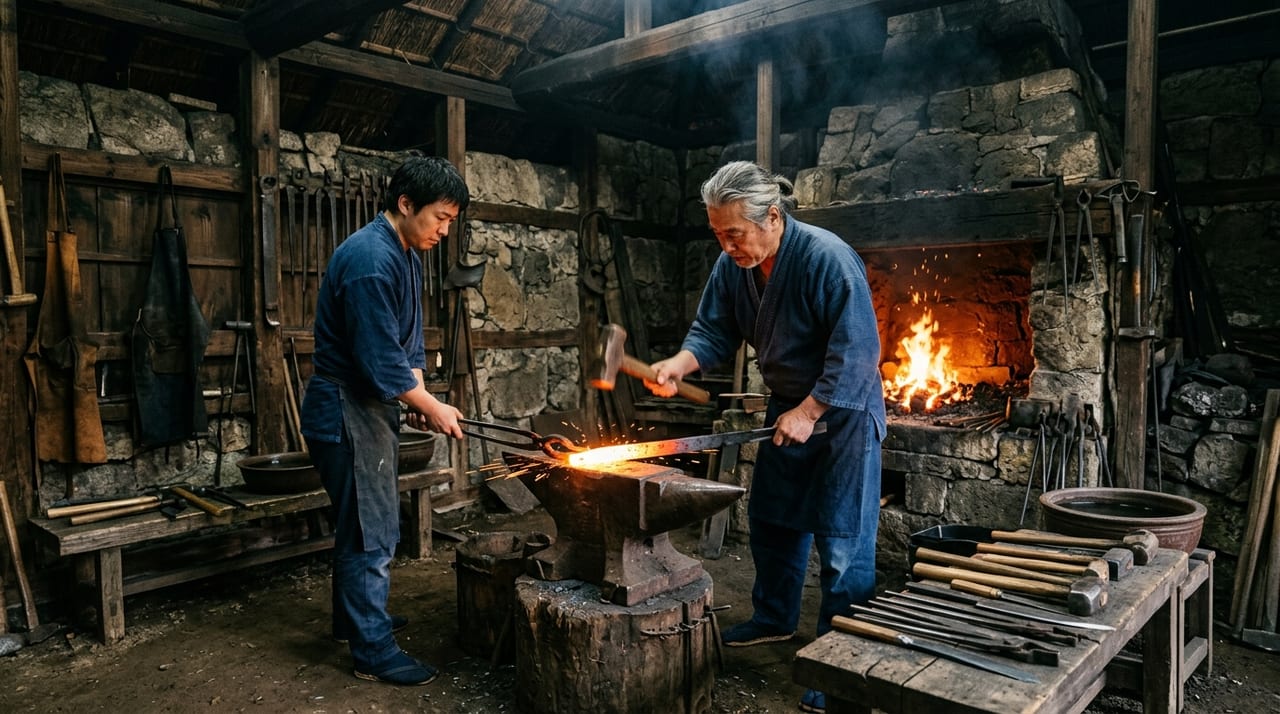
 * Image is for illustrative purposes only.
Tango no Kami Kanemichi
丹後守兼道
Description
Tango no Kami Kanemichi (1603–1672) was an early Edo-period swordsmith. Born into the Mishina school lineage that produced the Five Smiths of Kyoto (Kyō Go-kaji), he later moved from Kyoto to Osaka.
Lineage and Origins
His father was Tanba no Kami Yoshimichi of the Mishina school. Branching off from the Mishina family, which originated in Seki in Mino Province, Kanemichi received the title Tango no Kami, went by the name Naomichi around the Kan'ei era (1624–44), and later moved to Osaka. His signature is usually cut as 'Tango no Kami Fujiwara Kanemichi' or similar forms. He was a swordsmith from the prestigious Mishina school, with Tanba no Kami Yoshimichi as his father and Iga no Kami Kinmichi as his uncle.
Style
Inheriting the characteristics of Osaka Shintō, he continued the sudare-ba that his father Tanba no Kami Yoshimichi had founded, and produced splendid sudare-ba and gunome-chōji. The ji-hada is mainly refined itame-hada, and the hamon is based on gunome, with a bright, clear finish. He is valued for passing the sudare-ba style he inherited from his father on to the Osaka branch of the Mishina school.
Reputation and Lineage
The Osaka Mishina school continued throughout the Edo period as one of Osaka's important sword-smithing lineages. In the Kaihō Kenshaku ranking he is listed as a yoki-wazamono under the name 'Tango no Kami Naomichi', and his practical cutting performance was also well regarded. As one of the leading smiths of the early Osaka Shintō era, he holds a firm place in the history of Japanese swords.
Related Swordsmiths
堀川国広
Soshu tradition (New Sword)Horikawa Kunihiro
Momoyama to Early Edo period (New Sword genesis era)
山浦真雄
Sōshū and Bizen traditionYamaura Saneo
Late Edo Period (Shinshintō era)
肥後守輝広
ShintōHigo no Kami Teruhiro
Azuchi-Momoyama to early Edo period (around Keichō)
越前下坂
Sōshū tradition lineage (Shintō period)Echizen Shimosaka
Early Edo period (Shintō era)