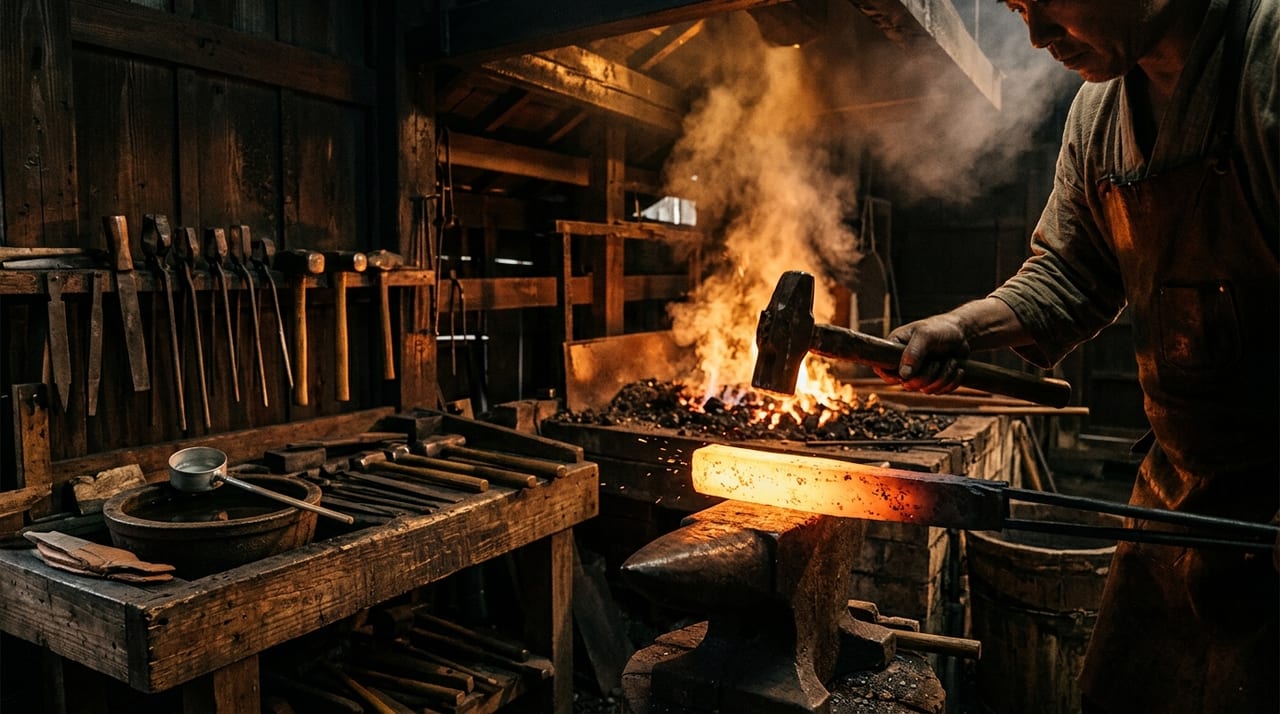
 * Image is for illustrative purposes only.
Shimada Yoshisuke
島田義助
Description
Shimada Yoshisuke was a swordsmith active in Suruga Province (present-day Shizuoka Prefecture) from the mid-Muromachi period through the Sengoku period, and is one of the master smiths representing the "Shimada school." The Shimada school was a group of swordsmiths based in Shimada in Suruga Province (around present-day Shimada City), which developed its own style under the strong influence of the Sōshū-den. As its central figure, Yoshisuke had a major influence on the Shimada smiths who followed him.
Yoshisuke's swords are most distinctive in that, while grounded in the bold style of the Sōshū-den, they add an independent interpretation rooted in the land of Suruga. The jigane (ground steel) shows flowing ō-itame, with mokume mixed in here and there, giving a bold surface texture. The roughness of the forging is deliberate, lending the entire blade a rustic and masculine impression. The hamon is mainly ō-gunome and togari-gunome, and within large, irregular patterns it is a dynamic temper that still shows a sense of regularity. The nie is coarse and large, which accentuates the blade's powerful presence. While following the lineage of Sōshū Masamune, it can be said to be an interpretation that prioritizes practical strength over the refinement of Masamune's works.
Yoshisuke is also known for his spears, and the ōmi-yari "Otegine," one of the Three Great Famous Spears of the Realm, is said to be his work. Otegine was made to order for Yūki Harutomo of Shimōsa and was destroyed in the Great Tokyo Air Raid of Shōwa 20 (1945).
Suruga Province, where the Shimada school was active, was a strategically important area. It passed from Imagawa clan rule through contests between the Takeda and Tokugawa, and finally became a base of the Tokugawa family. The era in which Yoshisuke lived was right in the midst of this great upheaval, and demand for swords for actual use was extremely strong. Within this historical context, Yoshisuke established the Shimada school's style, which valued sturdy practicality over decorative beauty, and played a part in raising the reputation of Suruga smiths.
The Shimada school included many smiths, such as Sukemune, Hirosuke, Yoshitsuna, and Motosuke, and the Yoshisuke name was passed down through several generations (according to various accounts, three or four generations). Currently, a sword with koshirae is held by the University Art Museum, Tokyo University of the Arts, and a spear inscribed "Yoshisuke saku" is held by the Kyushu National Museum. They are highly valued as precious cultural assets that convey to the present day the spirited character of Sengoku-period swordsmiths.
Famous Works
- Large-bladed yari, famous spear “Otegine” (destroyed by fire in 1945)
- Yari, signed Yoshisuke (Kyushu National Museum)
- Katana with koshirae (University Art Museum, Tokyo University of the Arts)