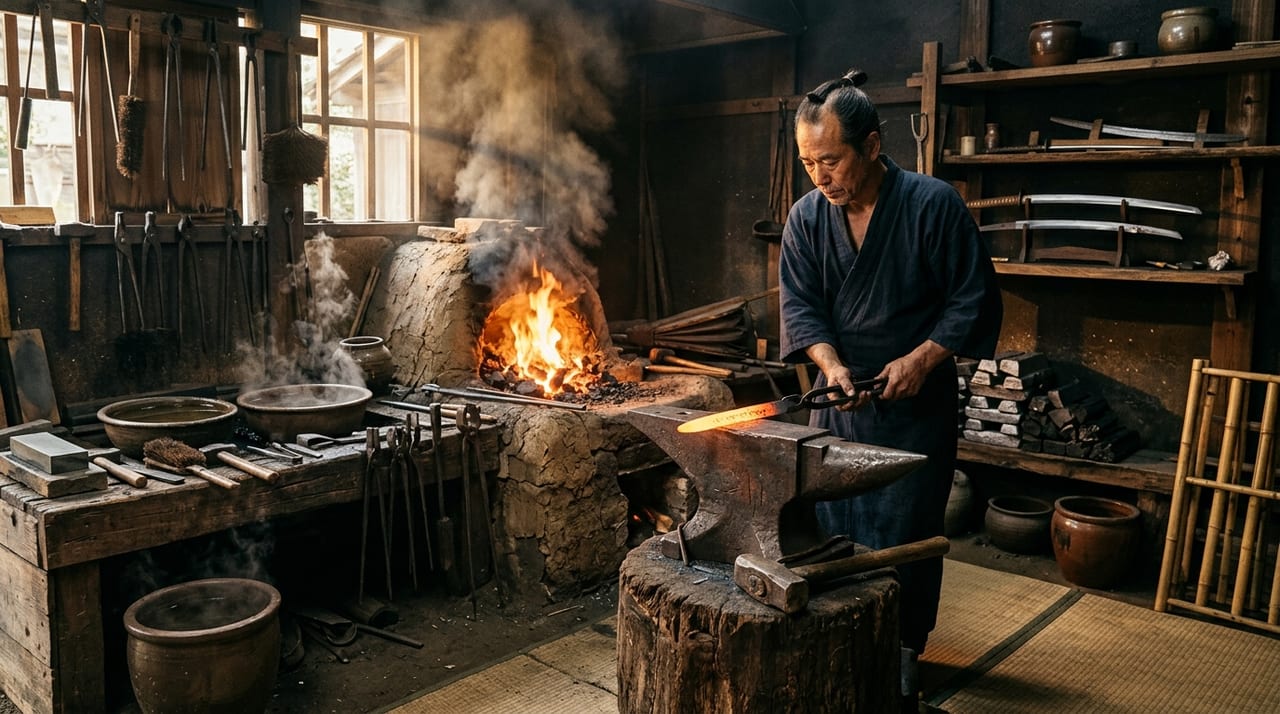
 * Image is for illustrative purposes only.
Satsuma Masafusa
薩摩正房
Description
Satsuma Masafusa and the Tradition of Satsuma Swords
Satsuma Masafusa is the name of a swordsmith who was active in Satsuma Province (Satsuma no kuni, present-day Kagoshima Prefecture) during the Edo period. Izu no Kami Masafusa, who moved to Satsuma around the Keichō era together with his father Maruta Bingo no Kami Ujifusa, is the best known. He has left his name in the sword history of southern Kyushu as one of the craftsmen representing the Satsuma school (Satsuma-ha). The sword industry of Satsuma Province developed in its own distinctive way under the protection of the Shimazu domain, and Satsuma swords were valued throughout the Edo period as sturdy, practical swords that embodied the "Satsuma spirit."
The Satsuma Domain (Shimazu clan) was a tozama daimyō that retained great independence even under the Tokugawa shogunate. Its martial spirit (shōbu no kifū) was directly connected to the domain retainers' strong interest in swords. Among Satsuma shizoku, swords were not mere weapons but symbols of samurai pride and spirit, and this spiritual context was also reflected in the swordmaking of Satsuma swordsmiths. Masafusa honed his skills within this martial culture of Satsuma and is evaluated as a craftsman who raised the technical standard of Satsuma swords.
Masafusa's Style and the Characteristics of Satsuma Swords
Izu no Kami Masafusa, together with his father Ujifusa, displayed a style that added features of the Sōshū tradition to the Mino tradition, with abundant nie in both the jigane and the hamon. This style is said to have become the source of the style of Satsuma shintō. The jigane of Satsuma swords is mostly ko-itame, tightly packed, with thick ji-nie, and many show chikei.
The hamon are mainly suguha or notare, along with gunome, and many have a composition in which nie is vigorously deposited. The hamon of Satsuma swords generally tends to be linear and simple, but the abundance of nie and the workings of kinsuji and sunagashi compensate for that simplicity and form a view worth appreciating. The hamon of Masafusa carries solid technical skill within this Satsuma-style simple beauty, and experienced viewers can understand the "deep flavor" unique to Satsuma swords.
Shimazu Domain's Sword Policy and Satsuma Swordsmiths
The Shimazu domain actively protected sword craftsmen as an important industry of the domain. Under the system of domain-appointed smiths (han-goyō kaji), swordsmiths secured a stable position and income, and in return they took on the important role of supplying swords to domain retainers. Masafusa is also considered to have been one of the craftsmen who worked within this domain protection system. The role the Shimazu domain's sword policy played in maintaining and developing the quality of Satsuma swords was great.
During the bakumatsu period, the Satsuma Domain played one wing of the Satsuma–Chōshū Alliance and became a driving force of the Meiji Restoration. In this historical role, the spiritual role played by the sword culture of Satsuma samurai cannot be ignored, and Satsuma swords are also a symbol of the samurai spirit that drove Japan's modernization. Masafusa's swordmaking came long before the historical upheavals of the bakumatsu period, but understanding Satsuma swords within this historical context gives a perspective that takes in the whole of Japanese history.
The Current State of Satsuma Sword Research and Evaluation of Masafusa
Research on Satsuma swords has advanced in recent years, and the individuality and techniques of Satsuma swordsmiths, who had not received sufficient attention until now, are being reappraised. A certain number of Masafusa's works survive, covering katana, wakizashi, and tantō, and a relatively substantial group of examples has been confirmed among Satsuma swordsmiths.
Touken-za introduces Satsuma Masafusa as a swordsmith born of the distinctive martial culture of southern Kyushu, and aims to convey the sturdy, straightforward beauty of Satsuma swords to modern enthusiasts. The appeal of Satsuma swords lies less in beauty as refined craft than in the direct expression of practical strength and samurai spirit. Their value is deeply rooted in the history of the bakumatsu period and in the spiritual history of the Japanese people.
Famous Works
- katana
- wakizashi