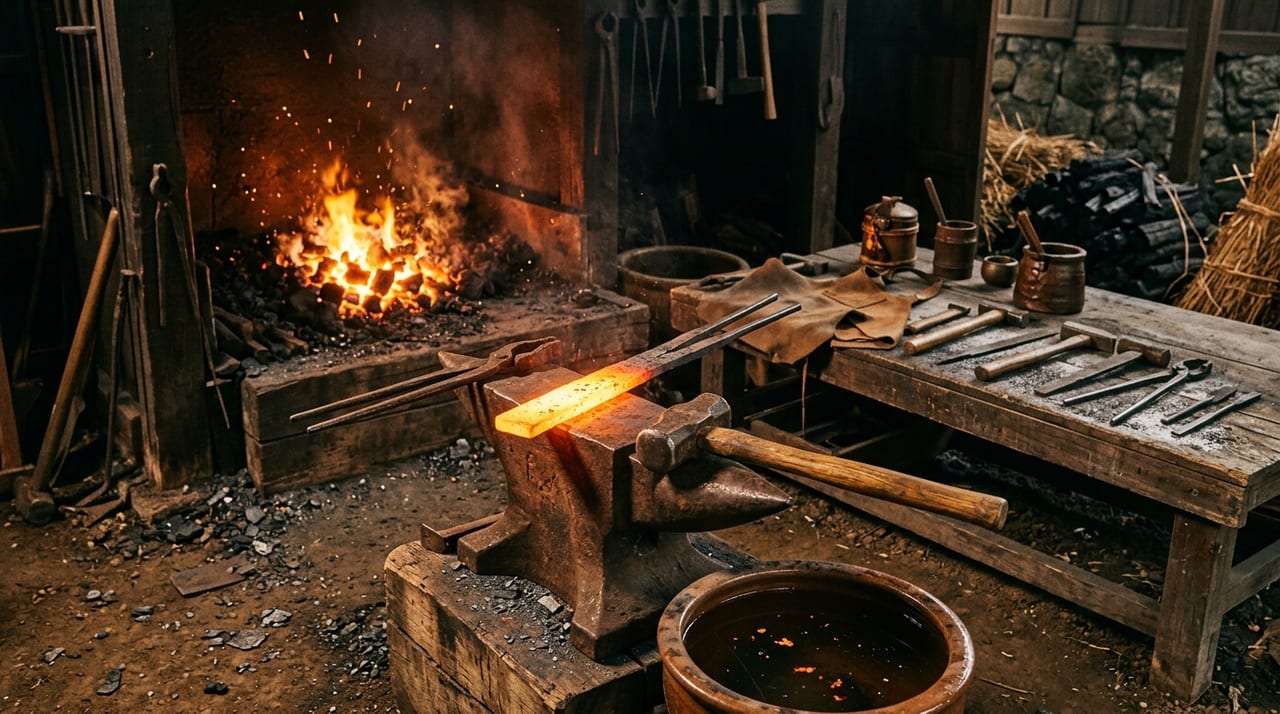
 * Image is for illustrative purposes only.
Osafune Norimitsu
長船則光
Description
Osafune Norimitsu——Representative Smith of Sue-Bizen
Osafune Norimitsu was a swordsmith active at Osafune in Bizen Province (present-day Okayama Prefecture) during the Muromachi period. The name Norimitsu was passed down over several generations, and the second generation, Kanshō Norimitsu, who was active around the Kanshō era, is especially well known. The Osafune school is the largest school in the history of Japanese swords, and Norimitsu is known as one of the craftsmen representing Sue-Bizen. He belongs to the generation that closed out the period of prosperity of the Osafune school from the Nanboku-chō period through the Muromachi period, and his name is recorded in sword history as a smith who represented the Sue-Bizen of the Osafune school in both quality and quantity.
The Osafune school traces its founding to Mitsutada of the Kamakura period and produced renowned smiths such as Nagamitsu, Kagemitsu, and Kanemitsu. Norimitsu lived several generations after these classical masters, but the technical tradition of the Osafune school still maintained a high standard. His works are highly valued in appraisal for especially stable quality among the Sue-Bizen. In the turbulent age when the authority of the Muromachi shogunate declined and moved toward the Sengoku period, Norimitsu's achievements in producing practical and artistically valuable swords in quantity contributed greatly to the spread and cultural establishment of Japanese swords.
Characteristics of the Style——Typical of Sue-Bizen
The greatest feature of Norimitsu's works is that, while faithfully inheriting the traditional style of the Bizen tradition, they adopt rational production methods suited to mass production. The jigane is centered on ko-itame and nagare-mokume, and many show the moist utsuri peculiar to Bizen. The forms called bō-utsuri and midare-utsuri are typical, and the presence of this utsuri is one of the most important appraisal elements distinguishing the Bizen tradition from other traditions.
The hamon consists mainly of forms typical of the late Muromachi period, such as kataochi-gunome and koshi-biraki gunome, and the hamon edge has a soft quality produced by ko-nie. Norimitsu's hamon differs from the solemn straight hamon of Ko-Bizen. It is a lively composition in which dynamic gunome continue, yet the moistness peculiar to the Bizen tradition is not lost. Within the hamon, sunagashi and fine kinsuji appear, forming a scene in which the qualities of Bizen steel come alive.
Inscriptions and Extant Works
Norimitsu also made works bearing long inscriptions such as "Bizen-no-kuni Osafune-jū Saemon-no-jō Fujiwara-no-Ason Norimitsu," and dated works also survive. An Important Cultural Property sword bears a date of the 12th month of Chōroku 3 and an inscription stating that it was made at Kurosaka in Takatori-no-shō, Mimasaka Province.
Some of the extant works of Norimitsu are swords designated as Important Cultural Properties. They are widely held by museums, art museums, and private collections in Japan and abroad, and they provide standard reference works essential for studying Sue-Bizen. These extant works show how great an academic role Norimitsu plays in sword appreciation and research.
The Sengoku Period and Demand for Bizen Swords
The late Muromachi period, in which Norimitsu was active, and the early Sengoku period were an age in which battles occurred frequently across Japan and demand for swords rose sharply. The Osafune smiths of Bizen responded to this strong demand by organizing their production system. Many military commanders and daimyō favored Bizen swords, and Norimitsu's swords are thought to have been worn at the waists of samurai in various regions and used on the battlefield.
In terms of mass production, his works differ in nature from the custom-made single works of the renowned Ko-Bizen smiths. However, Norimitsu's works kept a reliable technical standard even within mass production and continued to offer high-reliability quality among the Sue-Bizen. The reconciliation of quantity and quality is the reason Norimitsu is highly valued today as a craftsman representing Sue-Bizen.
Modern Evaluation and Research
In modern research on Japanese swords, Osafune Norimitsu holds an unshakable position as a representative smith of Sue-Bizen, and his extant works are referenced as the standard for understanding Sue-Bizen. In sword appraisal, thorough knowledge of the range of Norimitsu's works is treated as the foundation for appraising Sue-Bizen, and it is one of the essential knowledge items for researchers and appraisers.
TOUKENZA introduces Osafune Norimitsu as a representative of Sue-Bizen who, during the turbulent Muromachi period, preserved the tradition of Bizen swords while leaving behind a large number of excellent works. By conveying to modern enthusiasts the moistness of the Bizen tradition and the beauty of its utsuri, and by showing that Norimitsu's works are deeply rooted in the warrior culture of the Sengoku period, it aims to deepen understanding of the historical and cultural layering of Japanese swords.
Famous Works
- katana, signed Bizen-no-kuni Osafune-jū Saemon-no-jō Fujiwara no Asomi Norimitsu, dated Chōroku 3 (Important Cultural Property)