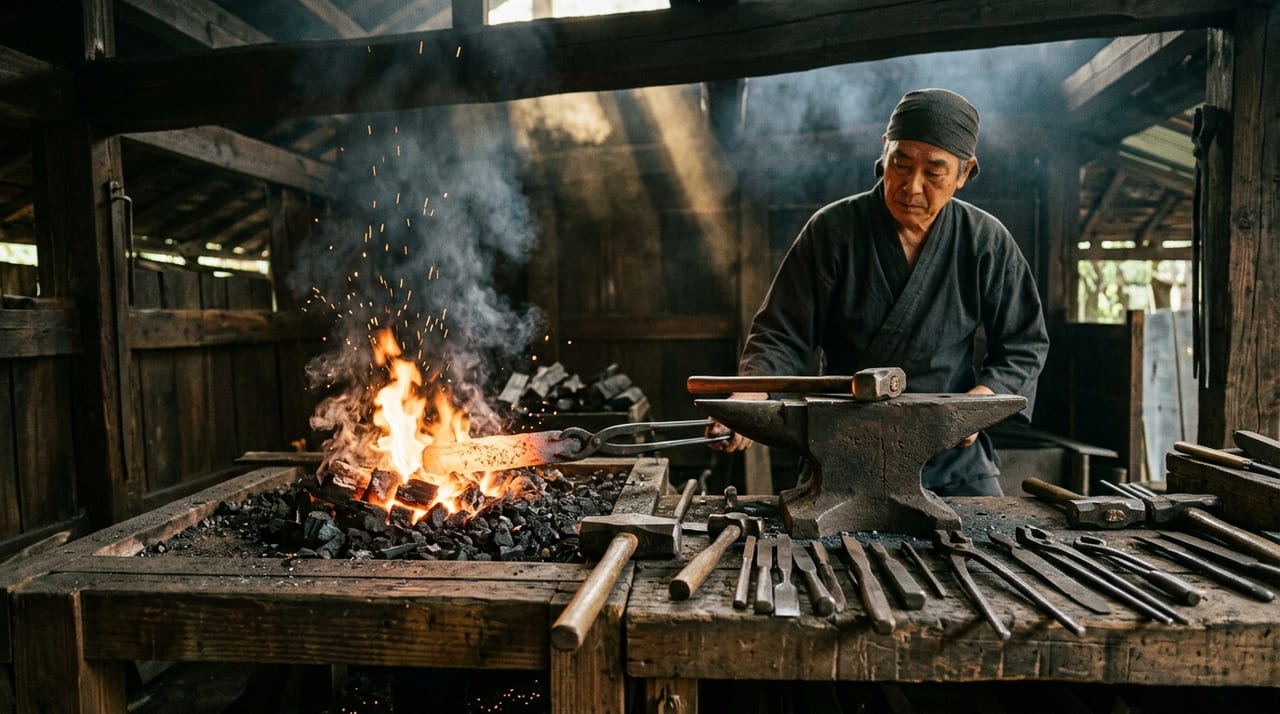
 * Image is for illustrative purposes only.
Ōno Yoshimitsu
大野義光
Description
Career
Ōno Yoshimitsu, born in 1948 in Niigata Prefecture, is a contemporary Japanese swordsmith. In 1969 he entered the workshop of the Tokyo swordsmith Yoshihara Yoshindo to train in sword forging. In 1975 he received an Encouragement Prize at the New Sword Masterpiece Exhibition, and in the same year joined the All Japan Swordsmith Association and received forging certification from the Agency for Cultural Affairs. He became independent in 1976, establishing his own forge in Kurosaki, Niigata Prefecture (now part of Niigata City).
Awards and Mukansa Status
From 1984 he won the Takamatsu-no-miya Prize for four consecutive years, and on the strength of that record he was certified mukansa ("exempt from judging") at the New Sword Masterpiece Exhibition in 1987. Mukansa status is granted to smiths who have repeatedly taken top prizes at the exhibition held by the Society for the Preservation of Japanese Art Swords, and represents the highest rank attainable by a living swordsmith.
Style
His work is founded on the Bizen tradition. He carries forward the chōji-midare (clove-shaped irregular temper pattern) of Bizen blades transmitted by the Ichimonji and Osafune schools, and is above all noted for jūka-chōji, a lavish pattern in which the clove heads appear to overlap like layered blossoms. His distinctive treatment of this pattern is known as "Ōno chōji" and is among the most recognizable hamon in modern Japanese swords.
Sanchōmō Copies
Among his best-known undertakings are copies of the National Treasure blade Sanchōmō (Yamatorige). These are characterized by a peninsula-like projection of the nioiguchi on the omote side, and are regarded as an attempt to recreate the brilliant irregular temper of Bizen Ichimonji work through modern forging methods.
Assessment
He is positioned as a smith who inherited the techniques of the Yoshihara line while establishing the ornate Bizen chōji-midare as a style distinctly his own.
Famous Works
- 山鳥毛写しの太刀