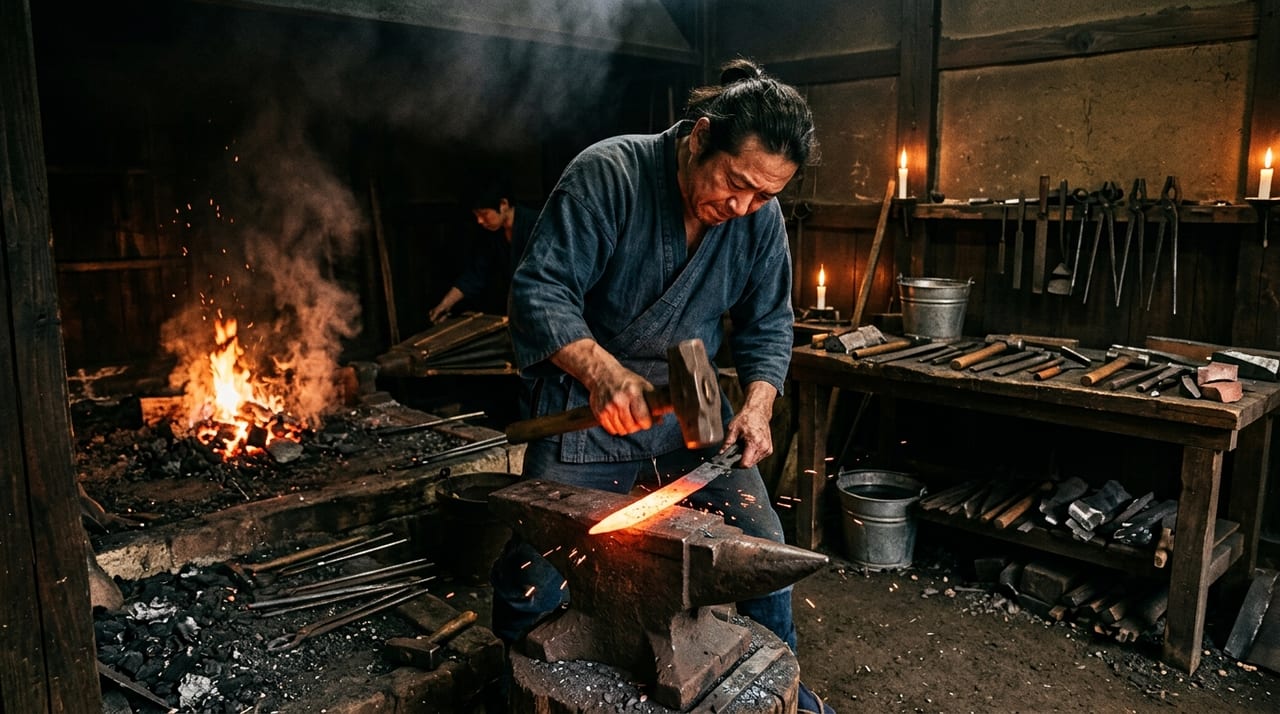
 * Image is for illustrative purposes only.
Ōmura Kaboku
大村加卜
Description
Ōmura Kaboku was an Edo-period swordsmith with an unusual background: although he was a physician to the Takada Domain in Echigo Province, he is said to have also made swords.
Origins as a Physician
Kaboku was originally a physician, serving the Matsudaira family of the Takada Domain in Echigo. He is said to have begun forging swords as a hobby around Kan'ei 21 / Shōhō 1 (1644), and he is said to have learned the craft from the Shitahara smiths.
From Rōnin to Physician of the Mito Tokugawa House
In Enpō 9 / Tenna 1 (1681), the Takada Domain was stripped of its fief following the Echigo Sōdō, and Kaboku became a rōnin and practiced as a surgeon in Teppōzu in Edo. He was later invited by Tokugawa Mitsukuni, lord of the Mito Domain in Hitachi Province, entered the service of the Mito Domain, and is said to have served as a physician-in-attendance and as a member of the otogi-shū. In Jōkyō 2 (1685), at Mitsukuni's command, he forged two swords, and the white scabbard (shirasaya) bears a record of six test cuts (tameshigiri).
Sword-Making and Techniques
His lifetime output is said to be just over one hundred swords, and he wrote the treatise Kentō Hihō. His work has two styles, the Sōshū and Bizen traditions, and he is known for using a distinctive forging method called “shin no jūgomai kōbuse-zukuri.”
Reputation
Although medicine was his main profession, his swords are of such high quality that they hardly seem the work of a mere pastime; they were popular from the Edo period onward, and many forgeries were made. The extant katana signed “Echigo Bakkashi Ōmura Kaboku Yasuhide” is designated as a Jūyō Tōken (Important Sword).
Related Swordsmiths
堀川国広
Soshu tradition (New Sword)Horikawa Kunihiro
Momoyama to Early Edo period (New Sword genesis era)
山浦真雄
Sōshū and Bizen traditionYamaura Saneo
Late Edo Period (Shinshintō era)
肥後守輝広
ShintōHigo no Kami Teruhiro
Azuchi-Momoyama to early Edo period (around Keichō)
越前下坂
Sōshū tradition lineage (Shintō period)Echizen Shimosaka
Early Edo period (Shintō era)