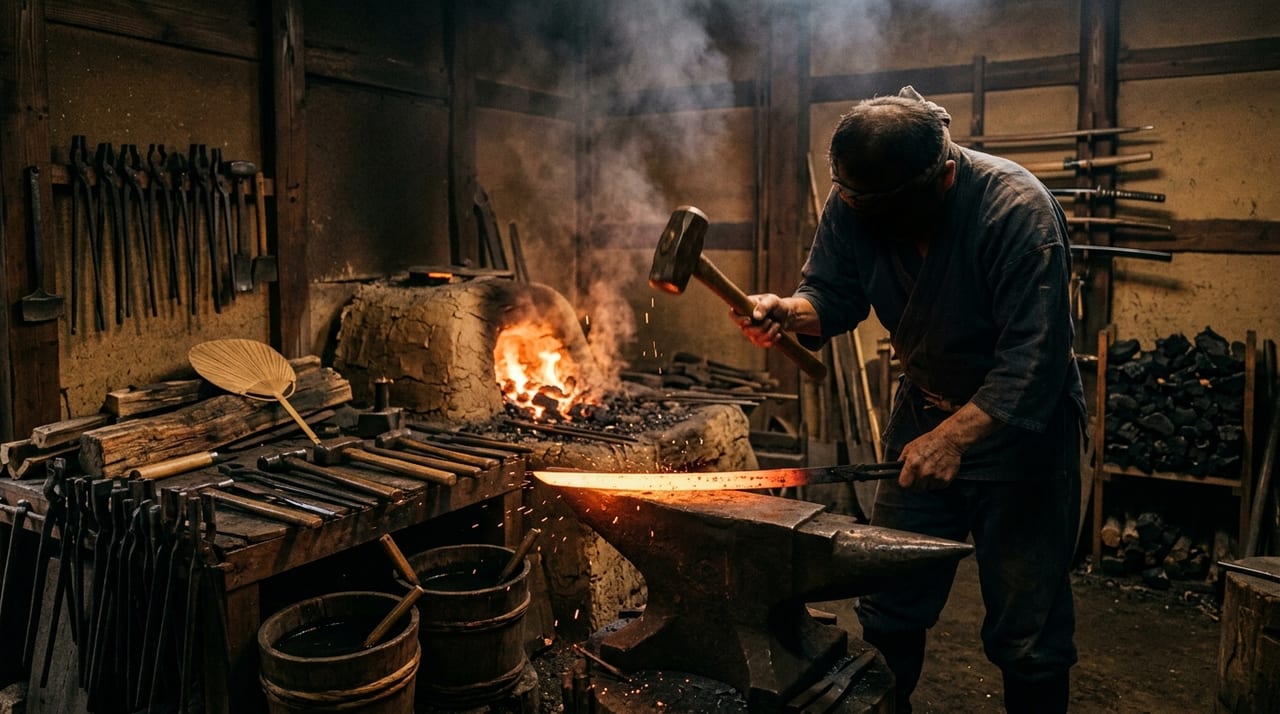
 * Image is for illustrative purposes only.
Ōmi no Kami Sukenao
近江守助直
Description
Ōmi no Kami Sukenao was a smith of the Ōsaka Shintō period, born in 1639 (Kan'ei 16) in Takagi Village, Ōmi Province, present-day Shiga Prefecture. He is known as a disciple of Tsuda Echizen no Kami Sukehiro, a master smith representative of Ōsaka Shintō, and as the husband of Sukehiro's younger sister.
Training and Career
Sukenao went to Ōsaka and studied under the second-generation Sukehiro, Tsuda Echizen no Kami Sukehiro, learning the techniques of blade-making. Later he received the title 'Ōmi no Kami' and married the younger sister of his teacher Sukehiro, taking the surname 'Tsuda'. He then returned for a time to his home village of Takagi to devote himself to forging, and works from this period are signed 'Ōmi no Kami Takagi-jū Sukenao'.
Succession to the Tsuda School
In 1682 (Tenna 2), after his teacher Sukehiro died, Sukenao moved back to Ōsaka and, as successor of the Tsuda school, supported the school's prosperity. His date of death is unknown, but since no works from after 1693 (Genroku 6) have been found, he is presumed to have died by around this time.
Characteristics of the Style
Sukenao's style closely resembles that of his teacher Sukehiro, yet it also shows its own features. He inherited the hamon techniques gunome-midare and tōran-midare that Sukehiro had perfected, but he can be distinguished from his teacher by a somewhat narrow blade body with a tendency toward saki-zori (tip curvature), and by the near absence of tamayaki, which Sukehiro was known for.
Representative Work
The Tokyo National Museum holds a katana inscribed 'Ōmi no Kami Takagi-jū Sukenao / dated an auspicious day in the 9th month of Enpō 6' (1678).
Related Swordsmiths
堀川国広
Soshu tradition (New Sword)Horikawa Kunihiro
Momoyama to Early Edo period (New Sword genesis era)
山浦真雄
Sōshū and Bizen traditionYamaura Saneo
Late Edo Period (Shinshintō era)
肥後守輝広
ShintōHigo no Kami Teruhiro
Azuchi-Momoyama to early Edo period (around Keichō)
越前下坂
Sōshū tradition lineage (Shintō period)Echizen Shimosaka
Early Edo period (Shintō era)