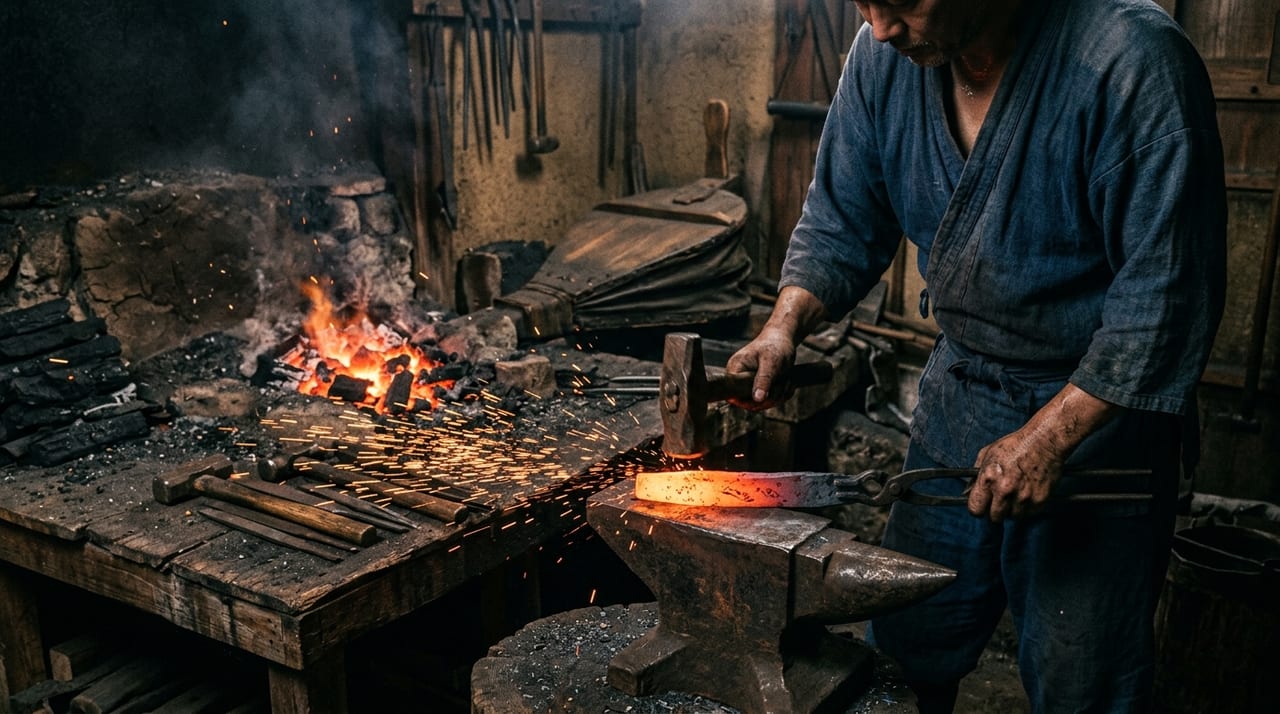
 * Image is for illustrative purposes only.
Mishina Tōkurō Teruhiro
三品藤九郎輝廣
Description
Mishina Tōkurō Teruhiro was a swordsmith who lived in Yamashiro Province (Kyoto Prefecture) during the early Edo period and was part of the Mishina school lineage. From the Mishina school emerged figures such as Kanedo's son, Echizen no Kami Masatoshi, who were among the Kyoto Five Forgemasters. He shaped sword culture in Kyoto during the early Edo period.
Teruhiro's style retained strong characteristics of early Shinshintō workmanship. The jihada displays flowing itame grain with a rough surface texture, and though marked by ji-kei patterning, conveys a powerful impression despite its somewhat coarse quality. The hamon is primarily composed of gunome and ōgunome patterns, occasionally mixed with yabazura-style edges. The nioi-guchi exhibits vigorous nie, with hadori (sandy striations) visible in the blade, demonstrating bold and robust craftsmanship. This generous, expansive style became the foundation upon which later Mishina smiths would build their pursuit of greater refinement and precision.
Teruhiro's period of activity, from Keichō through Kan'ei, corresponds to the establishment of a new order following the Battle of Sekigahara. The Tokugawa shogunate actively gathered skilled swordsmiths and formally recognized them as official governmental forgemasters (goyō-kaji), thereby ensuring the preservation and advancement of forging techniques. Within this system, Teruhiro served Fukushima Masanori and relocated to Aki, subsequently establishing a prominent social position serving the Asano clan of Hiroshima Domain.
His signature (mei) was typically the two-character inscription 'Teruhiro,' and examples bearing a chrysanthemum crest are also known. While extant works are limited in number, many survive in excellent condition as treasured family heirlooms of daimyo houses, making them invaluable records for understanding the origins of the Mishina school. His achievement in establishing the foundation of a major swordsmith family—whose descendants largely adopted the Mishina surname and continued into the late Edo period—was truly significant.
Famous Works
- 打刀 銘 輝廣(大名家伝来)
- 脇差 菊紋輝廣