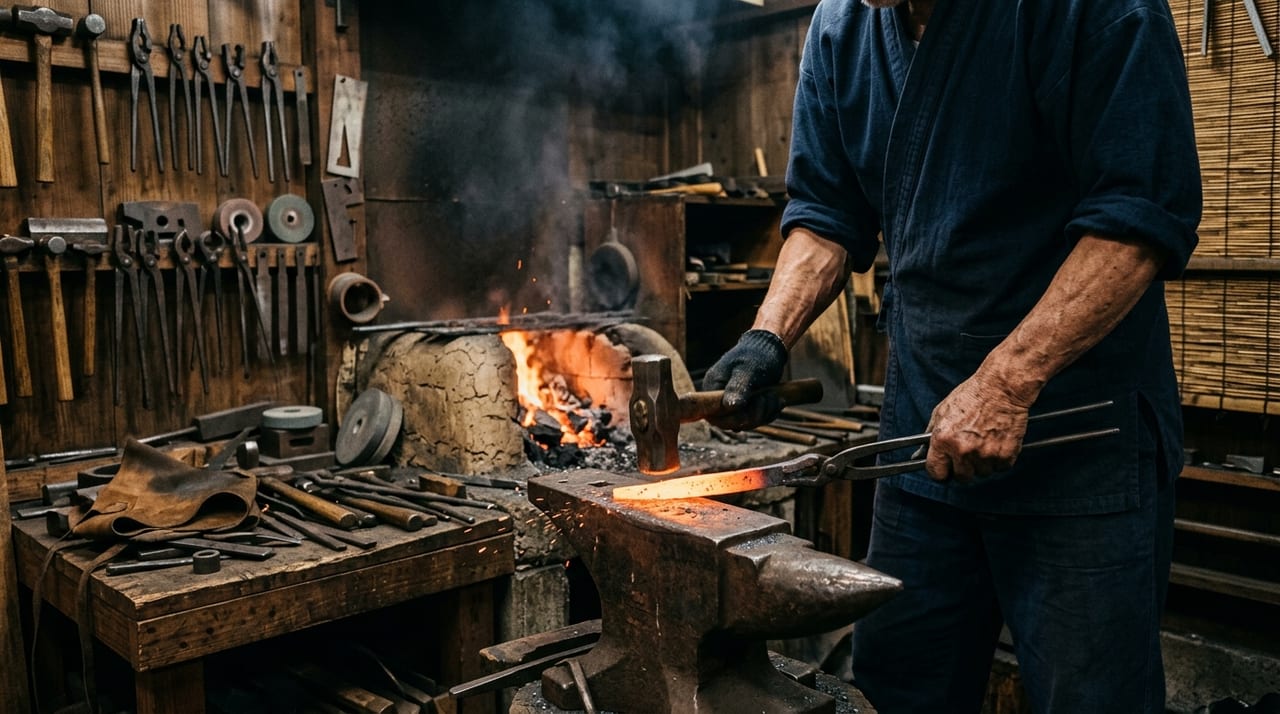
 * Image is for illustrative purposes only.
Hizen Yukihiro
肥前行広
Description
Hizen Yukihiro and the Golden Age of Hizen Swords
Hizen Yukihiro was a swordsmith active in Hizen Province (Hizen-no-kuni, present-day Saga and Nagasaki Prefectures) from the late Kan'ei era to the Kanbun era (roughly 1640s–1670s) in the early Edo period. He is recorded in the history of Kyushu swords as one of the craftsmen representing the heyday of Hizen swords (Hizen-tō). Yukihiro was a grandson of Tadayoshi I, and he received the title Dewa Daijō in Shōhō 5 (1648) and Dewa no Kami in Kanbun 3 (1663). Hizen swords, centered on Tadayoshi I (Tadayoshi, later Musashi Daijō Tadahiro), developed rapidly from the Keichō era (1596–1615) and became a major production center for new swords (shintō). Yukihiro is regarded as a craftsman who refined his own techniques during this heyday of Hizen swords.
The sword industry of Hizen developed under the protection of the powerful daimyō of the Saga Nabeshima domain. The Nabeshima domain actively protected and encouraged swordsmiths. By establishing a system for the stable supply of high-quality swords, it raised the reputation of the Hizen swords brand to national fame. Yukihiro was also active within this system of domain protection and encouragement, and he is recorded as one of the craftsmen who maintained and developed the high quality of Hizen swords.
Yukihiro's Style and the Characteristics of Hizen Swords
The jigane of Hizen Yukihiro's swords is mainly tightly forged ko-itame, and it is characterized by a uniform, fine-grained surface. The jigane of Hizen swords in general also features a finely refined ko-itame surface, and early Edo new-sword techniques have further enhanced its uniformity and sense of cleanliness. Yukihiro is said to have learned the Bizen tradition from the Ishidō school in Edo, and his works show a technical orientation that is strongly conscious of the Bizen tradition.
The hamon are mainly gorgeous chōji-style hamon and gunome-midare. In particular, the jūka-chōji-midare of the Ichimonji-utsushi often approaches the quality of old works. The hamon of Hizen swords in general have an orderly beauty. In Yukihiro's hamon, moderate variation and activity are added within this orderly beauty, giving viewers a refined sense of satisfaction.
The mei is cut as "Hizen-no-kuni Dewa no Kami Yukihiro" and similar, and because the character for "one" (ichi) is added at the head of the mei, his blades are also called "Hizen Ichimonji." Around Keian 3 (1650), he learned the forging method for imported iron, known as Dutch steel (Oranda-kō), in Nagasaki. Works with an added inscription on the nakago reading "Oranda-kitae wo motte saku" and similar are also a characteristic of this smith.
Distribution and Reputation of Hizen Swords
Hizen swords continued to receive high evaluation across the country throughout the Edo period. While the "Hizen-no-kuni Tadayoshi and Tadahiro" brand received the highest acclaim, Yukihiro is counted among the master craftsmen with particularly excellent skill among Hizen smiths, together with Tadayoshi I, Ōmi Daijō Tadahiro, Mutsu no Kami Tadayoshi and Masahiro I. Although the commercial value of Hizen swords did not reach that of the old famous blades of Bizen and Yamashiro, they were available as new swords (shintō) and spread widely to samurai, merchants and commoners. In this way they contributed to the popularization of sword culture in the Edo period.
Nagasaki, close to Hizen, was the gateway for trade and cultural exchange with overseas during the Edo period. Just as Yukihiro learned the forging method of Dutch steel in Nagasaki, this international environment also extended to Hizen swords.
Modern Study of Hizen Swords and Yukihiro's Place
Hizen swords still attract the interest of many researchers and enthusiasts today, and systematic study centered on Tadayoshi I is progressing. Study of the craftsmen around Tadayoshi, including Yukihiro, has gradually deepened, and efforts to clarify the characteristics of individual makers continue.
Extant works by Hizen Yukihiro span several forms, including katana, wakizashi and tantō. Touken-za introduces Hizen Yukihiro as one of the capable craftsmen who supported the heyday of Hizen swords. Its aim is to convey to modern enthusiasts the richness of Hizen sword art of the early Edo period, as embodied in his works. The clean and orderly beauty of Hizen swords is approachable even for people who are learning about Japanese swords for the first time, so it has value as an introduction. At the same time, it is a profound art whose flavor deepens the more one appreciates it.
Famous Works
- katana, signed Ichi Hizen no kuni Dewa no kami Yukihiro, i Oranda tanzō (Tokyo Fuji Art Museum)