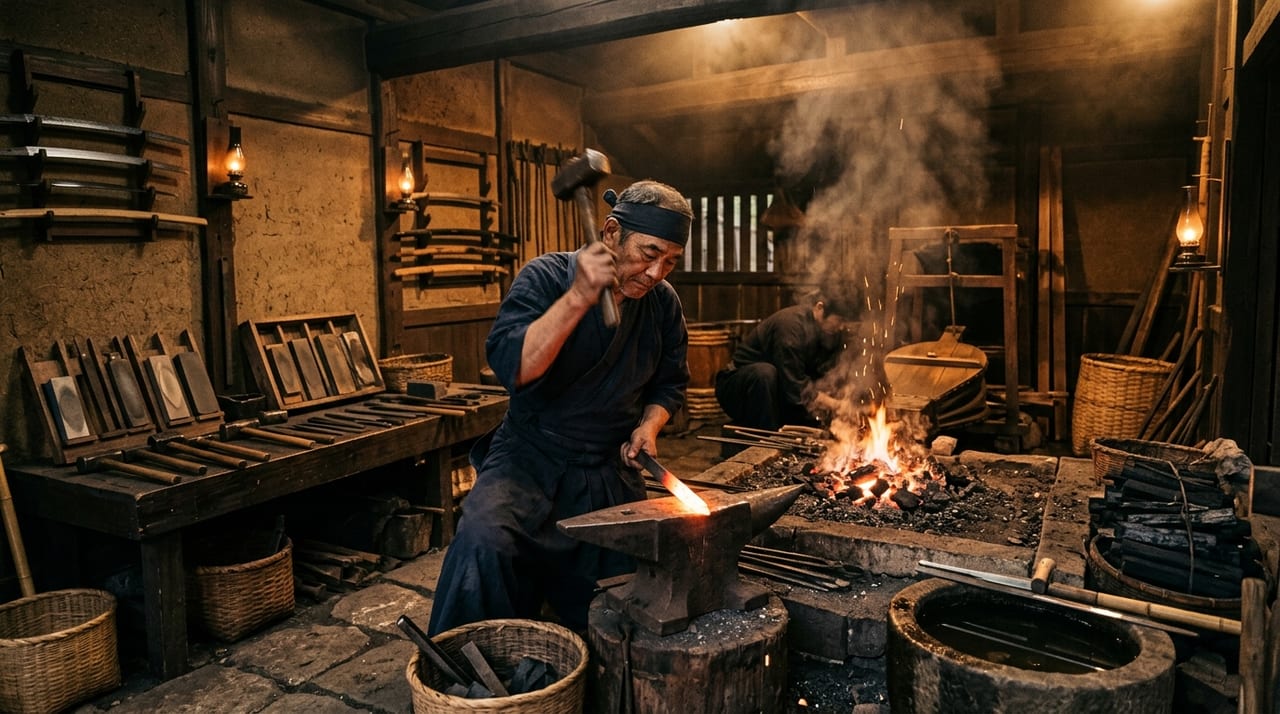
 * Image is for illustrative purposes only.
Hizen Tadahiro II
肥前忠広(二代)
Description
Hizen Tadahiro II: The Master Smith Who Carried On the Golden Age of Hizen-tō
Hizen Tadahiro II was a swordsmith active in Hizen Province (present-day Saga Prefecture and Nagasaki Prefecture) from the Kan'ei through Genroku eras (1632–1693) in the early Edo period. The tradition of Hizen-tō was founded in the early Edo period by Hashimoto Shinzaemon Tadayoshi, later known as Musashi Daijō Tadahiro, and was developed and handed down by the craftsmen who inherited the Tadahiro name. Tadahiro II is positioned as a representative craftsman of the period when the quality of Hizen-tō was at its highest.
Hizen-tō is one of the leading schools of shintō (new swords) representative of the early Edo period, developed around the name "Hizen Province" and the lineage of the Tadayoshi and Tadahiro signatures. Developed under the protection of the Nabeshima domain (Saga domain), Hizen-tō earned a distinctive reputation in early Edo sword circles for its refined technique and dignified style. The beauty of the jigane in particular is widely known as the greatest hallmark of Hizen-tō, and the works of Tadahiro II embody this quality at a high level.
The Secret of Hizen-tō's Jigane: nashiji-hada
What most distinguishes Hizen-tō from all other shintō is the unique surface texture of the jigane known as nashiji-hada. Nashiji refers to a beautiful surface pattern in which fine, uniform granular unevenness spreads across the entire jigane, resembling the skin of a pear. It is understood as ko-itame packed densely and uniformly into fine particles.
This texture is said to have been produced by the forging techniques established by the first Tadayoshi. Tadahiro II carried on the nashiji-hada technique at a high level and preserved the tradition of Hizen-tō in the beauty of its jigane.
The hamon includes a wide variety of styles, such as suguha, ko-midare, and gunome, but the hallmark of Tadahiro II is a well-balanced style of hoso-suguha or ko-gunome. The nie is fine and uniform, giving an elegant finish with a hamon edge that appears vividly tightened. Overall, the hamon of Hizen-tō is characterized less by the showiness of Ko-Bizen's chōji-midare than by an orderly, dignified calm, and Tadahiro II embodies this aesthetic of Hizen-tō.
The Nabeshima Domain's Sword Protection Policy and the Development of Hizen-tō
The greatest factor behind Hizen-tō's outstanding position in early Edo sword circles was the active protection and cultivation policy of the Nabeshima domain. Beginning with Nabeshima Katsushige, the first Saga domain lord, successive domain lords supported Hizen-tō as an important industry and culture of the domain, and they developed an environment to raise the status and skill of swordsmiths. As official domain smiths (goyō-kaji), guaranteed stable income and social standing, Hizen smiths were able to devote themselves to improving their craft, free from economic pressure.
Tadahiro II was also one of the craftsmen who worked within this domain protection system, and the role that Nabeshima domain support played in maintaining the quality of Hizen-tō cannot be overlooked. From the outset, Hizen-tō was mainly intended for supply to the warrior class and daimyō households, so it was required to combine practicality with dignity. The nature of this demand had a direct influence on the style of Hizen-tō, establishing a sincere and dignified style.
Extant Works and Cultural Evaluation
Extant works by Hizen Tadahiro II span tō, wakizashi, and tantō, and a certain number of dated pieces (nengi) have been transmitted. The works are held in museums and private collections in Japan and abroad. In terms of appraisal, distinguishing between the first Tadayoshi (Musashi Daijō Tadahiro) and Tadahiro II is a difficult challenge. However, researchers have analyzed the stylistic and signature characteristics of each generation in detail, and a distinct stylistic domain unique to Tadahiro II is recognized.
Even today, Hizen-tō is highly valued by sword enthusiasts for the beauty of its jigane, and the works of Tadahiro II are positioned within this appreciation. Because the nashiji-hada of Hizen-tō is brought out to the fullest by the skill of the togishi (polisher), Hizen-tō finished with first-rate polishing is considered to have a particularly exceptional beauty in its jigane.
The Significance of Hizen Tadahiro II at TOUKENZA
At TOUKENZA, we introduce Hizen Tadahiro II as a representative craftsman who carried the tradition of Hizen-tō to a high standard in the early Edo period. The three virtues of Hizen-tō, namely the beauty of nashiji-hada, the dignity of suguha, and a well-balanced taihai (body proportions), are perfected in the works of Tadahiro II. A single blade of his conveys to the present day the refinement and dignity of early Edo warrior culture. Among shintō, the distinctive dignity and nashiji beauty of Hizen-tō have continued to be highly valued by Japanese sword enthusiasts worldwide, and the Tadahiro lineage at its center embodies the essence of Hizen-tō culture.
Famous Works
- katana, signed Hizen no kuni Ōmi daijō Fujiwara Tadahiro
- tantō