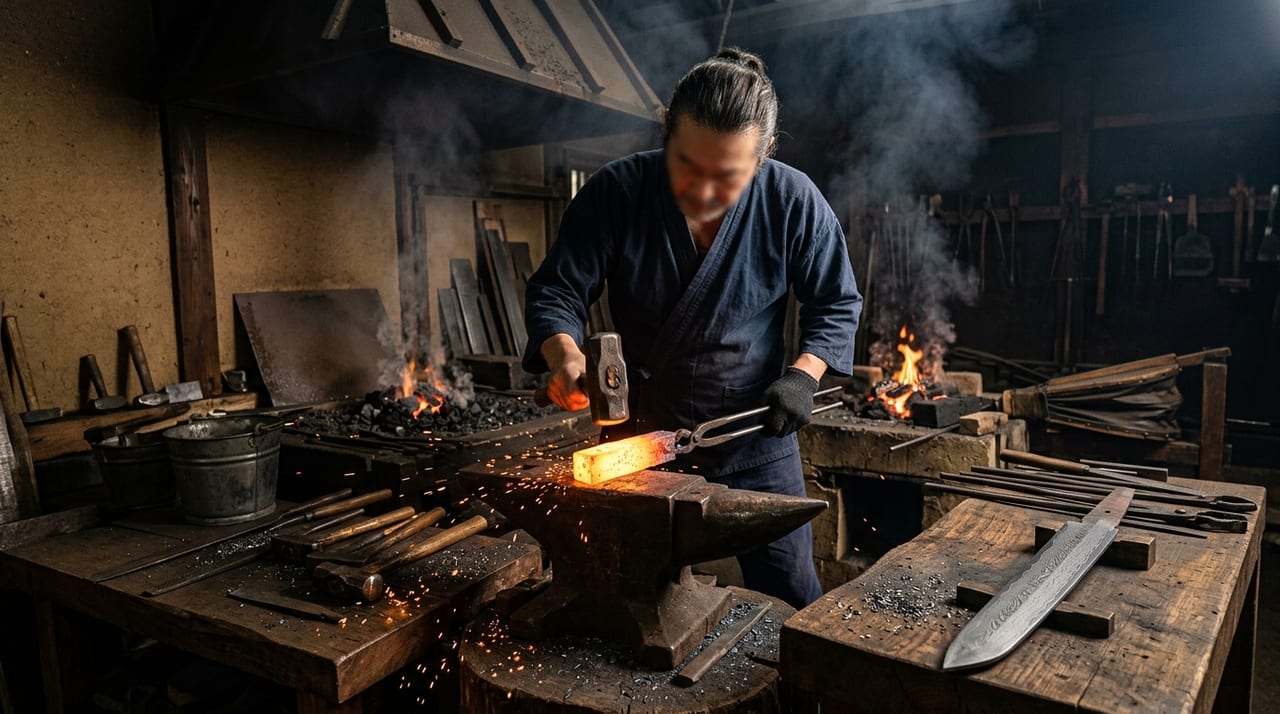
 * Image is for illustrative purposes only.
Gassan Sadanobu
月山貞伸
Description
A Treasure of the Modern Gassan School: Sadanobu
Gassan Sadanobu is a contemporary swordsmith active from the Heisei into the Reiwa era, and as the eldest son of Gassan Sadatoshi, Sadanobu inherits the tradition of the Gassan school. The Gassan school originated at Mount Gassan in Dewa Province (present-day Yamagata Prefecture), and is a distinct school characterized by its unique 'ayasugi-hada'; it achieved new development through Gassan Sadakichi, who moved from Dewa to Osaka in the late Edo period. As the legitimate heir of the Gassan school, Sadanobu is an important figure who has inherited and developed the ayasugi-hada technique for the present day.
Ayasugi-hada, the symbol of the Gassan school, is a distinctive pattern in the steel surface (jigane) in which orderly, wave-like flowing grain appears across the entire surface, forming a beautiful pattern over the whole blade, as if the annual rings of a cedar tree had been carved out in relief. This texture is also called 'Gassan-hada' because it symbolizes the Gassan school, and it is produced by a special forging technique. Sadanobu has the skill to reproduce this difficult ayasugi-hada perfectly, and continues to demonstrate that this traditional technique has not been lost in the present day.
The Ayasugi-Hada Technique: The Supreme Skill of the Gassan School
Put simply, ayasugi-hada is a distinctive wavy surface resembling wood grain, created by repeatedly folding and layering steel in complex ways; however, forging while controlling this surface exactly as intended is extremely difficult. The special folding technique of the Gassan school, transmitted since Gassan Sadakazu, is produced through an exquisite combination of steel composition and forging method, and this technique cannot be mastered without many years of training and experience.
Sadanobu's ayasugi-hada is particularly well-balanced, and the beauty of its wave-like pattern repeating at a steady rhythm throughout instantly captivates the viewer. The pattern changes in appearance depending on how light is cast on it, and showing new expressions each time it is observed from different angles is also one of the charms of ayasugi-hada. In Sadanobu's works, this ayasugi-hada blends completely with the beauty of the hamon, forming high artistic quality as a whole.
Technical Standard as a Modern Swordsmith
The hamon in Sadanobu's works is diverse, ranging from straight-edged (suguha) types to gunome and choji-midare; through combinations of the distinctive ayasugi-hada jigane and various hamon, each work has its own distinct character. Combined with modern polishing techniques, the beauty of the jigane and hamon of Sadanobu's swords is fully brought out, proving that Japanese swords possess a standard sufficient to hold up as artworks even in international appreciation settings.
As for sword forms, Sadanobu works across a broad range of types, including tachi, katana, wakizashi, and tanto, and in commissioned work produces pieces of various shapes and dimensions according to the client's requests. The ability to master classical techniques perfectly while working as a contemporary swordsmith, and to connect them with modern artistic expression, is evidence of Sadanobu's outstanding skill.
International Evaluation of the Gassan School and Sadanobu's Contribution
The ayasugi-hada of the Gassan school receives high praise not only within Japan but also among international Japanese sword enthusiasts and collectors. Its visual distinctiveness and beauty convey an intuitive beauty even to foreigners seeing Japanese swords for the first time, and it plays an important role in raising interest in Japanese swords around the world.
Furthermore, from the standpoint of preserving the Gassan school's techniques, Sadanobu's existence is of great significance. Special forging techniques such as ayasugi-hada are 'intangible cultural heritage' that would be lost forever if the smiths who can practice them were to die out. Sadanobu's continued transmission of the ayasugi-hada technique to the next generation holds immeasurable value even from the perspective of preserving Japan's traditional crafts.
Presentation of Works
Among Sadanobu's works, a sword forged in 2015 (inscribed 'Yamato no kuni jū Gassan Sadanobu kinsaku') was exhibited at the Nihon Bijutsu Token Hozon Kyōkai's 'Heisei no Meitō Meikō-ten' (Reiwa gannen). Also, swords by Sadanobu were displayed together at a solo exhibition of his father, Sadatoshi. At Touken-za, we introduce Gassan Sadanobu as a contemporary swordsmith aiming for a fusion of tradition and modernity, and as an inheritor of Japanese sword culture.
The Formation of Ayasugi-Hada and the History of the Gassan School
Tracing the history of the Gassan school back, there is a tradition that it originated at Mount Gassan (Yamagata Prefecture), one of the Dewa Sanzan, and that sword-making was carried out from the Heian period. However, according to the reliable records that can be confirmed at present, it is known that Gassan Sadakichi moved to Osaka in the late Edo period and laid the foundation for the modern development of the Gassan school. The first-generation Sadakazu was a master craftsman selected as an Imperial Household Artist (Teishitsu Gigei-in), and established the Gassan family lineage, continuing to his son Sadakatsu and his grandson, the second-generation Sadaichi (Living National Treasure).
As the eldest son of the present Gassan Sadatoshi, who carries on this lineage, Sadanobu has fully mastered the technical heritage passed down since the first-generation Sadakazu, and further develops an independent artistic world by adding modern sensibility and connoisseurship. Gassan school swords possess true value only when ayasugi-hada appears in an orderly manner across the entire blade, and because of this difficulty, Gassan school smiths have always been limited to a small number. Sadanobu's existence is a living proof that this rare technique continues to live on in the present day, and holds immeasurable significance both from the perspective of inheriting Japan's traditional crafts and from the perspective of sword art. Sadanobu's works will continue to be the most important materials for speaking of the Gassan school's tradition, and will remain indispensable to sword appraisal and research for future generations. Particularly for overseas enthusiasts, Gassan Sadanobu's ayasugi-hada, as one of the most visually striking examples demonstrating the diversity and depth of Japanese swords, continues to play an important role in the worldwide popularization of Japanese swords.
Famous Works
- Katana, signed Yamato no kuni-jū Gassan Sadanobu kinsaku (made 2015)