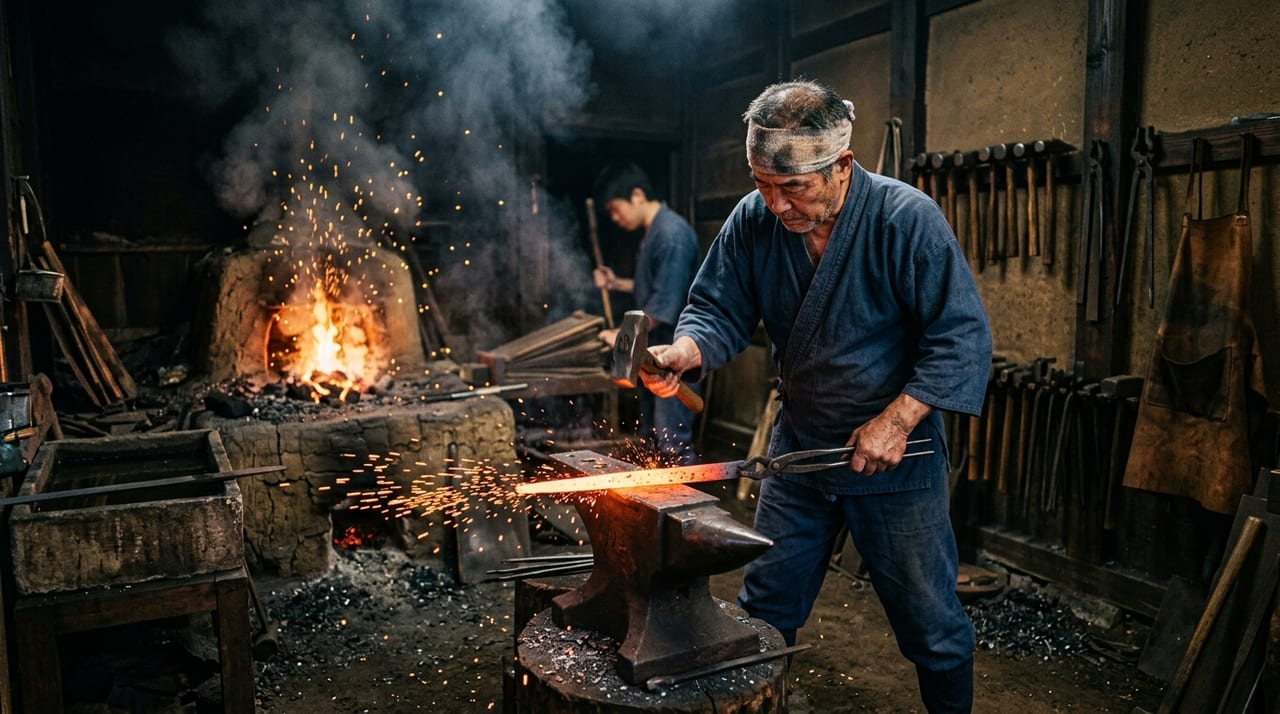
 * Image is for illustrative purposes only.
Echizen Kanemichi
越前兼道
Description
Echizen Kanemichi (越前兼道) was a swordsmith active from the Azuchi-Momoyama period through the early Edo period, and was an important ancestral smith of the Seki lineage who migrated from Minō no Kuni Seki (present-day Seki City, Gifu Prefecture) to Echizen no Kuni (present-day Fukui Prefecture) and established his own school. He is said to be the founder of the Mishina school, and Kanemichi's lineage holds an important position in Japanese sword history.
Kanemichi's blades possess a distinctive style combining the rational techniques of the Mino tradition with the refined sensibility of the Shintō period. The jihada centers on itame, displaying the powerful forging characteristic of Mino smiths, combining the robustness of a practical blade with the beauty of a collector's piece. The hamon displays a typical Mino-school heat-treat pattern in which gunome and notare intermix; the gunome with 'togarigokoro' (pointed tendency) is particularly noted by sword researchers as characteristic of the Seki-Mino lineage. The nioi-kuchi (scent edge) is bright and sharp, with the Mino tradition's fresh clarity suffusing the entire blade.
The historical significance of Echizen Kanemichi lies in transmitting the sword culture of Minō to regions along the Japan Sea coast, including Echizen, Kaga, and Tango. The Kanemichi lineage, which migrated from Seki, maintained the technical essence of the Mino tradition while based in Echizen, contributing to the development of sword culture in various regions. In particular, his grandson Izumi-no-Kami Kanesada achieved great renown throughout the Edo period, with Kanemichi's achievements forming the source of that lineage.
Mei (signatures) such as 'Kanemichi' and 'Echizen-zumi Kanemichi' are confirmed, with multiple extant examples bearing signatures. The sugata (form) shows variation according to forging period, ranging from the imposing saki-zori (forward curve) characteristic of the Momoyama period to the refined chū-kissaki (mid-point tip) uchi-gatana style of early Edo period swords.
Today, works by Echizen Kanemichi designated as Important Cultural Properties or Important Art Objects exist and are housed in institutions such as the Fukui Prefectural Museum and the Japanese Sword Museum. As a pioneer who transmitted the techniques of Minō smiths to the Japan Sea region and as the ancestor who founded the lineage of the great smith Izumi-no-Kami Kanesada, Echizen Kanemichi's name is forever remembered in sword history.
Famous Works
- 刀 銘 越前住兼道(重要刀剣)
- 脇差 銘 兼道(重要美術品)
- 打刀 銘 越前兼道