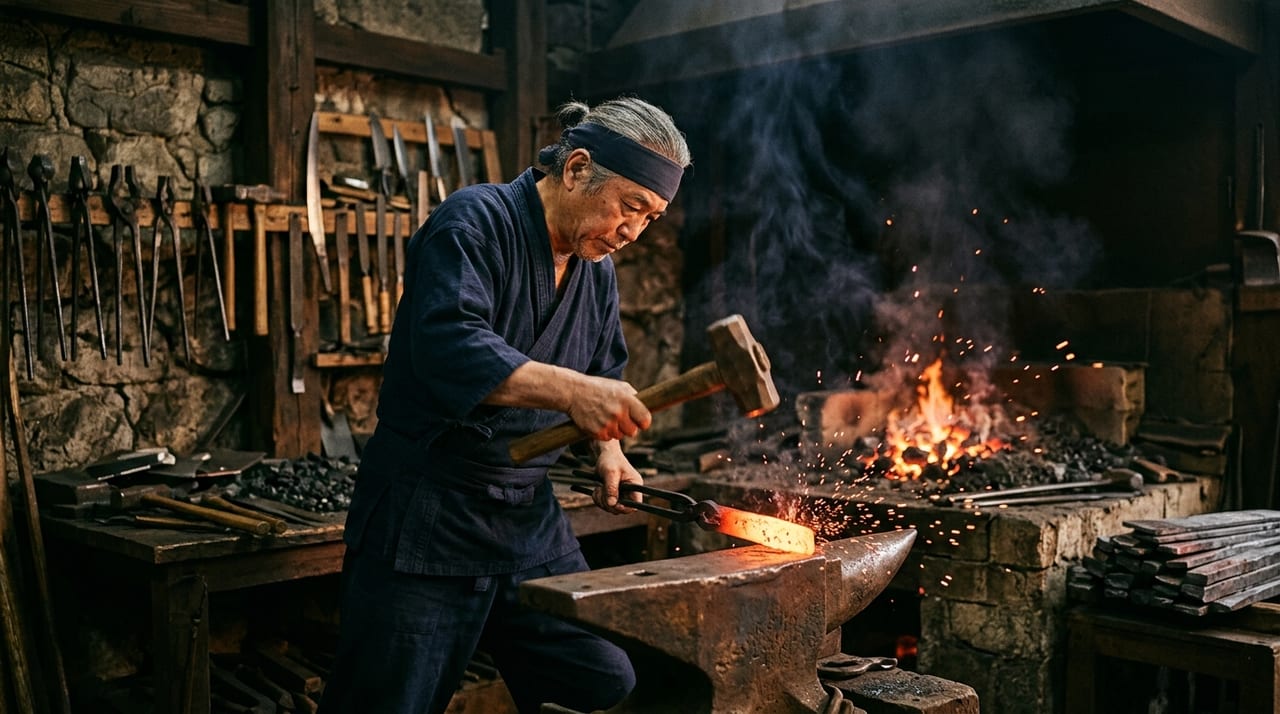
 * Image is for illustrative purposes only.
Bungo Yukihira
豊後行平
Description
Bungo Yukihira is a swordsmith who was active in Bungo Province (present-day Ōita Prefecture) from the late Heian period into the early Kamakura period, and he is a master representative of the Bungo smiths. Many details of his birth and death years and his detailed career remain unknown, yet since ancient times he has been revered as a figure shining brilliantly in the history of swords.
The greatest feature of Yukihira's swords is that, while strongly influenced by the Yamato tradition, they bear a distinctive regional character. The jigane is well packed (yoku tsumi), presenting a fine surface that is dense and glossy with a lustrous, moist quality. The hamon is based on ko-midare, with ko-nie appearing along the nioi-kuchi, sunagashi present, and some examples have a large yaki-otoshi above the machi. The kissaki is ko-kissaki, the koshi-zori is high, and the blade well preserves an elegant form that resembles old works of the late Heian period.
The most famous of Yukihira's works is the signed tachi designated as a National Treasure, "Mei: Bungo no kuni Yukihira saku" (Gō: Kokin Denju no Tachi; held by the Eisei Bunko). It has a blade length of about 80 centimeters and a commanding tachi form, and it is considered a masterpiece that fully displays Yukihira's style. In addition, several signed tachi and katana by Yukihira survive that are designated as Important Cultural Properties or Important Swords. Their inscriptions show an archaic, generous brushwork, and they possess a dignity that is not inferior even when compared with Yamato-den smiths of the same period.
The background to Yukihira's rise as a swordsmith in Bungo is deeply tied to the social upheaval of the latter half of the 12th century. The decline of the Taira regime and the rise of the samurai society under the Minamoto caused weapon demand to surge in various parts of Kyushu as well. Bungo Province was a geopolitical crossroads where the religious authority of Usa Jingū in neighboring Buzen overlapped with the rise of warrior bands, including the Ōtomo clan, and it offered an ideal environment for fine swordsmiths to exercise their skill. Yukihira is said to have answered the demands of his era while striving not merely to make weapons but to give swords spiritual and artistic value.
Yukihira's techniques had a great influence on later Bungo smiths. In the Muromachi period, Bungo smiths formed a major force and became known nationwide as "Bungo-mono," but their source can be unquestionably traced to Yukihira's forging philosophy. It is also said that several outstanding smiths trained under Yukihira.
Today, Yukihira's swords are carefully preserved by the Eisei Bunko, the Tokyo National Museum, Nikkō Futarasan Jinja, as well as by art museums and private collectors in various places. His reputation remains unshaken across the ages. While the Gokaden, the Yamato, Yamashiro, Bizen, Sōshū, and Mino traditions, are renowned as the regional traditions of Japanese swords, Yukihira's presence, which embodied a unique beauty in Bungo comparable to the Gokaden, has become an important reference point that is indispensable for surveying the whole history of Japanese swords.
Famous Works
- Tachi, signed Bungo-no-kuni Yukihira saku (National Treasure, Kokin Denju no Tachi, Eisei Bunko)
- Tachi, signed Bungo-no-kuni Yukihira saku (Important Cultural Property, Tokyo National Museum)
- Tachi, signed Yukihira saku (Important Cultural Property)