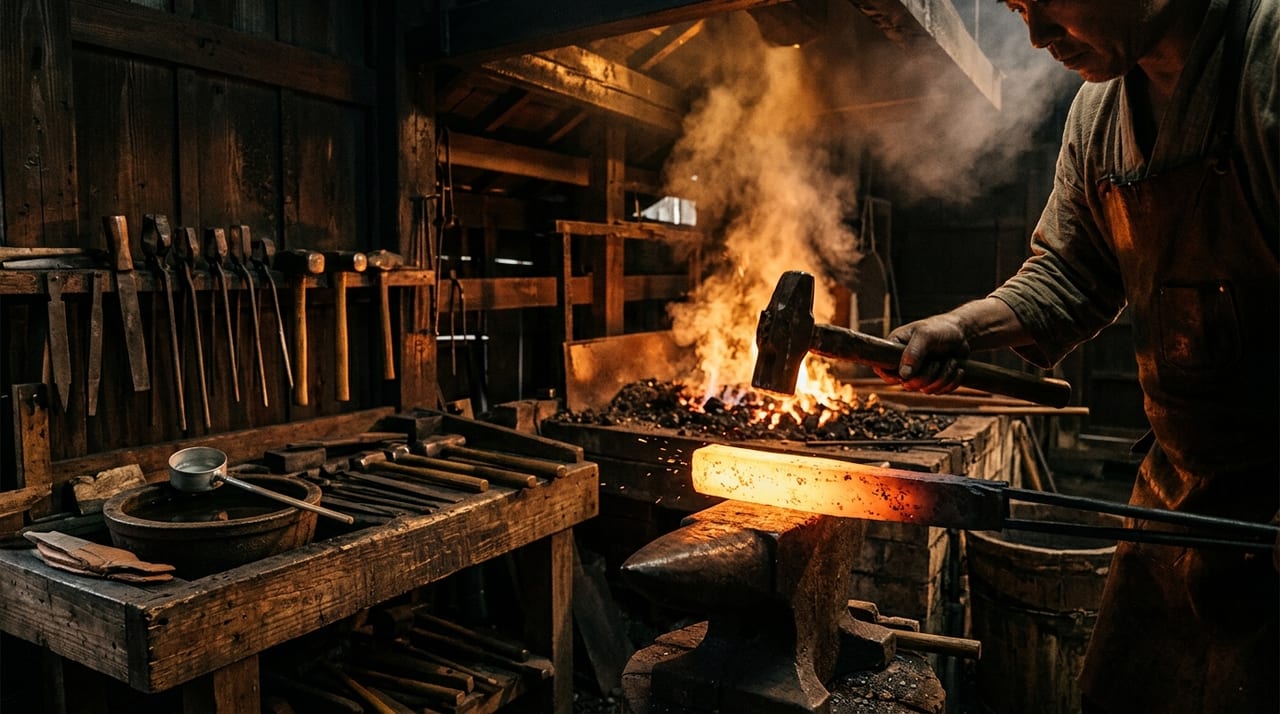
 * Image is for illustrative purposes only.
Awataguchi Kunitomo
粟田口国友
Description
Awataguchi Kunitomo was a swordsmith who was active in Awataguchi in Yamashiro Province (the area around the eastern end of Sanjō-dōri, Higashiyama Ward, Kyoto) from the early to middle Kamakura period. He is known as one of the swordsmiths of the group called the Six Awataguchi Brothers. The Awataguchi school was a group of Kyoto swordsmiths that carried the core of the Yamashiro tradition, and Kunitomo's brothers include Hisakuni, Kuniyasu, Kunikiyo, Arikuni, and Kunitsuna. Among these brothers, Kunitomo is valued as a swordsmith who realized the elegant aesthetic sense of the Yamashiro tradition at a high level, through his refined jigane and dignified hamon.
The greatest feature of Kunitomo's sword-making lies in the elegance and high degree of technical perfection that are the essence of the Yamashiro tradition. The jigane has tightly packed ko-itame and is evenly covered with fine ji-nie throughout, showing the typical form of what is called Awataguchi-hada. This Awataguchi-hada is a texture that later sword researchers refer to as the ideal for jigane expression in the Yamashiro tradition, and Kunitomo's works are positioned as one of its models. The hamon is mainly ko-midare and ko-chōji, with a gentle nioiguchi spreading evenly across the whole. It embodies the aesthetic sense of aristocratic culture from the late Heian period, which valued dignity and calm over roughness.
In early Kamakura-period Kyoto, the center of the shogunate was gradually shifting to Kamakura, but high-level artistic activity continued as the center of court culture. Against the background of this aristocratic Kyoto culture, the swordsmiths of Awataguchi, led by Kunitomo, are positioned as pioneers who clearly set out the direction of raising swords from "weapons" to "works of art." In particular, the reason Yoshimitsu, a later descendant of the school, is evaluated as the supreme master representing the Yamashiro tradition among the Gokaden lies in the technical and artistic foundation of the Awataguchi school that Kunitomo and his brothers built.
Tachi bearing signatures survive. The taihai is centered on the slender, elegant tachi form with a deep koshizori typical of the early Kamakura period, and some retain strongly the ko-kissaki style of the Heian period, embodying the transitional beauty of the Yamashiro tradition.
As one of the Six Awataguchi Brothers who contributed to the establishment of the Yamashiro tradition, Kunitomo occupies an important page in the history of how Japanese sword aesthetic standards were formed.
Famous Works
- Tachi signed Kunitomo