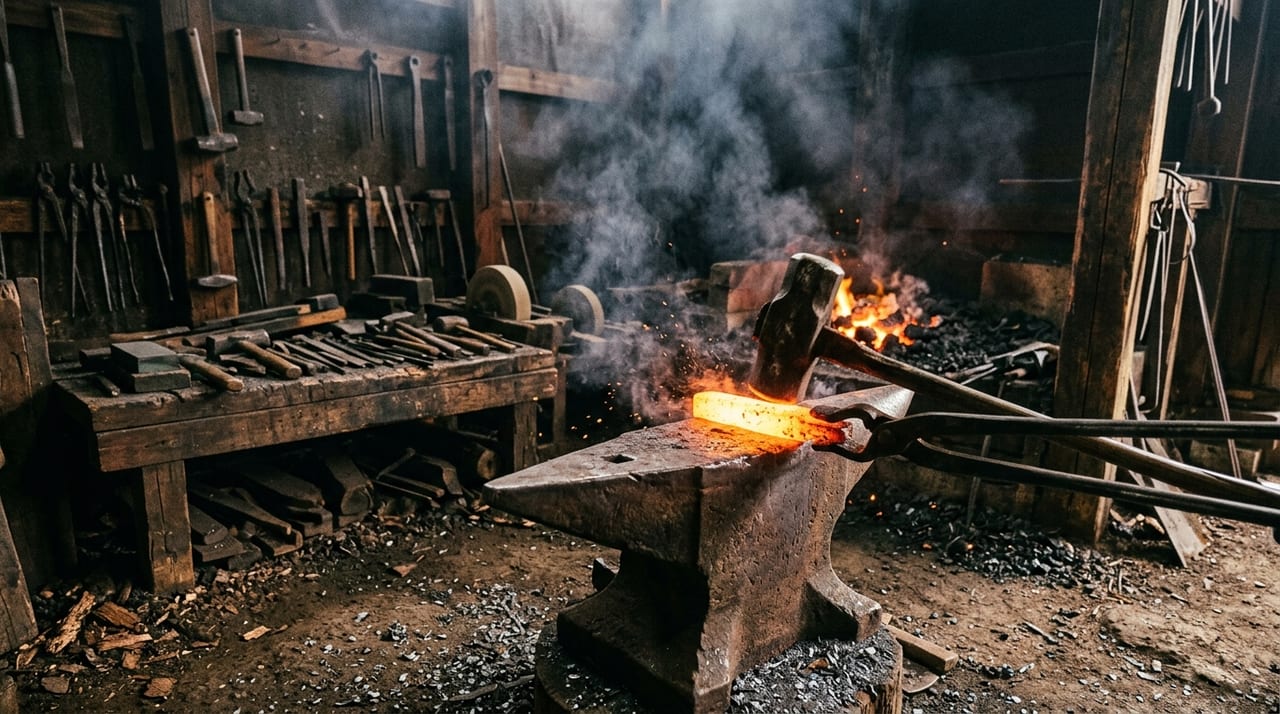
 * Image is for illustrative purposes only.
Amakuni
天国
Description
Amakuni—Progenitor of the Nihontō, Legendary Swordsmith
Amakuni is a legendary swordsmith said to have lived around the Taihō era (701–704) or in the Heian period, and is recorded in many traditions as the oldest swordsmith in Japan. Said to have been a smith of Yamato Province (present-day Nara Prefecture), Amakuni is portrayed in legend as the craftsman who first forged the curved sword (wantō), the shape of today's nihontō (Japanese sword), in place of the earlier chokutō (straight sword). Scholars hold various views on whether this legend is true, but there is no doubt that the name Amakuni is deeply rooted in nihontō culture as a symbol of the origin of the nihontō.
The most famous legend about Amakuni goes as follows. Amakuni, a swordsmith who served the emperor, was distressed to see that many of the swords of soldiers returning from war had broken. Amakuni shut himself in the forge with his son and prayed to the gods for seven days and seven nights. Then, from carefully selected iron sand, he produced steel and forged a new form of sword, single-edged and curved. This sword is said to be the prototype of the nihontō, and Amakuni came to be revered in later ages as the father of the nihontō.
Historical Background of the Legend—Sword Technology in Ancient Japan
The Asuka and Nara periods, when the legend of Amakuni took shape, were an age in which Japanese sword technology was undergoing a major turning point. Until then, the mainstream in Japan had been the chokutō (straight sword), transmitted from China and the Korean Peninsula, that is, straight swords without curvature. These were called tachi (written with two different sets of characters), among other names, and were widely used from the Kofun period through the Nara period.
However, from the 8th to the 9th century, Japanese swords gradually began to acquire curvature, and it is held that by around the 10th century the curved sword (wantō), which can be called the prototype of today's nihontō, had been established. This technical change is believed to have been driven by the combined effect of the development of mounted combat in Japan, the independent development of steel-refining technology, and the growth of an aesthetic sensibility unique to Japan. The legend of Amakuni can be understood as a mythic expression that recounts the origin of this historical technical transformation as the invention of a single genius craftsman.
Swords Traditionally Attributed to Amakuni
Swords traditionally attributed to Amakuni have been passed down at shrines and temples throughout Japan, and some have been carefully preserved to the present day. However, it is extremely rare for actual works from the Nara period to survive intact to the present day, and for many of the swords traditionally called "Amakuni works," it is difficult to confirm the authenticity of the attributed maker and date.
One of the most famous swords traditionally attributed to Amakuni is the "Kogarasumaru," which has been passed down as part of the Imperial Household collection (gyobutsu). The Kogarasumaru is a tachi said to have been a treasured possession of the Taira clan. It retains the archaic kissaki-moroha-zukuri style, a double-edged point, and has long been traditionally attributed to Amakuni. Swords like these, traditionally attributed to Amakuni, have significant meaning as cultural treasures that embody reverence for the origins of the nihontō and longing for antiquity, even if their actual makers and dates are unknown.
The Significance of Amakuni in Myth and nihontō Culture
The story of Amakuni is a manifestation of the mythic imagination underlying nihontō culture, in which the nihontō is spoken of as something with sacred meaning beyond that of a mere weapon. In Japan, since ancient times, sword-making has been closely tied to sacred rites (shinji), and smiths have been regarded as those who handle sacred fire and metal as proxies of the gods. Faith in the smiths' guardian deities, such as Inari and Kanayago-gami, has been inherited by swordsmiths today, and the legend of Amakuni resonates most deeply on this religious and mythic plane.
The legend of Amakuni also functions as a tale that personifies the technical essence of the nihontō, its transformation from a simple straight blade to a curved blade with sori. By telling of sori, the most essential feature of the nihontō, as a divinely inspired invention of a single genius craftsman, the inevitability and sanctity of the nihontō's distinctive form are culturally secured.
The Significance of Amakuni at Touken-za
At Touken-za, Amakuni is presented as the spiritual and cultural origin of the nihontō. Although he is a legendary figure whose historical existence is difficult to prove, the symbolic role the name Amakuni plays in nihontō culture is extremely important, and the aim is to convey the mythic and spiritual dimensions of the nihontō to modern enthusiasts through this legend. The cultural weight carried by a single nihontō is supported by the layering of more than a thousand years of history and myth stretching back to Amakuni, and understanding that depth is one of the richest entryways into appreciating the nihontō.
Famous Works
- Tachi “Kogarasu-maru” (Imperial Collection, attributed to Amakuni)
- Kokin Denju Yamato-no-kuni Amakuni gyo-tachi (Imperial Collection)