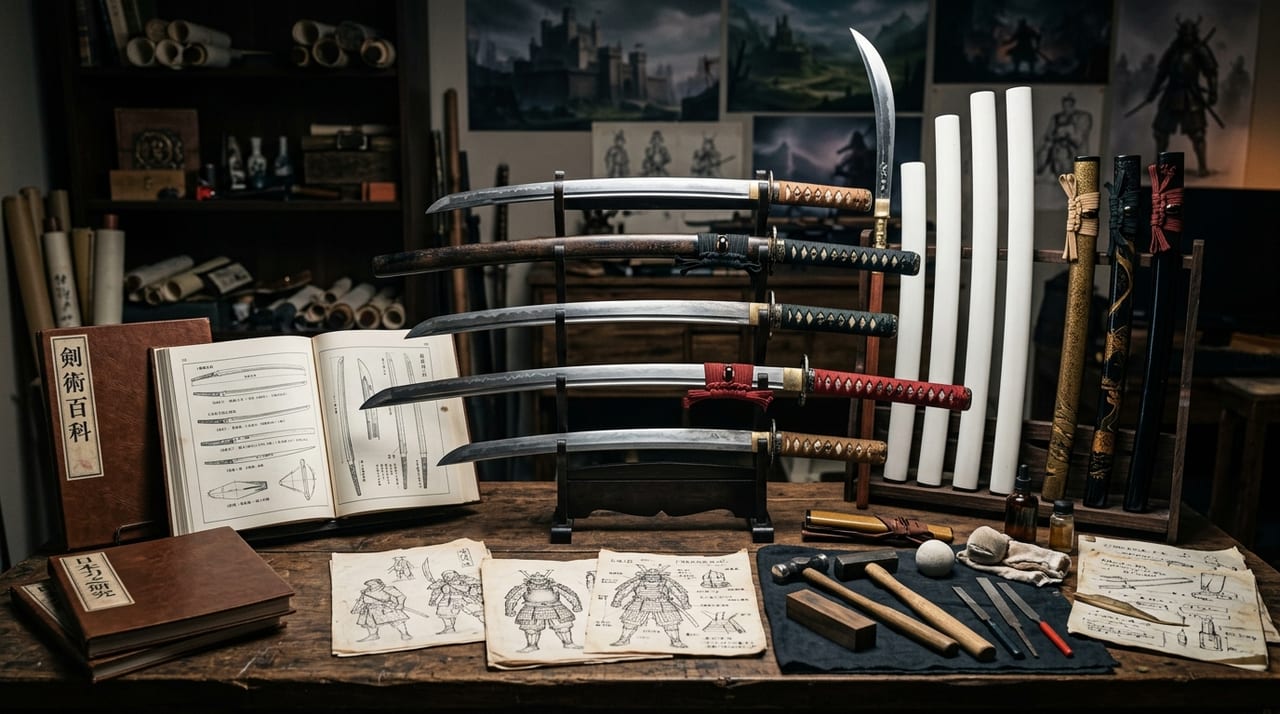
 * Image is for illustrative purposes only.
Way of the Samurai
侍道
A video game series developed and published by Acquire (2002–present). An action RPG in which players take on the role of a rōnin, choosing between honor, betrayal, and duels among competing factions to branch the narrative. Throughout the series, sword collection, enhancement, repair, and customization serve as core mechanics; the series is highly regarded by Japanese sword enthusiasts as a rare game that deepens knowledge of katana handling (white scabbard, koshirae, file marks, nakago).
Description
Way of the Samurai—The Only Rōnin Action-RPG Placing Sword Collection, Enhancement, and Repair at Its Core
The Way of the Samurai series is an action-RPG series developed by Acquire (with the first PS2 title released in 2002, followed by four sequels). In each game, players arrive as a "penniless rōnin" washed ashore in a particular location, navigating between multiple warring factions (Imperial forces, Bakufu, local clans, peasant rebellions, etc.). The narrative branches significantly based on choices about which factions to pledge loyalty to or betray. What remains consistent across all titles is the core mechanic of swords being fundamental to the game; the series offers unparalleled depth regarding sword usage, management, and meaning compared to other games.
### Sword Collection and Diverse Blade Types
A signature mechanic of the Way of the Samurai series is the vast collection of swords available to acquire in-game. Each title features dozens to over 100 swords, including uchigata (general-purpose swords), wakizashi, tachi, ryōtedaitachi (two-handed great swords), naginata, and special blade types (shikomizue hidden swords, shinobi blades, etc.). Each sword differs in sugata (blade profile), sori (curvature), hacholong (edge length), and weight, directly affecting combat style, attack speed, and reach.
Many sword names draw from actual famous blades and renowned swordsmith names, such as Kikuichimonji, Nagamitsu, Dōjikiri Yasutsuna, and Mikazuki Munechika. Through this, players naturally learn about renowned blade names, swordsmith names, and the diversity of sword morphology.
### Sword Degradation, Repair, and Enhancement Systems
What fundamentally distinguishes the Way of the Samurai series from other games is its sword degradation, wear, and repair system. Repeated combat reduces a blade's durability, causing chips and breakage. Blades with reduced durability suffer performance penalties and eventually break, becoming unusable. To prevent this, players must either request repair and polishing from a tōkenshi (swordsmith) or store the blade in a white scabbard.
This cycle of degradation, repair, and storage recreates the essence of real-world sword maintenance as a game mechanic. Actual katana require periodic polishing (typically every 2–5 years) and oil-based rust prevention, and develop chips, rust, and damage from use (combat). By incorporating this practical cycle as a core game mechanic, Way of the Samurai allows players to experience the fundamental cultural value that sword ownership requires both love and effort.
### The Distinction Between Koshirae and White Scabbard
In the Way of the Samurai series, different koshirae (sword fittings and mountings) can be applied to the same blade. With an identical blade body, players can select from various fittings—samurai-style black-lacquer scabbards, red-lacquer scabbards, gold-decorated koshirae—which change appearance and some stat values. This concept of separating blade from koshirae accurately embodies the essence of katana: the blade (the soul) and the fittings (scabbard, handle, tsuba) are distinct entities, and the same blade can be mounted with diverse koshirae.
The inclusion of the white scabbard (shiraaya) concept is equally important. A white scabbard is made of plain wood and exists solely to protect the blade in storage, without decorative elements. Way of the Samurai incorporates this real-world distinction between combat-use koshirae and storage-use white scabbard into its inventory system.
### The Rōnin and the "Ownership" of Swords
The protagonist setup of Way of the Samurai—a penniless rōnin—raises fundamental questions about sword culture. A rōnin is a masterless warrior without a liege lord and thus possesses no tamawarikatatana (sword granted by a lord). The protagonist of Way of the Samurai possesses only swords seized in battle, found, or purchased—these swords without a lord reflect inversely upon the complex ownership dynamics of sword culture, where a samurai's blade is simultaneously a personal possession and a symbol of bonds with one's lord.
The narrative branching based on whether players pledge loyalty to a faction or betray all sides functions as a mechanism for players to experience the fundamental samurai question: "Whose sword shall I become?" as a game mechanic.
### Sword Knowledge in Way of the Samurai 4 (2011)
In the series' final entry, Way of the Samurai 4 (PS3, 2011), the concepts of nakago (tang), yasurieme (file marks), and mei (signature) appear, adding a subsystem for blade authentication and appraisal. This represents an attempt to have players experience the actual process of katana authentication—verifying the tang, file marks, and signature—as in-game puzzles. The game was highly praised by sword enthusiasts as a title that allows players to directly experience sword appraisal.
### Perspective for Sword Collectors
The Way of the Samurai series is a rare medium through which players naturally acquire practical knowledge of swords. The impact of blade type, edge length, and weight differences on combat; the importance of degradation, repair, and polishing; the distinction between koshirae and white scabbard; the concepts of nakago and mei—these are all directly applicable to real-world sword collecting and are presented in an accessible game format. Many players report that playing Way of the Samurai sparked their interest in katana and inspired them to seek out authentic blades. The series is regarded as an effective medium for introducing newcomers to sword culture.
Real Swords Featured
Kikuichimonji
Nagamitsu
Dōjikiri Yasutsuna
Mikazuki Munechika
See authentic Japanese swords
See authentic Japanese swordsThis page is intended to introduce Japanese sword culture and is not affiliated with any of the works mentioned.