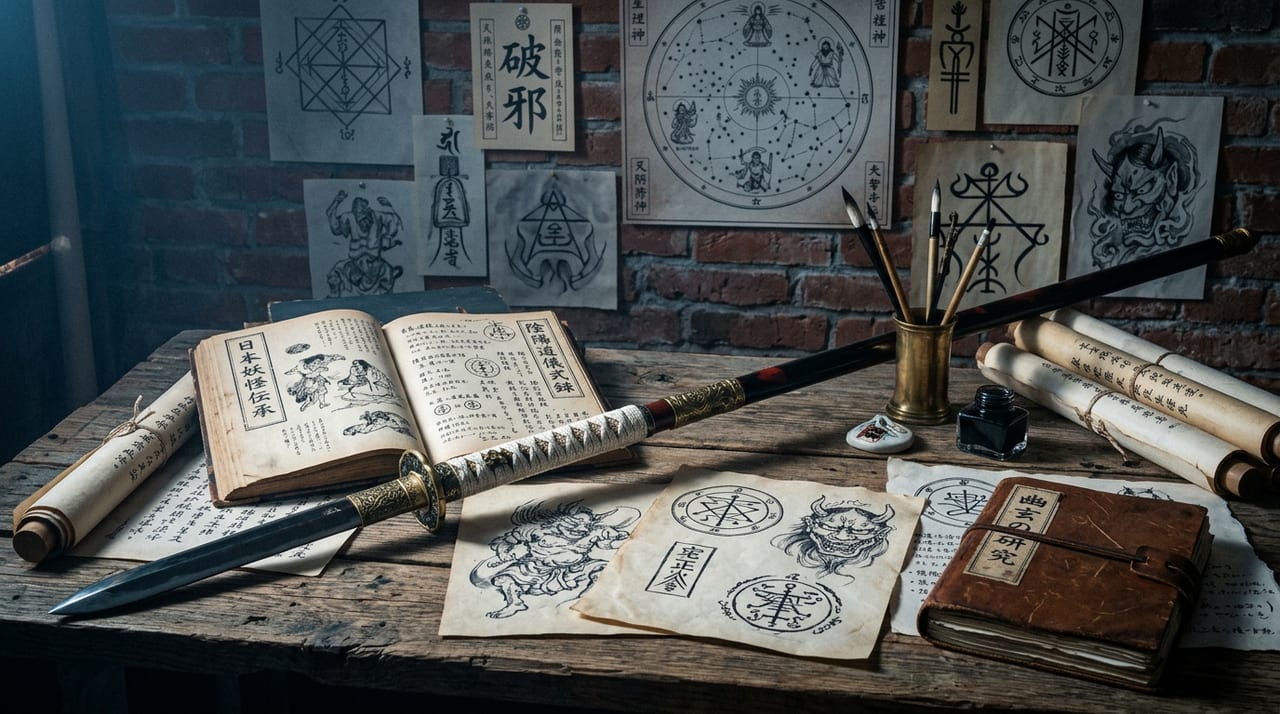
 * Image is for illustrative purposes only.
Ushio and Tora
うしおととら
A shonen manga by Fujita Kazuhiro, serialized in Weekly Shonen Sunday (Shogakukan, 1990–1996). The story follows Aotsuki Ushio, who draws the 'Beast Spear' — a sacred weapon that has sealed the demon Tora for 500 years — and teams up with Tora to face the great demon Hakumen no Mono. The Beast Spear, a spiritually charged ancient weapon, is central to the narrative, set within a Japanese horror-fantasy world grounded in yokai lore, onmyodo, and Shinto cosmology. Adapted into an anime series in 2015–2016.
Description
Ushio and Tora — The Beast Spear and Japanese Spiritual Weapon Tradition and Yokai Cosmology
Ushio and Tora (1990–1996, by Fujita Kazuhiro, serialized in Shogakukan's Weekly Shonen Sunday) is valued as a work that masterfully fused three themes in the history of shonen manga: "the joint struggle of yokai and human," "a spiritual weapon from the ultra-distant past," and "Japan's indigenous spiritual-monster cosmology." In 2015–2016 it was adapted as a television anime produced by MAPPA and Studio VOLN, and gained a new generation of viewers roughly twenty years after the original manga concluded.
### The Beast Spear — Japanese Spiritual Weapon Tradition Parallel to the Sword
The central weapon of this work, the Beast Spear (Kemono no Yari), is established as "a spear with spiritual power, forged in the ultra-distant past." In appearance it is a spear with a grip bundled from white beast fur and a sharp, arrowhead-like tip, imbued with the special spiritual power to "exorcise and slay yokai." The user undergoes a transformation in which they "absorb the form and power of the yokai," and while remaining human are able to exercise yokai power—a setting that inherits the theme of "the mutual transformation of weapon and wielder" found in Japanese spiritual weapon tradition.
In Japanese weapon culture, alongside the sword, the spear (yari) occupies an extremely important position as the weapon of the samurai. The spear of the Sengoku period—exemplified by "Spear Kanbei (Watanabe Kanbei)," "the long-spear tactics of Asakura Soteki," and "Honda Tadakatsu's Tonbokiri (Dragonfly Cutter)"—held a leading role on the battlefield alongside the Japanese sword. The Beast Spear can be situated within the context of Japanese spiritual weapon tradition as a transposition of "the spiritual and martial authority possessed by the sword" into the form of a spear.
In particular, the Tonbokiri—Honda Tadakatsu's celebrated spear, discussed in sword history alongside famous swords as a "renowned spear"—shares with the Beast Spear a legendary structure of "superhuman cutting power (the anecdote that a dragonfly that flew and struck the tip was cut cleanly in two)," and resonates with the Beast Spear's "spiritual cutting power that even exorcises yokai."
### The White-Faced One — The Cosmology of Onmyodo and the Great Yokai War
The final antagonist of this work, the White-Faced One (Hakumen no Mono), is established as a great yokai rooted in Japanese yokai tradition and the cosmological framework of onmyodo (the Way of Yin and Yang). The White-Faced One has the setting that it "crossed from China to Japan thousands of years ago and became deeply involved in the history of Japanese yokai and humans." Its appearance, with a "white face," fuses the tradition of the fox yokai—the white fox (byakko)—with the symbolic significance of "white" in onmyodo (white simultaneously symbolizes purity and death).
The cosmological antagonist of this setting also connects to the spiritual role of the Japanese sword—"the sword that exorcises evil (the sword as shinki/goshintai, a divine repository)"—in cutting through spiritual power (yokai energy, evil spirit). The Beast Spear functions as a spiritual weapon that exorcises yokai according to the same cultural grammar as the sacred sword (shinken) tradition of Shintoism—the Kusanagi no Tsurugi of Amaterasu and the swords of Okuninushi—which function as "divine implements that dispel evil."
### The Dramatic Craft of Fujita Kazuhiro — "The Violence of Emotion" and the Aesthetics of the Blade
Fujita Kazuhiro is known after "Ushio and Tora" for works such as "Karakuri Circus" and "Moonlight Act," and his dramatic characteristic is "overwhelming emotional impact" and "the death and rebirth of characters."
The depiction of the blade (Beast Spear) in Ushio and Tora is particularly noteworthy in that it indissolubly combines "the physical power that the weapon possesses" with "the emotional power of the one who wields it." The setting in which the spiritual power of the Beast Spear is amplified by "the wielder's anger, sorrow, and will to protect" can be read as a contemporary manga expression of "shinpo (mind method)" in Japanese martial arts and sword technique—the philosophy that "the state of the spirit determines the power of the weapon."
This bears a deep affinity with the spiritual dimension of Japanese sword culture: "zanshin (remaining spirit) in iaido—the tension that lingers in the heart even after the blade is sheathed" and "kenzo ichinyo (the philosophy that sword and Zen are inseparable)."
### The 2015–2016 Anime Adaptation — Connection to the Modern Sword Boom
The television anime version of Ushio and Tora (2015–2016) coincided precisely with the period when the "Touken Ranbu" boom reached its peak, and was broadcast in a social context in which interest in Japanese "spiritual weapon culture" was heightened. The "indigenous Japanese yokai, onmyodo, and Shinto cosmology" of the original manga was reimagined in the anime version as contemporary visual beauty, and functioned as content that awakened interest in Japanese spiritual weapon tradition—the "culture of sacred and spiritual implements, including the sword"—and their transmission.
### A Collector's Perspective
Ushio and Tora is not a work that takes the sword (Japanese sword) as its direct subject, but it provides an important reference point for understanding the cultural context of Japanese "weapon spirituality." The understanding that in Japan the sword has been treated not merely as a weapon but as a "sacred implement imbued with spiritual power"—the context in which famous swords such as the "Kusanagi no Tsurugi," the "Tonbokiri," and the "Higekiri and Hizamaru" have been transmitted as "weapons with spiritual tradition"—deepens further through the narrative function of the "Beast Spear" in Ushio and Tora. Readers with an interest in sword collecting are able to position this work as a gateway for exploring the legends of famous swords from the perspective of "the Japanese sword as a spiritual weapon."
Real Swords Featured
Tonbokiri (famous spear of Honda Tadakatsu, one of the Three Great Spears, Shizuoka Prefectural Museum of Art et al.)
Kusanagi no Tsurugi (Atsuta Shrine, one of the Three Imperial Treasures)
Higekiri (Genji clan heirloom tachi, Kitano Tenmangu Shrine)
Hizamaru (Genji clan heirloom tachi, Daikakuji Temple)
See authentic Japanese swords
See authentic Japanese swordsThis page is intended to introduce Japanese sword culture and is not affiliated with any of the works mentioned.