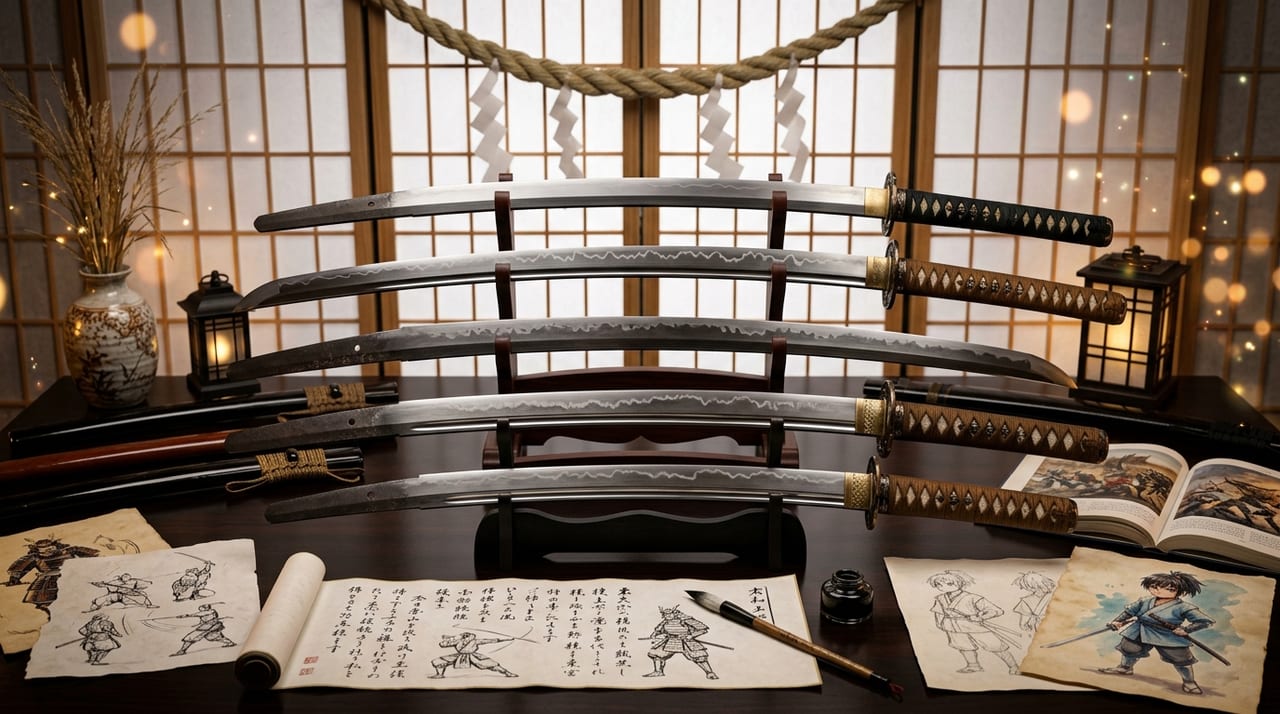
 * Image is for illustrative purposes only.
Toji no Miko (Katana Maidens)
刀使ノ巫女
A TV anime produced by Studio 5Group, aired in 2018 (24 episodes). High school girls called 'Toji' (Sword Users) wield special Japanese swords called 'Okatana' to fight monsters known as 'Aratama.' The setting of the Okatana — based on real historical sword-making traditions such as Yamashiro-den, Soshu-den, and Bizen-den — the different swordsmanship styles of each school, and the relationship between a sword's 'kaku' (rank/quality) and the aptitude of its bearer form the narrative's core. An important example of modern anime that incorporated the traditional classification of the 'Gokaden' (five traditions of Japanese sword-making) into character settings, functioning as educational content for sword culture. Along with Touken Ranbu, the series generated major attention in 2018 as sword-themed content.
Description
Toji no Miko — A "Sword Education Content" That Embodied the Five Traditions and Real Swordsmith Names in Modern Anime
Toji no Miko (2018, Studio 5-kumi) incorporated into its character and world-view settings one of the most important traditional classifications of Japanese sword culture: the "Gokaden" (Five Traditions) — the five major regional traditions of Japanese sword-making: Yamashiro-den, Yamato-den, Bizen-den, Soshu-den, and Mino-den. The setting in which high school girls called "Toji" fight against monsters called "Aratama" using special Japanese swords called "Mikami" functioned as a "sword education content" — delivering historical and technical knowledge of the Japanese sword as entertainment. The significance of this work for Japanese sword culture lies in the fact that it sincerely incorporated actual Japanese sword traditional classifications, swordsmith names, and sword-school martial styles into its anime settings, functioning as an "entry point to Japanese sword culture" for younger generations.
### The Five Traditions (Gokaden) — Settings Based on Sword-Making Heritage and Each Character
The most important sword setting in Toji no Miko is "The Five Traditions of the Mikami." The Five Traditions of Japanese sword-making are five regional traditions formed during the Kamakura to Muromachi periods, with each region possessing its own distinctive forging techniques, temper patterns (hamon), and sword shapes. Yamashiro-den (centered in Kyoto) — produced master smiths such as Sanjō Munechika and Awataguchi Yoshimitsu. Characterized by dignified slender sword shapes and flowing hamon patterns. Yamato-den (centered in Nara) — the oldest tradition. Five schools: Senjuin, Taima, Shikkake, Tegai, and Hosho. Characterized by concise and practical workmanship. Bizen-den (centered in Okayama, formerly Bizen Province) — the largest tradition. Produced smiths such as Osafune, Ichimonji, and Norimune. Characterized by bold workmanship with distinctive choji (clove-shaped) hamon patterns. Soshu-den (centered in Kanagawa, formerly Sagami Province, Kamakura) — produced master smiths such as Masamune and Sadamune. The defining characteristic of Soshu-den is the strong "nie" (crystalline sparkle) in the hamon and wild, turbulent osamidare (large-scale turbulent) hamon patterns. Mino-den (centered in Gifu, formerly Mino Province) — a practical tradition. The production site of mass-produced practical swords during the Sengoku period by the Seki smiths. Toji no Miko incorporated these five traditions as the characteristics of the "Toji" and their "Mikami," mapping each character's sword-fighting style and combat characteristics to the features of the corresponding tradition.
### The Mikami Settings — Adoption of Real Swordsmith Names
A notable aspect of the Mikami settings in Toji no Miko is the adoption of actual historical swordsmith names and sword names as the names of the Mikami. The protagonist Etou Kanami's Mikami "Chidori" (Thousand Birds). Otome Jujō Hiyori's Mikami "Kogarasumaru" (Little Raven Circle) — established as a name derived from the famous tachi "Kogarasumaru" from the Heian period. These Mikami names are not purely fictional creations but are based on actual Japanese swords and legendary names, functioning as "reference points" through which viewers watching the anime can reach the actual history of Japanese swords.
### The Sword-Fighting Style of Toji — Correspondence with the Actual Technical Theories of Each School
Toji no Miko maps each "Toji's" sword-fighting style to the five regional traditions of the Five Traditions, with a design where "differences in sword-school styles manifest as differences in character combat styles." Soshu-tradition sword-fighting — the characteristic "nie hamon" of Soshu swords (the wildness of the hamon line) is embodied in the "powerful and wild sword-fighting" of Soshu-tradition characters. Bizen-tradition sword-fighting — the characteristic "choji hamon" of Bizen swords (smooth, wave-shaped hamon lines) is embodied in the "flowing sword-fighting" of Bizen-tradition characters. Yamashiro-tradition sword-fighting — the characteristic "dignified, slender sword shape" of Yamashiro swords is embodied in the "refined sword-fighting" of Yamashiro-tradition characters. This "correspondence between sword characteristics and character sword-fighting styles" is excellent design as sword culture education — allowing audiences to experience the traditional Five Traditions classification within an entertainment context.
### "Aratama" and Japanese Swords — A Shinto Perspective on Blades
At the core of Toji no Miko's world-view is the concept of "Aratama" (Rough Spirit). Aratama refers to the "rough, violent aspect of divine spirits" in Japanese Shinto, and in this work it is materialized as "monsters." The prefix "mi" (御) in "Mikami" (Sacred Sword) is an honorific prefix indicating sacredness, and the sword is positioned as a "sacred weapon." This setting embodies the "Shinto-religious dimension" of the Japanese sword — the fact that swords are not merely weapons, but are frequently enshrined as "goshingtai" (divine spirit vessels) in Shinto shrines, making them sacred presences. The "spiritual, Shinto-religious dimension" of the Japanese sword is an important axis for sword collectors in understanding Japanese swords not as mere art objects or weapons, but as "spiritual symbols of Japanese culture."
### Comparison with Touken Ranbu — The 2018 "Sword Content" Boom
Toji no Miko was broadcast in 2018, continuing the "Touken Joshi" (Sword Girls) boom sparked by "Touken Ranbu" (from 2015). Where Touken Ranbu was content in which "sword girls admired male characters personifying swords," Toji no Miko adopted an active setting of "women fighting while wielding swords." This contrast embodies an important aspect of sword culture — the relationship between swords and women. Historically, there existed a tradition of female warriors in Japan (users of the naginata, women who carried kaiken personal-defense blades), and the setting in Toji no Miko of "women wielding Mikami" is a modern reinterpretation of this tradition.
### A Perspective for Sword Collectors
Toji no Miko is an important entry-level work for sword collectors and enthusiasts as the most accessible anime for learning the traditional Five Traditions classification of Japanese swords. By experiencing the characteristics of each tradition — Yamashiro-den, Yamato-den, Bizen-den, Soshu-den, and Mino-den — their hamon patterns, sword shapes, production regions, and historical backgrounds — as "character personalities," abstract sword classifications are retained in memory as concrete images. Through the adoption of actual swordsmith names and legendary sword names (Chidori, Kogarasumaru, etc.), access paths from the anime to actual sword history are designed, making clear the intent of this work as "sword-fan cultivation content."
Real Swords Featured
Tachi (Long Sword)
Naginata (Polearm)
Kaiken (Personal-Defense Dagger)
See authentic Japanese swords
See authentic Japanese swordsThis page is intended to introduce Japanese sword culture and is not affiliated with any of the works mentioned.