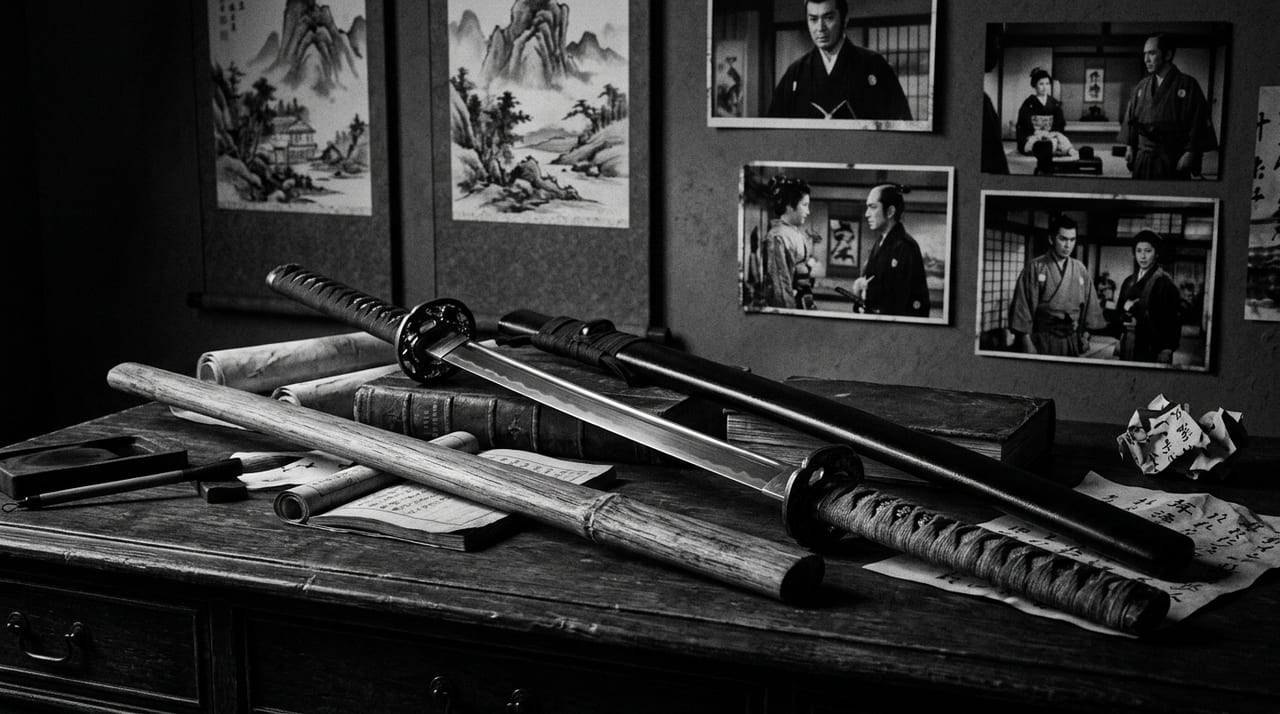
 * Image is for illustrative purposes only.
Thunderbolt Fantasy: Sword Seekers
サンダーボルトファンタジー 東離劍遊紀
A collaborative Taiwanese glove-puppet theater production by Gen Urobuchi (Nitroplus) and PILI International Multimedia, airing as a TV series from 2016. Set in the world of Tōri Ken Yūki, the story revolves around the pursuit of legendary sacred swords (shinki). Led by the swordsman Shang Bu Huan, a cast of distinctive blade-wielders perform intense sword fights through exquisitely crafted puppetry, captivating sword enthusiasts with a unique fusion of Japanese and Taiwanese sword culture and the wuxia worldview.
Description
Thunderbolt Fantasy: Sword Seekers — A Miraculous Fusion of Taiwanese Puppet Theater and Japanese Sword Culture
Thunderbolt Fantasy: Sword Seekers (2016–, by Gen Urobuchi × PILI) is a distinctive collaboration in which screenwriter Gen Urobuchi — known for Puella Magi Madoka Magica and Fate/Zero — provided the world-building and script for a work that elevates traditional Taiwanese glove-puppet theater (potehi) through modern cinematic technology. Highly acclaimed in Japan, Taiwan, and the Chinese-speaking world, it has produced three TV series and a theatrical film.
### Sacred Blades and Spiritual Power — Resonance Between the Wuxia World and Japanese Sword Culture
The narrative core of the work is a fierce competition for a sacred sword called the Heavenly Punishment Sword (Tenkei-ken). The Heavenly Punishment Sword is a blade of extraordinary power, embodying the fundamental theme of sword culture: the brilliance and might of a famous blade.
This duality of "sacred sword and cursed sword" resonates deeply with the tradition of "cursed sword legends" (yōtō densetsu) in Japanese sword culture. Muramasa is known as a cursed sword said to have brought calamity to the Tokugawa clan; Dojigiri Yasutsuna is held to possess spiritual power as the sword that slew the demon Shuten-doji at Ōeyama. The theme of "the spiritual power and curse harbored by a sword" belongs to the same cultural context as Japan's yōtō and reitō (sacred sword) traditions.
### Shang Bu Huan and the Aesthetics of Swordsmanship — The "Movement of the Blade" in Puppet Theater
The protagonist Shang Bu Huan is established as an exceptional swordsman (alias: Blade Without Edge) wielding a wooden sword. Through the exquisite puppet technique of PILI, Shang Bu Huan's sword art is visualized as "fluid rotations, swift draws, and wide arc-like cuts" — movements that can be understood as a fusion of Chinese martial sword arts (taijijian, wushu jian) and the principles of Japanese kendo and iaido: "large cuts using the whole body" and "the beauty of the sword tip's trajectory."
Potehi puppets are approximately 30–40 cm precision figures, and their depiction of "the hand holding the sword," "the rotation of the waist," and "the sweep of the sleeve" constitutes a highly artistic miniaturization and stylization of actual swordplay movements.
### Gen Urobuchi's Screenplay — The Narrative Design of "Sword and Stratagem"
What Urobuchi brought to the work is a dark fantasy worldview and a narrative structure of plots and betrayals. The swordsmen in the story function not merely as warriors of physical force but as strategists, each with complex motives, secrets, and histories.
This inseparability of "sword and stratagem" connects deeply with the concept of heiho (military strategy) in Japanese sword culture — the idea that swordsmanship is not merely the technique of cutting, but a comprehensive "Way of the Warrior" encompassing strategy, psychology, and cunning. Just as Miyamoto Musashi's Go Rin no Sho was written as "a book of strategy transcending swordsmanship," the swordsmen of this work are portrayed as "strategists bearing swords," embodying the theme of the unity of sword and thought.
### The Meeting Point of Taiwanese Potehi and Japanese Sword Culture
In the tradition of Taiwanese glove-puppet theater, the sword (jian) occupies a position as one of the most important weapons. While the Chinese sword (double-edged, straight blade) differs in form from the Japanese katana (single-edged, curved), the cultural meanings — "a weapon harboring spiritual power," "a symbol of the martial spirit," "the tradition of mythological and historical famous swords" — share a high degree of commonality with Japanese sword culture.
That this work was born from the collaboration between Nitroplus (also co-developer of Touken Ranbu) and Taiwanese potehi holds symbolic significance from the perspective of "the mutual exchange of East Asian sword cultures." Japanese and Taiwanese/Chinese sword cultures have fused as contemporary pop culture, producing content that connects sword enthusiasts across Japan, Taiwan, and the Chinese-speaking world.
### A Collector's Perspective
Thunderbolt Fantasy provides valuable reference points for sword collectors as a work in which "the aesthetic and spiritual dimensions of swords" can be experienced through wuxia fantasy. The themes of "the spiritual power and curse of the famous sword," "the spiritual bond between sword and swordsman," and "the stratagem and history surrounding the sword" resonate deeply with Japan's cursed sword and famous sword traditions, functioning as a gateway to a panoramic view of East Asian sword culture.
Real Swords Featured
Muramasa (famed cursed sword by the Kuwana smith Muramasa of Mie Prefecture, the blade shunned by Tokugawa Ieyasu)
Dojigiri Yasutsuna (National Treasure, Tokyo National Museum, Heian period — the sword with which Minamoto no Yorimitsu slew the demon Shuten-doji at Ōeyama)
Onigiri Yasutsuna (Daikakuji Temple, sacred heirloom sword of the Minamoto clan)
See authentic Japanese swords
See authentic Japanese swordsThis page is intended to introduce Japanese sword culture and is not affiliated with any of the works mentioned.