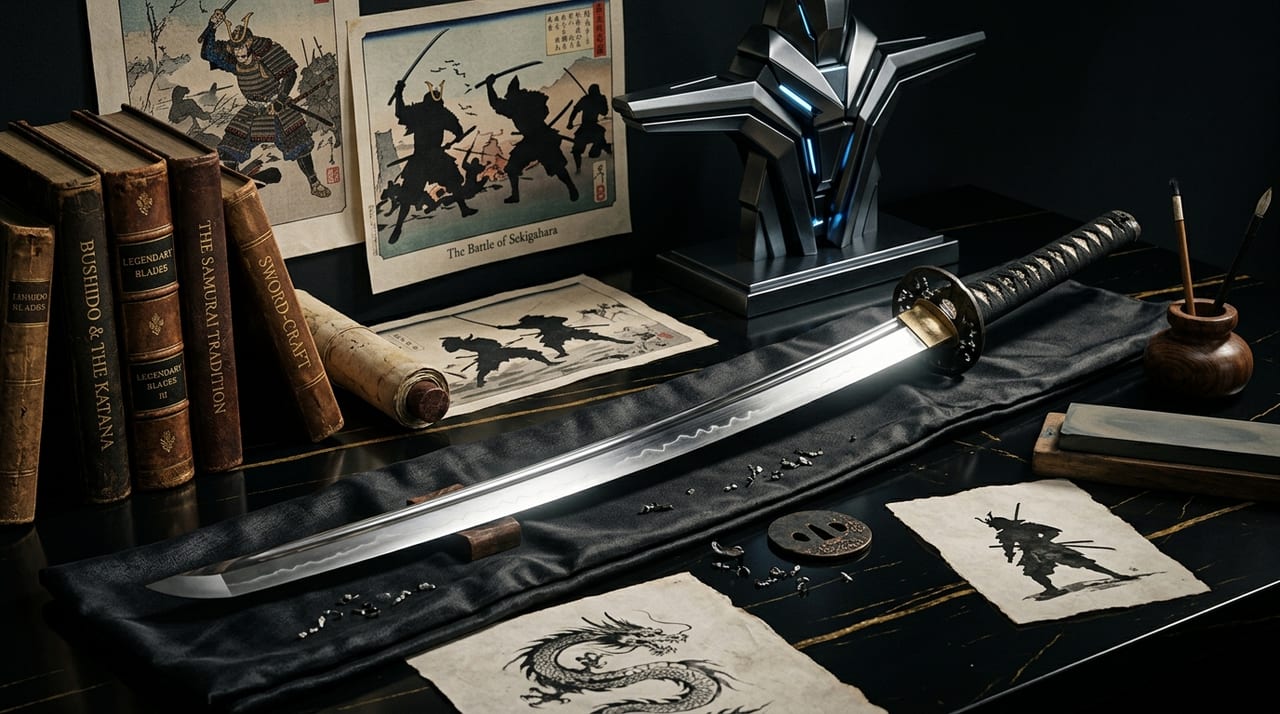
 * Image is for illustrative purposes only.
The Wolverine (2013)
ウルヴァリン: SAMURAI
Marvel film directed by James Mangold (2013). Wolverine (Hugh Jackman) travels to Japan and confronts the Silver Samurai — a villain wielding a massive katana-armed power suit belonging to a Japanese noble family. The narrative opposition of 'adamantium claws versus Japanese sword' — and the premise of a family heirloom blade that can cut through any metal — spread the mythological image of the katana as the 'ultimate blade that cuts through anything' across the North American film market. Contains multiple homages to Kurosawa films and stands as one of the largest-scale Western film introductions to Japanese sword culture.
Description
The Wolverine: SAMURAI — "Adamantium vs. the Japanese Sword" and the Mythological Cutting Power Etched into Global Cinema
The Wolverine: SAMURAI (director James Mangold, 2013) is the second solo Wolverine film in Marvel's X-Men franchise, an action film set in Japan. The narrative structure—in which Wolverine (Hugh Jackman), encased entirely in adamantium (a fictional super-hard alloy), confronts the "Silver Samurai" from the renowned Japanese Yashida family—presents the premise "the world's hardest metal versus the Japanese sword" at maximum scale to North American and European cinema audiences, embedding the mythological image of the katana as a blade capable of cutting through anything into the global film market at its broadest reach.
### "The Japanese Sword That Cuts Through Adamantium" — The Cinematic Ultimate Expression of Mythological Cutting Power
The massive blade wielded by the Silver Samurai in the film's climax is established as capable of cutting through Wolverine's adamantium claws. Within the Marvel Universe, adamantium is defined as "the most indestructible metal on Earth," and the premise of "a Japanese sword that cuts through the world's hardest metal" functions as the cinematic ultimate expression of the core concept of Japanese sword legend: the notion that "a named blade possesses transcendent cutting power."
In actual Japanese sword culture, the "cutting power of a named blade" transcends mere physical performance and operates as a mythological concept. As the legends demonstrate—"the Masamune blade cuts even water grasses" and "the Muramasa blade thirsts for blood and draws itself from its scabbard"—the cutting power of named swords has been transmitted across generations as a supernatural force that exceeds the physical level. The premise of a sword cutting through adamantium is Hollywood's most ambitious cinematic expression of this mythological concept of cutting power, reformulated as "severing the Earth's hardest metal."
### The Yashida Family Heirloom Sword — Family Treasure and the Narrative of Succession
The critical element in the "Silver Samurai" narrative is the story backdrop that the sword has been passed down through generations as an heirloom weapon of the Yashida family. The setting of an "ultimate sword-wielding powered suit" as a family heirloom can be interpreted as a science-fiction extension of the Japanese sword-culture concept of the "family treasure blade"—a named sword preserved and transmitted across generations by a noble house, becoming the symbol of the family's authority and spiritual continuity.
Throughout Japanese history, heirloom blades such as the Toyotomi family's Mikazuki Munechika, the Tokugawa "Muramasa Curse" legend, and the Maeda family's tachi have been treated not as mere weapons but as "spiritual entities bound to the fate of the house." The Silver Samurai represents Hollywood's reinterpretation of this concept—"a heirloom blade bound to the family's destiny."
### Homage to Kurosawa — The Inheritance of "Japanese Visual Beauty"
Throughout the film, the visual vocabulary of Kurosawa films—most prominently Seven Samurai and Yojimbo—is directly referenced. The climactic duel in torrential rain (homage to Seven Samurai's finale), the cinematography of sword technique using slow motion (inheritance of Kurosawa's fight choreography direction), and silhouetted swordsman imagery in stark black and white (quotation of Yojimbo's visual motifs)—these visual references demonstrate that Hollywood cinema uses Kurosawa films as a direct reference axis when expressing "the visual beauty of the Japanese sword."
### Japanese Location Shooting and Visual Presentation of Sword Culture
Much of the film was shot on location in Japan, and the actual Japanese landscapes—rural Nagano, Tokyo, Nagasaki (including atomic bomb scenes)—function as the visual backdrop for sword-culture depiction. In particular, sword-combat scenes set against rural Nagano landscapes present to English-speaking audiences the visual connection between "Japan's natural landscape and the Japanese blade." This imagery of "sword combat unfolding within actual Japanese terrain" conveys to non-Japanese-speaking viewers an intuitive sense of the cultural context: that the Japanese sword is "inseparably bound to the land, culture, and history of Japan itself."
### Box Office Performance and the International Popularization of Japanese Sword Culture
The Wolverine: SAMURAI was a major international box-office success, grossing $414 million worldwide (approximately ¥60 billion), introducing Japanese sword culture to audiences across North America, Europe, Asia, and Latin America. The degree to which this film contributed to the international establishment of the image "katana = a mythological weapon with transcendent cutting power" is substantial, and the film's role in popularizing the English word "katana" among younger Western audiences cannot be overlooked.
### A Perspective for Sword Collectors
The Wolverine: SAMURAI is one of the best reference points for understanding "what Hollywood sees in the Japanese sword." The premise of "cutting through adamantium" illuminates how deeply the mythological image of the katana's cutting power is embedded in Western cinematic imagination. The reality that the Japanese sword's "mythology of cutting power"—which, in actual sword appraisal, remains a value criterion as evidenced by tameshigiri (test-cutting) records—circulates through the cultural medium of Hollywood cinema as the ultimate image of "a blade that severs the world's hardest metal" becomes a crucial key for sword collectors to understand "why people worldwide are captivated by the Japanese sword."
See authentic Japanese swords
See authentic Japanese swordsThis page is intended to introduce Japanese sword culture and is not affiliated with any of the works mentioned.