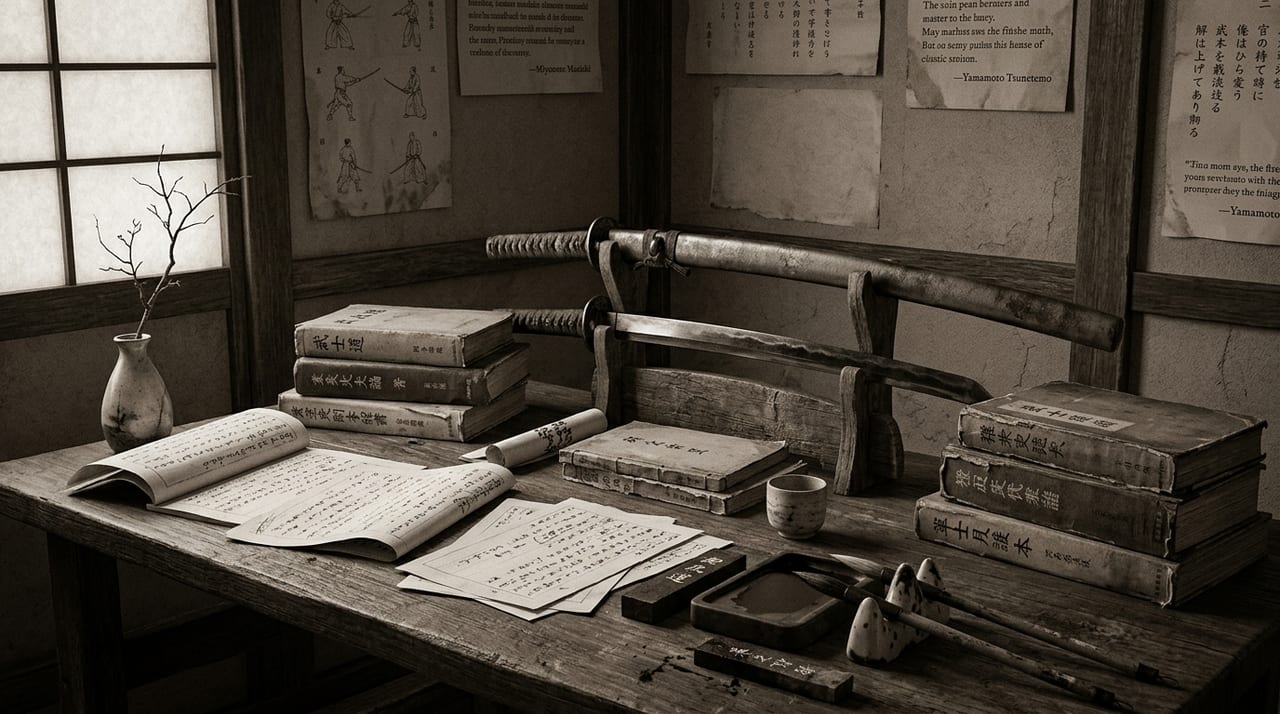
 * Image is for illustrative purposes only.
Daibosatsu Toge
大菩薩峠
Based on the unfinished magnum opus by Nakazato Kaizan (serialized 1913–1941), this 1966 masterpiece film was directed by Okamoto Kihachi and stars Nakadai Tatsuya. Featuring Tsukue Ryūnosuke—a swordplay genius without conscience, a nihilistic swordsman—as its protagonist, this rare work simultaneously portrays the pinnacle of sword technique and spiritual desolation. The theme 'The path of the sword is the path of death' continually interrogates both the beauty of the Japanese sword and the profound karmic depths of human nature.
Description
Nakazato Kaizán and the Unfinished Epic
The source novel of Daibosatsu Toge is one of Japan's longest unfinished works, serialized continuously in newspapers by Nakazato Kaizán from 1913 to 1941. This grand narrative—spanning 41 volumes and exceeding 10,000 pages in total—remained unfinished due to the author's death, yet the refinement of its swordsmanship narrative and philosophical depth are esteemed highly even in modern times. The protagonist, Tsukue Ryūnosuke, despite being a peerless genius in sword technique, is depicted as a 'nihilistic swordsman'—possessing neither the will to live nor fear of death. His blade is depicted not as a tool for killing his opponent but as if the very act of wielding the sword constitutes his raison d'être, embodying the paradoxical philosophy that 'the ultimate swordsmanship is nihilism.' From an anarchist ideological position, Nakazato Kaizán sought to relativize military force (the sword) itself; while Daibosatsu Toge wears the garb of a swordsmanship novel, it harbors fierce anti-violence and anti-bushido messages within. The unfinished narrative form itself generates the effect of reinforcing the theme 'The path of the sword knows no end.'
Director Okamoto Kihachi and Nakadai Tatsuya's 'Blade of Madness'
The 1966 film adaptation was directed by Okamoto Kihachi and stars Nakadai Tatsuya as Tsukue Ryūnosuke. The Tsukue Ryūnosuke embodied by Nakadai possesses flawless beauty in his sword technique, yet what shines in his eyes is the 'light of death'—utterly devoid of human emotion. The film's sword-fighting scenes transcend the conventions of traditional Japanese cinema, becoming innovative through their visual pursuit of the reality of people being cut down and dying. As a counterpoint to the Musashi archetype portrayed by Inagaki Hiroshi and Uchida Tomu—'the light and shadow of the sword'—Nakadai's Tsukue Ryūnosuke in Daibosatsu Toge forms the darkest extreme of the swordsman in Japanese film history. The film adapts only a portion of the source novel; the complete story of Tsukue Ryūnosuke remains unseen in cinematic form even today, but this paradoxically highlights the film's fragmentary perfection.
Late-Edo Swordsmanship: The World of Tennen Rishin-ryū and Shintō Munen-ryū
Daibosatsu Toge is set in the late Edo period, and the swordsmanship practiced by Tsukue Ryūnosuke and other swordsmen models actual schools of the era. In the late Edo period, competition among schools was fierce, with dojo-storming and serious duels occurring regularly. Schools such as Tennen Rishin-ryū (the official style of the Shinsengumi), Shintō Munen-ryū (Renheikan), and Kagami Shin'meiji-ryū (Shigakukan) had dojos concentrated in Edo (Tokyo), attracting accomplished swordsmen from across the nation. The 'soundless stance' mastered by Tsukue Ryūnosuke is depicted as an original swordsmanship unbound to any particular school, symbolizing 'sword beyond form'—the ultimate realm of martial discipline.
The Beauty and Evil of the Blade—What the Japanese Sword Symbolizes
The critical question that Daibosatsu Toge poses to Japanese sword culture is: 'Can the beauty and evil of the sword be separated?' Tsukue Ryūnosuke's blade is beautiful and perfect in outward form, yet its beauty is rooted in pure murderous intent and nihilism. The Japanese sword is originally a craft object idealized as the 'unity of beauty and function,' but Daibosatsu Toge presents in extreme form the paradox that the spiritual quality of the wielder determines the sword's value. The proposition that the aesthetic sense and technical skill a smith invests in a single blade cannot be separated from the spirit of the wielder is posed acutely through this work. For those engaged in collecting and appreciating Japanese swords, Daibosatsu Toge becomes a profound mirror for questioning 'What is the blade?' The martial principle 'The sword is the heart' is most brilliantly illuminated by Tsukue Ryūnosuke's counterexample—this work depicts quietly yet relentlessly the fate of one who possesses the perfect sword while possessing no heart. As a catalyst for collectors to question their own 'spiritual disposition,' Daibosatsu Toge is an incomparable teaching tool.
Global Recognition and the Legacy of Japanese Swordsmanship Cinema
The 1966 Daibosatsu Toge film has received extraordinarily high praise from Western film critics and is positioned in cinema history as 'the world's most thoroughgoing cinematic portrayal of a nihilistic swordsman.' Renowned international directors such as Quentin Tarantino and Jim Jarmusch have expressed their respect for this work, and Daibosatsu Toge is known worldwide as a classic representing Japanese swordsmanship cinema.
Global Recognition and the Legacy of Japanese Film
The 1966 Daibosatsu Toge film has received extraordinarily high praise from Western film critics and is positioned in cinema history as 'the world's most thoroughgoing cinematic portrayal of a nihilistic swordsman.' Renowned international directors such as Quentin Tarantino and Jim Jarmusch have expressed their respect, and Daibosatsu Toge remains known today throughout the world as a classic representing Japanese swordsmanship cinema.
Tōkenza and the Philosophy of the Blade
The 'philosophy of the sword' that Daibosatsu Toge raises contains questions one cannot avoid when appreciating and collecting Japanese swords. TOUKENZA respects the blade as 'humanity's finest craft object' while introducing the sword culture and philosophy that lie beneath it. Just as the nihilistic swordsman such as Tsukue Ryūnosuke embodies in extreme form, the Japanese sword also serves as a mirror reflecting the spirit of its bearer. For those drawn to the world of Daibosatsu Toge, we hope you will take actual late-Edo-period blades in hand and confront for yourselves the question 'What is the sword?' through the quiet weight and beauty these blades possess.
Real Swords Featured
Sōshū-den Ōdachi (Nanboku-chō Period)
As a sword befitting the nihilistic swordsman depicted in Daibosatsu Toge, the magnificent ōdachi of the Sōshū tradition stands as one of the most symbolic choices. The ōdachi forged by master smiths of Sōshū such as Masamune, Sadamune, and Hiromitsu are characterized by hamon of overwhelming presence and dread, embodying an aesthetic of 'swords that overwhelm the beholder.' Many ōdachi from the Nanboku-chō period underwent reworking and remained in practical use in subsequent eras; thus, the scenario of late-Edo-period swordsmen wielding 'unnamed old blades for practical use' possesses historical authenticity.
Nagasone Kotetsu (Late-Edo Cutting Excellence)
The blades of Nagasone Kotetsu, a master smith of the early Edo period, were among the most difficult to obtain and valued by serious practitioners during the late Edo period. In the late-Edo setting of Daibosatsu Toge, Kotetsu blades transcended mere weapons to become symbols of 'the pinnacle of swordsmanship,' functioning as proof of the sword-rank of their bearers. Indeed, an anecdote of Kondō Isami boasting of his Kotetsu remains among Shinsengumi lore, demonstrating Kotetsu's status in late-Edo swordsman society. As a blade befitting an absolute swordsman such as Tsukue Ryūnosuke, Kotetsu represents one of the most fitting choices.
Katayama Munetsugu (Saijō Ōbizakubutsu Masterwork)
The blades of Katayama Munetsugu, a master smith representing late-Edo Edo, were ranked as 'saijō ōbizakubutsu' (最上大業物), the highest classification in Edo-period blade grading. The worldview of devastating cutting power—striking down an opponent in a single blow—as depicted in Daibosatsu Toge possesses a certain historical foundation in the actual cutting efficiency of masterworks such as Munetsugu's. In the world of late-Edo combat swordsmanship, obtaining a blade by Munetsugu was among a swordsman's supreme aspirations.
Suishinshi Masahide (Theoretical Pioneer of Shinshintō)
Suishinshi Masahide was a master smith and sword theorist of the late Edo period, pioneering the shinshintō (new-new-sword) movement that advocated for 'a return to ancient-blade techniques.' In the late-Edo swordsman society setting of Daibosatsu Toge, Suishinshi's theories profoundly influenced standards for blade production and evaluation, offering one answer to the question 'What makes a fine sword?' His blades are highly regarded for the balance between beautiful jigane and effective hamon; they represent an existence that evokes paradoxical resonance with the figure of Tsukue Ryūnosuke pursuing nihilistic perfection—'perfect yet lacking vitality.'
Bizen Ichimonji School (Kamakura Period Apex)
The Ichimonji school of Bizen in the Kamakura period, inheriting the legacy of the ōban-kajishi (imperial smiths) commissioned by Emperor Gotoba, represents the apex of sword-crafting tradition. Their blades, marked by magnificent chōji-midare hamon and superior jigane, rank among the finest in Japanese sword history. As a sword symbolizing the 'absolute blade' depicted in Daibosatsu Toge, the masterworks of the Ichimonji school hold the most appropriate historical position. The majority of surviving Ichimonji blades are designated as National Treasures or Important Cultural Properties, and their rarity and beauty amplify the mythic image of 'a perfect blade beyond reach.'
See authentic Japanese swords
See authentic Japanese swordsThis page is intended to introduce Japanese sword culture and is not affiliated with any of the works mentioned.