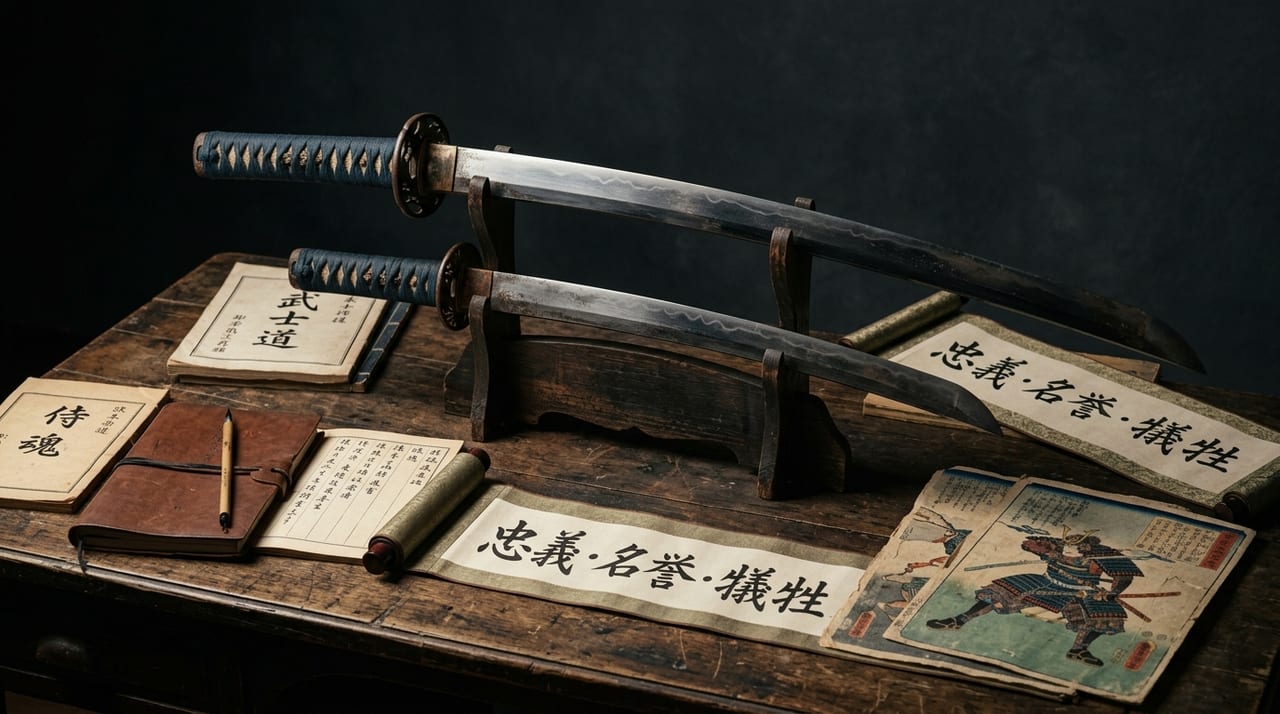
 * Image is for illustrative purposes only.
Sword Gai: The Animation
Sword Gai: The Animation
A Netflix Original anime (2017–2018, 12 episodes × 2 seasons) based on the manga by Toshiki Inoue (writer) and Osamu Kine (illustrator). A supernatural fantasy in which the spirit of a cursed blade inhabits a human body and transforms its wielder into a 'tōjin' (刀人—a blade-human fusion). A work that embodies the concept of 'spiritual possession' of the Japanese sword as contemporary dark action anime.
Description
Sword Gai: The Animation——Spiritual Possession of the Cursed Blade and the Contemporary Reinterpretation of Japanese Sword Tradition
Sword Gai: The Animation (2017–2018, Netflix Original anime, 24 episodes total) is a dark action anime produced by Production I.G based on the manga by Toshiki Inoue (writer), Keita Amemiya (character design), and Osamu Kine (illustrator). Centered on the core concept of 'a cursed blade's spirit dwelling in a human body and limbs, transforming its wielder into a fusion of human and blade called a tōjin (刀人)', the work is highly regarded as a contemporary dark fantasy reinterpretation of 'demon blade legends' and the ancient Japanese belief of 'spirits dwelling in blades.'
### The Tōjin (刀人)——The Ultimate Perspective on Human-Blade Fusion
The work's most original concept is the 'tōjin (刀人)'——a 'fusion of human and blade' born when a cursed blade's spirit possesses a human. The protagonist 'Kai (凱)' is raised by a swordsmith from childhood and bears a prosthetic limb in place of his right arm lost in an accident; into this prosthetic is embedded the blade of the cursed sword 'Shiryū (死龍).'
This concept of 'a blade becoming part of the body' can be understood as the ultimate expression of the 'unity of blade and warrior' that underlies Japanese sword culture. As epitomized in the phrase 'the sword is the warrior's soul,' the spiritual and ontological fusion of sword and wielder is a fundamental theme in Japanese sword culture. By expressing this 'unity of blade and human' as literal physical fusion, Sword Gai embodies the pinnacle of Japanese sword philosophy as contemporary anime.
### The Cursed Blade Shiryū (死龍)——The Contemporary Inheritance of Demon Blade Legends
The work's central blade, 'Shiryū (死龍)', is depicted as 'a cursed sword that once claimed many lives, with the karmic weight of those killings accumulated within the blade.' This concept of 'karmic burden accumulating in a blade through taking life' directly continues the core motif of demon blade legends in Japanese sword culture.
The most renowned among Japanese demon blade legends is the 'Muramasa (村正)', with the belief that 'a blade that claimed many lives harbors vengeful spirits and leads its wielder to madness.' Sword Gai's 'Shiryū' can be understood as a contemporary variation on the Muramasa legend. The narrative structure of 'a cursed blade possessing a specific person and transforming their life' transplants the story grammar of demon blade legends——'a demon blade driving a warrior to ruin'——into the context of contemporary dark action.
### The 'Blade Collection' Setting——A Museological Worldview of Fine and Demon Blades
In Sword Gai's worldview, multiple 'cursed blades and weapons' exist, each with its own unique spiritual properties, history, and curse. The setting that a 'cursed blade research organization (Shield)' collects, studies, and manages cursed weapons worldwide introduces the concept of 'museological collection and management of blades' as narrative background.
This setting of 'cursed weapon collection and management' has an interesting parallel to real-world Japanese sword collecting culture. In Japan, the possession and transfer of blades are strictly regulated under the 'Firearms and Swords Control Law,' with institutional frameworks for registration, cultural property designation, museum curation, and private collecting to 'preserve and transmit fine blades.' Sword Gai's 'cursed blade management organization' can be understood as a dark mirror of this real-world blade regulation system.
### Production I.G's Visuals——Animating the Movement of the Japanese Blade
The animation for Sword Gai, produced by Production I.G (the studio behind 'Ghost in the Shell' and 'Attack on Titan'), pays particular attention to detailing scenes of 'blade movement, cutting strikes, and drawing.' The 'curve (sori), blade length (hawatari), and trajectory of the kissaki (point)' are visually emphasized, with 'battle aesthetics that leverage the Japanese blade's morphological characteristics' serving as a crucial visual element of the work.
High-speed blade-drawing scenes that apply the mechanics of iaijutsu (居合抜き——drawing and cutting in one fluid motion) embody the aesthetic form of the 'first strike' (初太刀) from real iaido practice as animation. The 'sayabashiri (鞘走り——the sound and motion as the blade separates from the scabbard during drawing)' of the Japanese sword serves as a dramatic device heightening combat tension, creating a work that offers profound satisfaction to viewers with knowledge of the Japanese blade's functional and aesthetic properties.
### Japanese Sword as Dark Fantasy——Updating the Contemporary 'Demon Blade Philosophy'
Sword Gai is a work with a clear ambition to 'reinterpret the spiritual and curse-bearing aspects of the Japanese sword as contemporary dark fantasy.' Through distribution on Netflix as a global platform, themes from Japanese sword culture——'demon blade legends, spiritual possession, and the unity of human and blade'——have reached an international audience.
While 'Touken Ranbu' modernizes Japanese sword culture by personalizing fine blades as beautiful male characters, Sword Gai modernizes the 'spiritual danger and curse-bearing darkness' of the Japanese sword through the concept of 'cursed blades possessing and merging with humans.' Both works can be understood as different expressions of a shared cultural project: 'the personification of Japanese swords and contemporary expression of their spiritual dimensions.'
### A Perspective for Blade Collectors
Sword Gai: The Animation is a work that allows viewers to experience the deepest layers of Japanese sword culture——'spiritual possession of the blade, demon blade legends, and the ontological fusion of human and sword'——as contemporary dark action anime. Themes of 'the unique spiritual life of a cursed blade,' 'the spiritual unity of blade and wielder,' and 'the karmic burden and curse dwelling in a blade that claimed many lives' serve as contemporary gateways for Japanese sword collectors to understand 'the spiritual dimensions of fine and demon blades.'
Real Swords Featured
Muramasa (村正, representative of demon blade legends—the Japanese belief that a cursed blade drives people to madness)
Dōjikirigasutuna (童子切安綱, National Treasure, Tokyo National Museum—a representative example of spiritual power dwelling in a blade)
Onikiri (鬼切, a spiritual blade passed down through the Genji clan—a blade possessing the sacred power to cut cursed beings)
See authentic Japanese swords
See authentic Japanese swordsThis page is intended to introduce Japanese sword culture and is not affiliated with any of the works mentioned.