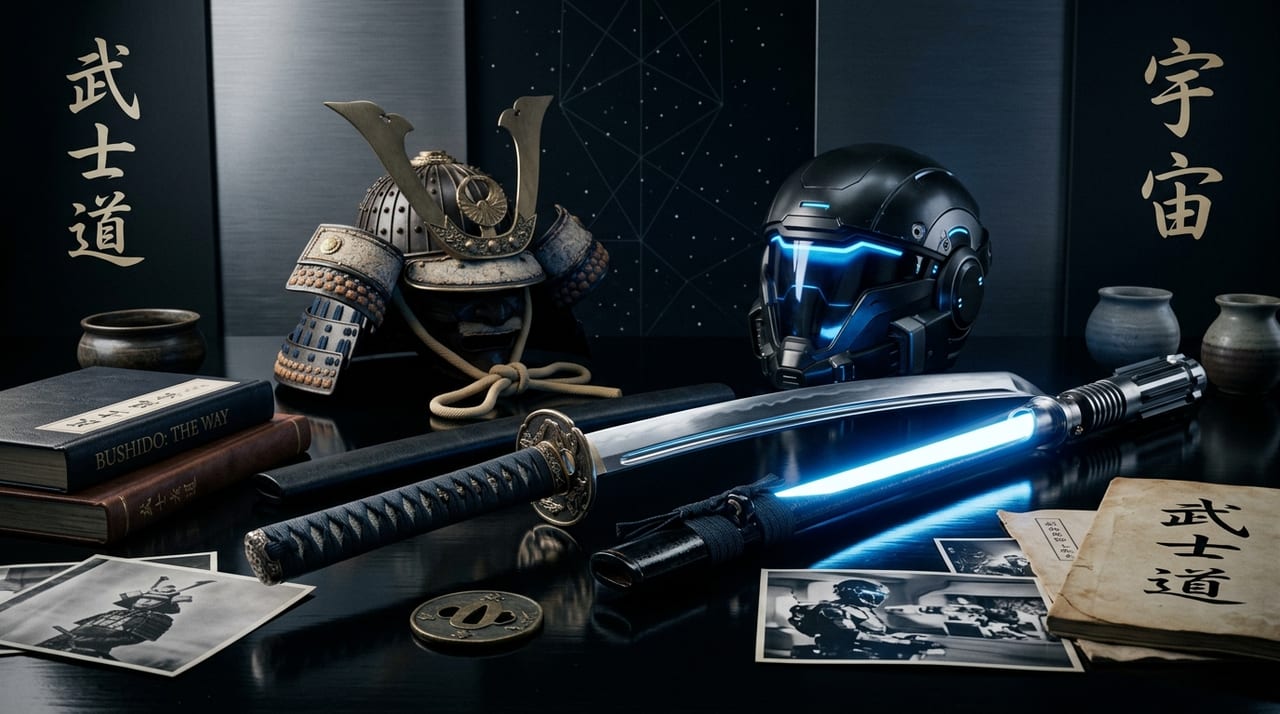
 * Image is for illustrative purposes only.
Star Wars
スター・ウォーズ
A galactic epic that George Lucas created under heavy influence from Kurosawa Akira's period dramas. The name Jedi is said to derive from jidaigeki (period drama), and the stances and swordplay of the lightsabers reflect kendo and iaido techniques in depth. Darth Vader's helmet draws on Sengoku-period samurai armor, and the concept of the Force parallels the East Asian idea of ki. The culture of the Japanese samurai and the sword forms a foundation of the world's largest science fiction film series.
Description
Kurosawa Akira's Influence
George Lucas created Star Wars (1977-) under heavy influence from Kurosawa Akira's period dramas, making it one of the most important cultural bridges in film history. As Lucas himself has repeatedly said, the story structure of The Hidden Fortress (1958) became the skeleton of Episode IV: A New Hope, and the droids R2-D2 and C-3PO correspond directly to the two peasants Tahei and Matashichi from The Hidden Fortress. The group battle structure of Seven Samurai shaped the battle scenes throughout the series, and the composition of a masterless samurai (rōnin) drifting between two rival factions in Yojimbo is reflected in the character design of Han Solo.
Jedi and the Bushi
The name Jedi is said to derive from jidaigeki (period drama), and Jedi Knights are depicted as galactic-scale bushi (samurai). The Jedi philosophy of controlling emotion and protecting peace in the galaxy in a spirit of service deeply resonates with the virtues at the core of bushidō: gi (righteousness), yū (courage), jin (benevolence), rei (courtesy), makoto (sincerity), meiyo (honor), and chūgi (loyalty). In particular, the spirit of giving oneself up for a greater cause is the very ideal of selfless service in bushidō, and it shows that Lucas drew the spiritual core of his work from Japanese samurai culture.
Lightsaber Swordsmanship
The lightsaber duels clearly reflect the techniques of kendo and iaido. In the original trilogy (Episodes IV-VI), the stance of holding the hilt with both hands and raising the blade at the center is essentially kendo's chūdan-no-kamae, and basic Japanese swordsmanship techniques appear throughout, such as overhead strikes from jōdan and kesa-giri cuts with a turn of the wrist. The prequel trilogy (Episodes I-III) adopted more acrobatic choreography, but its systematized lightsaber combat forms I through VII can still be read as modeled on the systems of Japanese sword schools. Nick Gillard, who choreographed the prequel trilogy's fights, is said to have created a new style of combat that fuses various swordsmanship traditions.
Vader's Helmet
Darth Vader's iconic helmet draws direct inspiration from the helmets of Sengoku-period warlords. In particular, the shape of Vader's helmet recalls the helmet of Date Masamune, which has a crescent-moon maedate (front crest). The concept of the Force parallels the East Asian idea of ki, and Jedi meditation training overlaps with Zen seated meditation (zazen). Also, the setting in which Jedi build their own lightsabers resonates with the culture in which samurai chose their own swords and valued their oneness with the blade.
A Cultural Bridge
As the world's largest science fiction film series, Star Wars carried the essence of Japanese samurai culture to audiences around the world, even if unconsciously. Those who learn that the Jedi fighting across the galaxy carry the traditions of the Japanese samurai and the sword will come to understand the Japanese sword more deeply.
Real Swords Featured
Kendo
A systematized form of Japanese swordsmanship as a modern competitive martial art. Practitioners wear shinai (bamboo swords) and bōgu (protective gear: men, kote, dō, and tare) and compete by scoring one of four valid strikes: men (head), kote (wrist), dō (torso), and tsuki (thrust). Its origins trace back to the invention of bōgu and shinai in the mid-Edo period, which added the concept of jigeiko (free practice in which partners strike freely) to earlier swordsmanship centered on kata practice, a groundbreaking development. Modern kendo stances fall into five broad categories: jōdan, chūdan, gedan, hassō, and waki-gamae. The systematization of stances in lightsaber combat in Star Wars is clearly influenced by this. The All Japan Kendo Federation has approximately two million registered practitioners in Japan, and kendo is also widely practiced overseas.
Iaido
A uniquely Japanese martial art in which the sword is drawn from its scabbard and the drawing itself is the attack. Basic training typically involves practicing kata alone against imaginary opponents with a real sword or an iaitō (practice sword). The two major schools derived from the founder, Hayashizaki Jinsuke, are Musō Jikiden Eishin-ryū and Musō Shinden-ryū. Iaido training emphasizes the fluidity of the whole sequence, from drawing and cutting through chiburi (blood-clearing) to nōtō (returning the sword to the scabbard), along with the concentration of the mind. The principle of "winning while the sword is still in the scabbard" (saya no uchi) expresses the idea that victory is decided before the sword is drawn. The solemnity of a Jedi igniting a lightsaber resonates with the tension of the drawing cut in iaido.
Bushido
The sum of moral codes embodied by the Japanese samurai class, built on seven pillars: gi (righteousness), yū (courage), jin (benevolence), rei (courtesy), makoto (sincerity), meiyo (honor), and chūgi (loyalty). Bushidō was not written law. It was an unwritten code passed down through oral teaching and practice, from master to disciple and from father to son. It became widely known to the world through Nitobe Inazō's Bushido: The Soul of Japan, written in English in 1900, and had a major influence on Western intellectuals, including President Roosevelt. The Japanese sword is a spiritual symbol of bushidō and is called the soul of the samurai. The Jedi view of the lightsaber, as not merely a weapon but the very being of a Jedi, can be read as an adaptation of the spiritual significance of the sword in bushidō to a galactic setting.
Kurosawa Akira's Period Dramas
A group of films that brought Japanese samurai and the sword to the world, including Seven Samurai (1954), Yojimbo (1961), Sanjuro (1962), and The Hidden Fortress (1958). Kurosawa combined rigorous historical research with cinematic dynamism and brought the art of screen swordplay to its peak. His influence extends beyond film to the whole lineage of modern action cinema, including Star Wars, Mad Max, John Wick, and The Matrix. The samurai Kurosawa depicted, a solitary swordsman of superior skill who agonizes over the contradictions of society, is the direct prototype of the Jedi Knight. When Lucas and Spielberg served as presenters at the 1990 Academy Honorary Award ceremony, where Kurosawa was honored, it symbolized the scale of Hollywood's debt to him.
This page is intended to introduce Japanese sword culture and is not affiliated with any of the works mentioned.