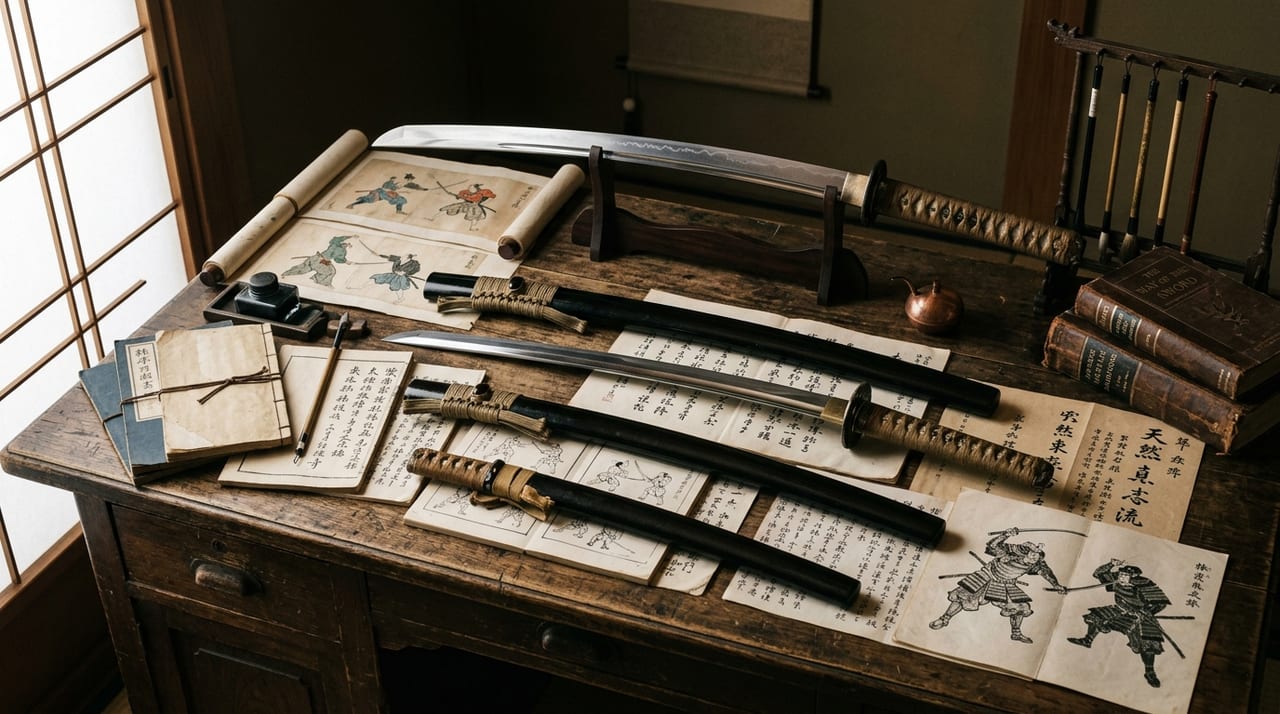
 * Image is for illustrative purposes only.
Shura no Toki: Age of Chaos
修羅の刻
A long-running manga (from 1989) by Kawahara Masatoshi in which practitioners of the fictional Mutsu Enmei-ryu style fight real historical swordsmen across Japanese history, from Miyamoto Musashi to Sakamoto Ryoma to the Shinsengumi.
Description
Shura no Toki and Mutsu Enmei-ryu
Shura no Toki is a spinoff martial arts manga by Kawahara Masatoshi of "Shura no Mon" and began serialization in Monthly Shonen Magazine from 1990. The story centers on the lineage of "Mutsu Enmei-ryu," a fictional ancient martial art school, and is a historical martial arts manga in which warriors descended from Mutsu bloodlines born in each era fatefully clash with the greatest martial artist of their time. "Mutsu Enmei-ryu" is a fictional school with the premise that bare hands can overcome any weapon, but its techniques are based on actual theories of ancient martial arts, karate, jujutsu, and swordsmanship, earning appreciation not only from martial arts fans but also from researchers of martial arts and martial traditions. The history depicted in Shura no Toki, through the fictional figure of Mutsu, provides detailed descriptions of the swordsmanship characteristics of real swordsmen and warriors such as Miyamoto Musashi, Sasaki Kojiro, Sakamoto Ryoma, and Kondo Isami, offering profound insight into the history of Japanese swordsmanship.
The Miyamoto Musashi Arc—Confrontation with the Sword Saint
The most famous episode in Shura no Toki is the "Miyamoto Musashi Arc." This episode, depicting the confrontation between Miyamoto Musashi, legendized as history's greatest swordsman, and a Mutsu warrior, details in original interpretation the essence of Musashi's swordsmanship style—the theory of two-sword technique, manipulation of distance, and psychological warfare. Kawahara's interpretation of Musashi is grounded in the perspective that Musashi was not merely "history's greatest swordsman" but rather "a revolutionary artist of swordsmanship," reflecting deep engagement with Musashi's philosophy of swordsmanship as recorded in the "Go Rin No Sho." The depiction of Sasaki Kojiro's legendary "Tsubame Gaeshi" technique in the duel on Ganryu Island is also striking, and a kinesiological interpretation of "Tsubame Gaeshi" as an actual swordsmanship technique is attempted.
The Bakumatsu Arc—Sakamoto Ryoma and Kondo Isami
In the Bakumatsu Arc of Shura no Toki, a clash between Sakamoto Ryoma and a Mutsu warrior is depicted. Historically, Sakamoto Ryoma was a practitioner of Hokushin Itto-ryu with swordsmanship skills approaching full mastery, and was uniquely among all Bakumatsu swordsmen an expert marksman with pistols. Kawahara brings this unique character trait of Ryoma—a swordsman who wielded both sword and pistol—to life within the fictional setting of confrontation with Mutsu through his original interpretation. The confrontations with Shinsengumi members Kondo Isami, Hijikata Toshizo, and Okita Soji are also depicted, with detailed depiction of the characteristics of the actual swordsmanship school Tennen Rishin-ryu—its practical combat style rooted in the Tama farming regions and its training system emphasizing actual combat over formal patterns. The Bakumatsu Arc has become a work referenced even by swordsmanship history researchers as the chapter that most realistically depicts the swordsmanship of actual historical swordsmen.
Depiction of Various Swordsmanship Schools
One of the greatest strengths of Shura no Toki is its detailed depiction of the characteristics of various Japanese swordsmanship schools based on actual historical records. The fierce preemptive striking and one-hit-kill style of Shijutsu-ryu, the rational modern swordsmanship system of Hokushin Itto-ryu, the practical rural swordsmanship of Tennen Rishin-ryu, and the soft body movements and yin-yang transformations of Shinkage-ryu—the characteristics of these schools are demonstrated viscerally within the format of confrontations. Many swordsmanship schools still retain their forms in Japan today, and for readers interested in the characteristics, history, and lineages of each school, Shura no Toki serves as the most comprehensible "encyclopedia of swordsmanship schools." TOUKENZA handles swords from the eras that swordsmen of these schools actually used, allowing visitors to directly experience the weapons of the actual practitioners of swordsmanship depicted in each era of Shura no Toki.
The Philosophical Confrontation Between Japanese Sword and Bare Hands
The distinctive feature of Shura no Toki is its consistent exploration of the theme of confrontation between swordsmen wielding Japanese swords and bare-handed warriors. The premise that "no matter how excellent the sword, before Mutsu Enmei-ryu it becomes useless as a weapon" is also a questioning of the essential nature of the Japanese sword—that a sword only gains meaning when unified with the skill of the wielder. The philosophy of the Japanese sword—that a sword is not merely a metal tool but an inseparable extension of the wielder's skill, will, and spirit—is the central proposition repeatedly presented through each confrontation in Shura no Toki. This paradox—the master of the greatest sword defeated by a bare-handed warrior—functions as an expression of the profound truth that the value of the Japanese sword lies not in "the sword itself" but in "the unified state of human and sword."
Real Swords Featured
Echizen Yasutsugu (Musashi's Era Swords)
Echizen Yasutsugu was a leading swordsmith of the Keicho-Genna period (early 17th century), patronized by Tokugawa Ieyasu and known for the 'aoi-mon shita-saka' designation. He represents the sword culture of Miyamoto Musashi's era — the transition from Sengoku to early Edo, when the sword shifted from battlefield weapon to spiritual and artistic object. His surviving works document this pivotal transition in Japanese sword history.
Hokushin Itto-ryu and Sakamoto Ryoma's Sword
Sakamoto Ryoma studied Hokushin Itto-ryu under Chiba Sadakichi — one of the most systematic and modern of the late-Edo sword schools. Ryoma's personal sword is believed to have been an 'Mutsu no Kami Yoshiyuki' — a Tosa Province combat blade. Shura no Toki's Bakumatsu arc accurately depicts Ryoma's unique combination of genuine sword mastery and pragmatic embrace of modern firearms.
Jigen-ryu Combat Swords (Satsuma's Deadly Style)
Jigen-ryu, the sword school of Satsuma domain warriors, was feared in the Bakumatsu era for its devastating first-strike principle: 'never miss the first cut.' Paired with Satsuma-forged practical combat blades, Jigen-ryu practitioners were regarded as among the most dangerous swordsmen in Japan. Shura no Toki depicts this school's terrifying intensity, which is grounded in historical accounts of Satsuma warriors' ferocity.
See authentic Japanese swords
See authentic Japanese swordsThis page is intended to introduce Japanese sword culture and is not affiliated with any of the works mentioned.