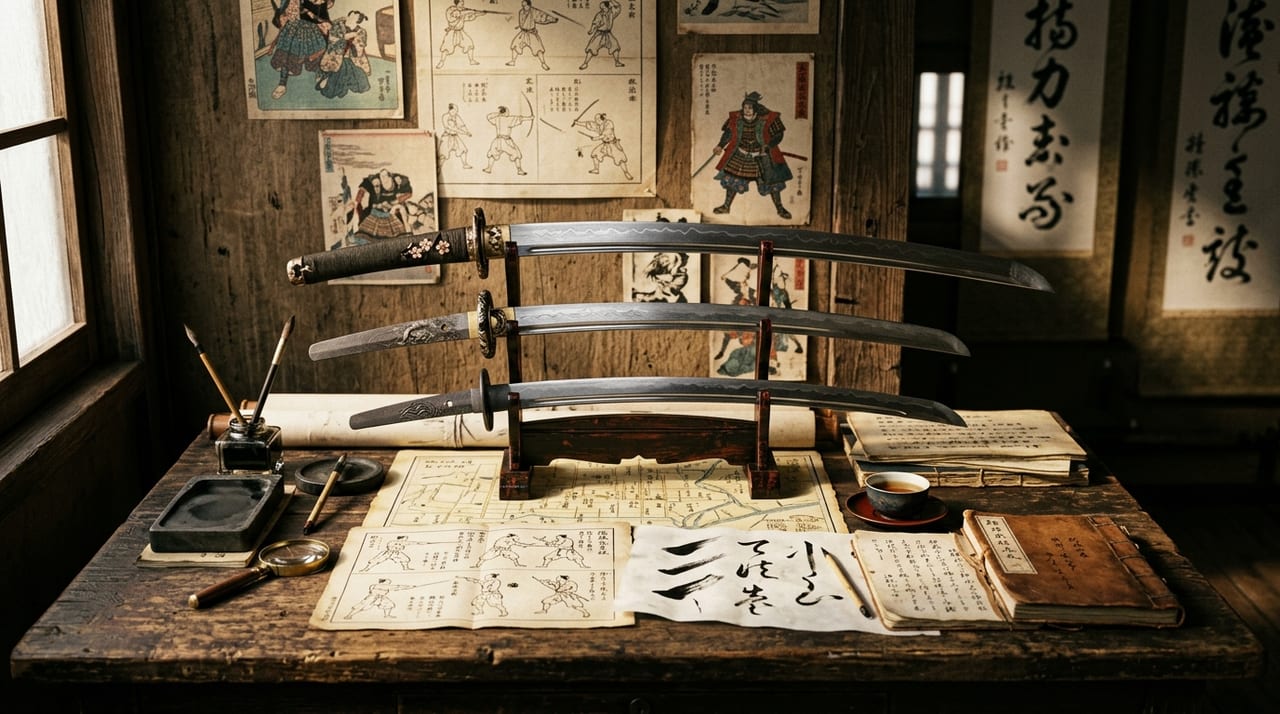
 * Image is for illustrative purposes only.
Shinsengumi Keppūroku (Shinsengumi: Band of Assassins)
新選組血風録
Short story collection by Shiba Ryōtarō (1962–1964). A collection of short stories featuring each member of the late-Edo Shinsengumi as protagonists, depicting how swordsmen such as Kondō Isami, Hijikata Toshizō, Okita Sōji, Nagakura Shinpachi, and Saitō Hajime lived in scenes of sword combat. The work embodies as literature the technical characteristics of the sword schools employed by each member (Tennen Rishin-ryū, Hokushin Ittō-ryū, Shintō Munen-ryū, etc.), the fighting approach of Shieikan-lineage swordsmen as practical combat technique, and the aesthetics of death-by-the-blade among late-Edo swordsmen. Alongside Mibugishi Den, it stands as one of the twin peaks of "Shinsengumi literature"—an essential work for understanding late-Edo sword culture.
Description
Shinsengumi Keppūroku — Shiba Ryōtarō's Literary Depiction of "Kiri-ai" (Sword Combat) in Late-Edo Sword Culture's Reality
Shinsengumi Keppūroku (Shiba Ryōtarō, 1962–1964) is a connected short-story collection where each narrative centers on a different member of the Shinsengumi, the late-Edo public-security force. The stories of historical swordsmen such as Kondō Isami, Hijikata Toshizō, Okita Sōji, Nagakura Shinpachi, Saitō Hajime, and Todō Heisuke unfold primarily around scenes of actual kiri-ai (mortal sword combat). The work is notable in Japanese sword culture because it embodies at the highest literary level the "practical combat swordsmanship" of the Bakumatsu period—the profound chasm between dojo practice and actual killing.
### The Shinsengumi's Sword Schools — Centered on Tennen Rishin-ryū
Shinsengumi members came from multiple sword schools, and Keppūroku portrays this school-based diversity as the defining character of each short story's protagonist. Tennen Rishin-ryū is the mainstream school of Shieikan-trained practitioners including Kondō Isami, Hijikata Toshizō, and Okita Sōji, known for practical forms that "deflect the opponent's attack and immediately counter." This school's practical character—a stance premised on actual sword combat rather than dojo kata practice—forms the foundation of combat style for Shieikan-lineage members throughout the stories. Hokushin Ittō-ryū is mastered by practitioners such as Todō Heisuke and is depicted as "strikes calibrated to the weight of a real sword" and body-contact swordsmanship premised on one-stroke beheading. Shintō Munen-ryū is mastered by Nagakura Shinpachi, is known as "thrusting swordsmanship," and is reflected in Nagakura's combat approach in the work.
### Literary Depiction of "Kiri-ai" (Sword Combat) — The Aesthetics of Practical Swordsmanship
The paramount literary characteristic of Keppūroku is the precision of its depictions of kiri-ai—actual mortal combat with live blades. Shiba Ryōtarō conducted extensive historical research on the Shinsengumi and reconstructed "how actual Bakumatsu swordsmen fought" through literary realism. Specifically, the following elements are depicted: the actual reality of "sen" (initiative)—unlike dojo practice, in actual kiri-ai all of "sen" consists of "sen no sen" (cutting before the opponent moves), and there is no room to aim for "go no sen" (responding after the opponent's movement) at life's threshold. The weight of a single exchange—actual mortal sword combat differs entirely from dojo "ippon" (points); in a first exchange, one party is gravely injured or dies. Fatigue and terror—continuous combat against multiple enemies, the smell of blood, the pain of wounds—these are depicted as the "psychological exhaustion" of practical swordsmanship.
### Okita Sōji's Sword — The Depiction of "Genius"
One of the most celebrated short stories in Keppūroku, "Okita Sōji's Love," depicts the sword characteristics of the genius swordsman Okita Sōji as literature. What Shiba Ryōtarō portrays as Okita's sword characteristic is "mushin no ken" (the sword of no-mind)—the state of a swordsman free of extraneous thought, where only the act of cutting exists—which is the core concept of "the realm of nothingness" in Japanese martial philosophy of kendo, Zen, and Bushidō. The concept "the master of swordsmanship does not consciously perceive the sword" and "the first-rate swordsman does not think while wielding the sword" is, through the historically real swordsman Okita, transformed into literary language in Keppūroku.
### The Ikedaya Incident and Actual Records of Sword Combat
The historical core of Shinsengumi Keppūroku is the "Ikedaya Incident (1864)." Shinsengumi members stormed the inn "Ikedaya" where Sonnō-jōi (restore the emperor, expel the foreigner) partisans were engaged in conspiracy, and actual kiri-ai broke out between Kondō Isami's four-man team and numerous partisans. The records of this incident—testimonies from Kondō, Okita, and Nagakura, and the journals of surviving partisans—remain as primary sources for "how actual Bakumatsu swordsmen fought with live swords." Keppūroku is literarily reconstructed based on these historical materials and is valued as a rare work that, while historical fiction, possesses "historical-source realism."
### The End of the Sword — The Twilight of Sword-Culture
Another important theme of Keppūroku is "the end of the age of the sword." Following the Meiji Restoration of 1868, the Shinsengumi was disbanded, and the Haitorei edict (1876) abolished samurai sword-carrying rights. Each short story in Keppūroku depicts this "end of the blade's age" through the death of each member, and functions as a literary record of "the last era when the Japanese sword functioned as an actual weapon." Shiba Ryōtarō's Shinsengumi members are depicted as embodiments of temporal tragedy—swordsmen who "lived by the sword alone, only to be left behind by an age that no longer needed the sword."
### Perspective for Sword Collectors
Shinsengumi Keppūroku is a work where one can experience at the highest literary level "how the Japanese sword was actually used in late-Edo combat." The technical characteristics of actual sword schools—Tennen Rishin-ryū, Hokushin Ittō-ryū, Shintō Munen-ryū—are presented as concrete combat depictions within the narrative, allowing intuitive understanding of "how school differences influenced actual kiri-ai." Through the literary reconstruction of the actual historical event of the Ikedaya Incident, it is one of the works where one can most realistically experience the atmosphere of "the last era when the Japanese sword functioned as an actual weapon."
Real Swords Featured
Uchigatana
Tennen Rishin-ryū school
Hokushin Ittō-ryū school
See authentic Japanese swords
See authentic Japanese swordsThis page is intended to introduce Japanese sword culture and is not affiliated with any of the works mentioned.