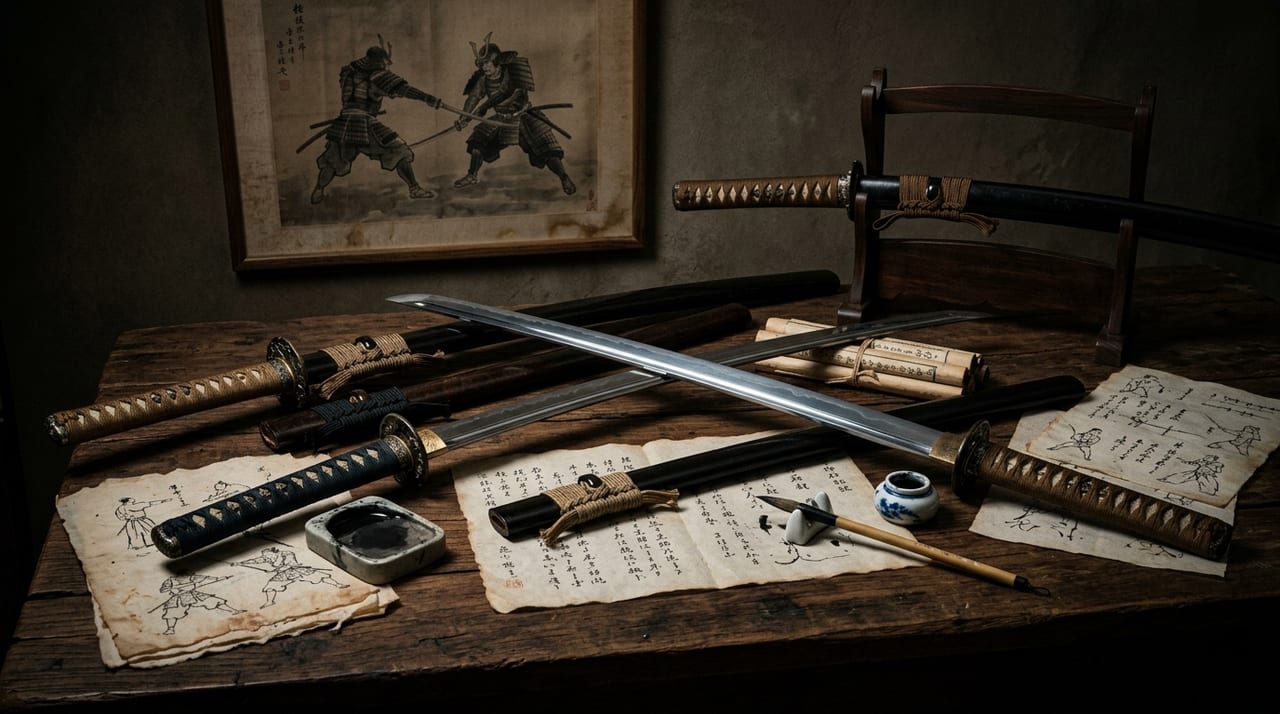
 * Image is for illustrative purposes only.
Shigurui
シグルイ
A manga adaptation of Nankō Nanjo's novel, depicting brutal sword duels in early Edo-period Japan with unflinching realism and deep attention to authentic swordsmanship.
Description
Overview and Historical Setting
Shigurui is a manga adaptation by Takayuki Yamaguchi of Nankō Nanjo's historical novel 'Suruga-jo Gozen-jiai,' serialized from 2003 to 2010. The setting is early Edo period, during a sword tournament held by Tokugawa Tadanaga, lord of Suruga Castle, under the reign of the third shogun Tokugawa Iemitsu. The story depicts the tragic intertwining of two swordsmen across past and present—Fujiki Gennosuke, a one-armed swordsman, and Irako Seigen of the Iwamoto Kogan school, a genius bordering on madness. Yamaguchi Takayuki's overwhelming artistic power realistically captures the weight of each sword strike, the arc of blood spray, and the severing of human flesh, establishing the work as a landmark of the swordsman genre through its unflinching portrayal of the Japanese sword's essential nature as a killing instrument.
Precision of Swordplay
The greatest distinguishing feature of Shigurui is its overwhelming realism in depicting swordsmanship. While the sword forms and techniques of the Iwamoto Kogan school depicted in the work are original creations built on the foundation of real classical martial arts, their portrayal of movement, distance, and breath captures the essence of ancient sword tradition. In true sword combat, control of distance matters more than elaborate technique; a single slash inflicts real damage to the human body; the warrior's movements are shaped by extreme psychological states—the work pursues the truth of the sword beyond entertainment swordplay. Practitioners of kendo and iaido frequently assess scenes as 'close to the feeling of actual sword combat,' making it a work that resonates deeply with those who practice the Japanese sword.
Terror and Beauty of Japanese Swords
The foundational current running through the work is pure reverence for the Japanese sword as a weapon. The Japanese sword simultaneously embodies the refined beauty of a work of art and the functional beauty of a tool specialized for cutting down human beings. Shigurui depicts both aspects without any compromise—the act of drawing the blade, the stance of the swordsman, the trajectory of the cut, and the moment the edge severs flesh are all portrayed as a mixture of terror and beauty. The death aesthetics concealed within the superhuman speed symbolized by the Kogan school technique 'Nagareboshi' represents a contemporary reinterpretation of the mystique of the Japanese sword that stories of legendary swordsmen have long depicted.
Choice and Manufacture of Swords
Given the work's setting in early Edo period, the swords depicted correspond to blades from the 'Shintō' (new sword) era, forged between Keichō and through Genna and Kan'ei. This period marked a transition from the bold, grandiose sword aesthetics of the Momoyama era, and as Edo culture became more refined, there emerged a demand for swords that combined elegance with practicality. The swords forged during this time, when masters such as Echizen Yasutsugi, Hizen Tadayoshi (first generation), and Musashi Daijō Koretsu were active, embody the warrior culture of the bakuhan system and are characterized by an excellent balance between practical effectiveness and artistic merit.
Modern Influence
Shigurui has received literary recognition transcending the bounds of swordsman manga and is remembered as a work that philosophically questions the relationships between violence and beauty, life and death, and madness and technique. It was also adapted into anime in 2007, and its heterodox aesthetics have influenced numerous creators both within Japan and internationally. As essential reading for those with an interest in swordsmanship and Japanese sword culture, it continues to acquire new readers even today.
Real Swords Featured
Shinto-Period Uchigatana (Keichō–Kan'ei Era)
The early Edo period setting of Shigurui corresponds to the Shinto (new sword) era of Japanese sword history. Smiths such as Echizen Yasutsugu, Hizen Tadayoshi (first generation), and Musashi Daijō Korenaga (master of Nagasone Kotetsu) established the practical uchigatana style worn by Edo-period samurai. These blades, typically 70–75 cm, became the standard sidearm of the warrior class and are prized for both cutting performance and refined aesthetics.
Hizen Blades (First Generation Tadayoshi)
The first-generation Hashimoto Shinzaemon Tadayoshi of Hizen Province (modern Saga Prefecture) founded the acclaimed Hizen sword tradition in the early Edo period. Characterized by fine komokume grain and a gentle, luminous straight hamon called 'numeri-ha,' Hizen blades represent the ideal of refined practicality that Edo-period swordsmen sought. They remain highly regarded among collectors today.
See authentic Japanese swords
See authentic Japanese swordsThis page is intended to introduce Japanese sword culture and is not affiliated with any of the works mentioned.