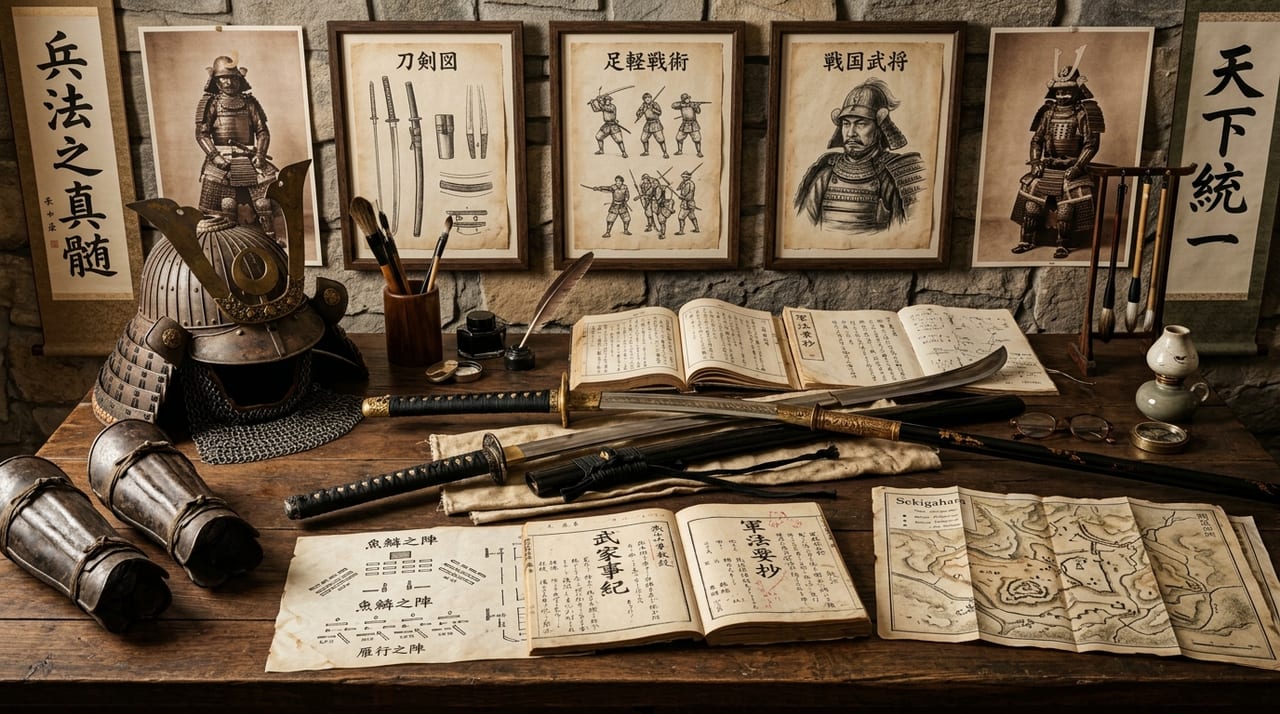
 * Image is for illustrative purposes only.
Sengoku
センゴク
Manga series by Hideki Miyashita (2004–2022, serialized in Young Magazine). A grand manga epic comprising four series—Sengoku, Sengoku Tensho-ki, Sengoku Ittou-ki, and Sengoku Gaiden: Okehazama Senki—largely concluded across all volumes. Centered on the historical Sengoku warlord Sengoku Hidehisa, it depicts the era of Nobunaga, Hideyoshi, and Ieyasu's unification of Japan with meticulous historical accuracy. Highly regarded for balancing historical accuracy with manga entertainment, it is characterized by detailed depictions of Sengoku weapons including katana, spears, and firearms. Particularly notable for its military analysis of the Battle of Okehazama and its excellent depiction of the actual role of swords in Sengoku-period battles (secondary weapon after spears).
Description
Sengoku—Rigorous Historical Accuracy Embodies the Actual Role of Swords in Sengoku-Period Battles
Sengoku (by Hideki Miyashita, 2004–2022, serialized in Young Magazine) is an epic manga centered on the historical warlord Sengoku Hidehisa of the Sengoku period (15th–16th centuries). It is regarded as one of the finest Sengoku manga for balancing historical accuracy with manga entertainment. Across four series totaling over 100 volumes, consistent detailed depictions of Sengoku weapons including katana, spears, firearms, and bows are presented. It is highly valued among sword enthusiasts and historians as the most accurate manga depiction of the actual role of Japanese swords in Sengoku-period battles.
### Sengoku Hidehisa—The Sword Significance of a Weak Warlord Becoming Strong
Sengoku Hidehisa (1552–1614) was a historical warlord who served Nobunaga and Hideyoshi. His career was marked by repeated battle failures, followed by disgrace, exile, and comeback. The choice of Sengoku Hidehisa as protagonist reflects not the dashing exploits of a famous general, but rather a pursuit of realism—how an ordinary warlord survives amid the harsh realities of the Sengoku period (death, defeat, hardship). This motif of a weak protagonist's growth is reflected in the treatment of swords. Rather than depicting "miraculous swordsmanship," Sengoku shows realistic sword usage by Sengoku warlords—blades used as a secondary weapon after spears, as a last resort in close combat.
### The Role of Swords in Sengoku Battles—The Historical Truth of "Spears as Main, Swords as Secondary"
One of Sengoku's greatest historical contributions is its thorough depiction of the actual role of swords in Sengoku-period battles. While many historical dramas and manga feature protagonists who excel with swords, Sengoku, based on historical fact, clearly depicts that the primary weapon in Sengoku battles was the spear (yari), with the sword as a secondary weapon in close combat. The reasons for the spear's superiority are depicted as follows: reach advantage—the spear's shaft length (2–3 meters) far exceeds the sword's reach; ease of use in formations—in group tactics, "simultaneous spear thrusts" are more effective than individual sword cuts; superiority of the "thrusting" weapon—thrusting with a spear is more effective against armor than cutting with a sword. Sengoku's depiction of this reality—spears as main, swords as secondary—contributes to correcting the common image that the Japanese sword was the primary weapon of Sengoku warlords, providing an important historical perspective for accurately understanding sword culture in its proper context.
### The Battle of Okehazama—Sengoku's Military Analysis and Swords
Sengoku Gaiden: Okehazama Senki is a work that depicts the 1560 Battle of Okehazama in detail from a professional military analysis perspective. This battle, in which Oda Nobunaga's small force routed Imagawa Yoshimoto's large army through a surprise attack, is historically significant as one of the best examples of the military reality of Sengoku-period battles. Okehazama Senki depicts weapon usage in the Battle of Okehazama as follows: primary weapons—spears, firearms, bows (long-range attacks before close combat); close-combat weapons—sword (used in final one-on-one engagements); officers' weapons—uchi-gatana (worn by warlords, serving as self-defense and a status symbol). This depiction of "role differentiation among weapons" is regarded as the most accurate manga representation of the actual function of swords in the Sengoku period.
### Oda Nobunaga and Toyotomi Hideyoshi's Swords—Depictions of Famous Swords in Sengoku
Sengoku also provides careful depictions of the swords of the three great unifiers—Oda Nobunaga, Toyotomi Hideyoshi, and Tokugawa Ieyasu. A famous sword associated with Oda Nobunaga is the Souza Samonji—a renowned blade said to have been taken from Imagawa Yoshimoto. Nobunaga had gold characters inscribed to commemorate his victory, reading "Eiroku three, fifth month, nineteenth day, Yoshimoto defeated and killed, engraved as the sword he carried." The act of inscribing a captured enemy's sword embodies an important aspect of Japanese sword culture: the blade functioning as evidence of victory and a symbol of power. Sengoku incorporates the political and symbolic significance of swords for Sengoku warlords by depicting these "swords of the unifiers" from the perspective of Sengoku Hidehisa, who served both Nobunaga and Hideyoshi.
### Tanegashima Firearms and Swords—The Weapons Revolution of the Late Sengoku Period
Sengoku provides detailed depiction of how the "Sengoku weapons revolution"—the proliferation of tanegashima firearms beginning with their introduction in 1543—affected Sengoku-period battles. The spread of tanegashima accelerated the "shift in the role of swords." Primary long-range weapon—shifted from bow to tanegashima; change in close combat—with tanegashima proliferation, "close combat itself decreased," reducing the relative opportunities for sword use; warlord self-defense—in an era when blades couldn't stop bullets, the sword's character as "self-defense tool and status symbol" strengthened. This "shift in sword roles during the tanegashima era" is one of the most important perspectives for understanding the history of swords in the Sengoku period, and Sengoku is regarded as the manga that depicts this most comprehensively.
### Perspective for Sword Collectors
Sengoku is an important reference point for collectors and enthusiasts who wish to accurately understand the historical context of swords. It most accurately depicts the actual historical role of the Japanese sword in Sengoku battles—not the primary weapon of miraculous swordsmanship, but a secondary close-combat weapon following the spear. Particularly valuable is Sengoku's depiction of the Sengoku period in understanding the historical context of how sengoku-goshirae (practical, functional fittings for actual combat) differs from edo-goshirae (elaborate fittings for ceremonial dress). It also serves as a pop-culture gateway for learning the historical background of "swords of the unifiers"—actual famous swords used by great generals, exemplified by Nobunaga's Souza Samonji.
Real Swords Featured
Uchi-gatana
Spear
Tanegashima
Souza Samonji
See authentic Japanese swords
See authentic Japanese swordsThis page is intended to introduce Japanese sword culture and is not affiliated with any of the works mentioned.