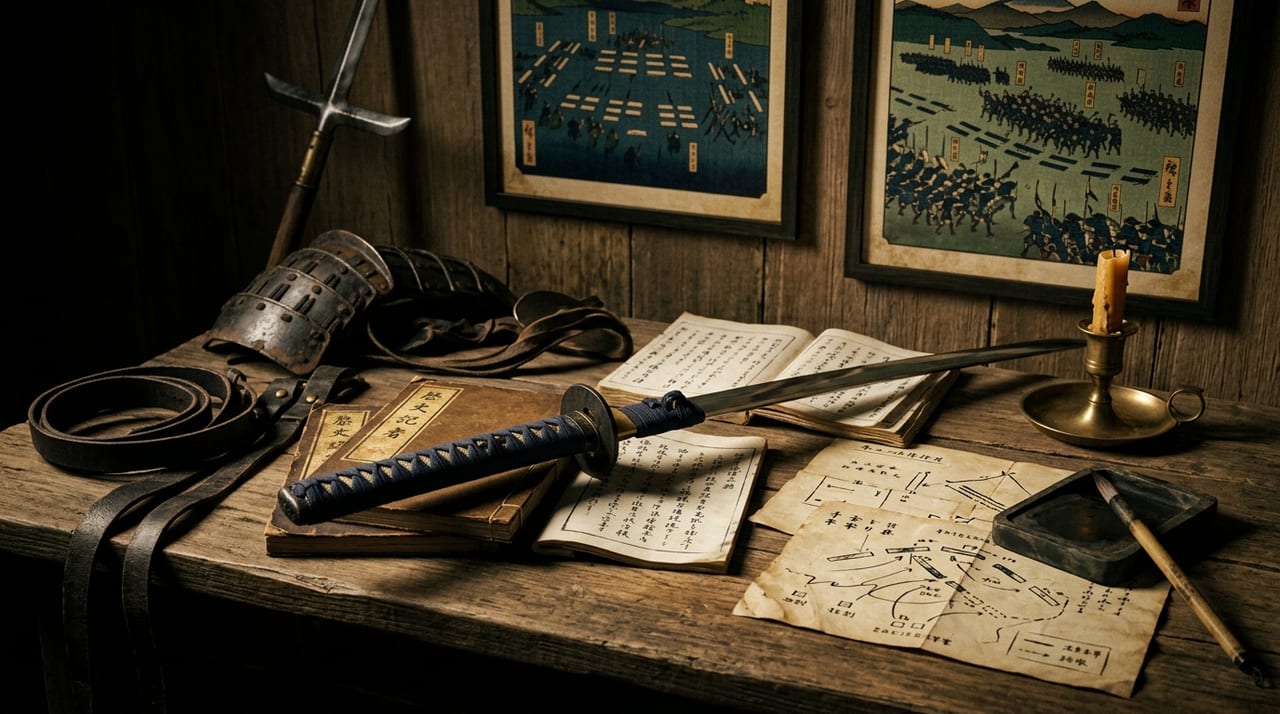
 * Image is for illustrative purposes only.
Sekigahara (Film, 2017)
関ヶ原(映画・2017年)
A 2017 historical film directed by Masato Harada and starring Junichi Okada, based on the novel of the same name by Ryotaro Shiba (1966). It depicts the Battle of Sekigahara in 1600—the decisive battle for supremacy—from the perspective of Mitsunari Ishida. A work that addresses 'swords and politics' among warlords in the late Sengoku period directly and seriously. The practical swordplay scenes of the Sengoku era, choreographed by Junichi Okada (who has grounding in Jeet Kune Do, Kali, and Shooto), received serious critical acclaim. Unusually for a Japanese battle film, in its serious depiction of individual swordplay within combat, it holds visual significance as a representation of sword culture.
Description
Sekigahara (2017)—The Intersection of 'Swords and Politics' Embodied in the Battle of Succession
Sekigahara (directed by Masato Harada, 2017) is a grand historical film based on the historical novel "Sekigahara" (1966) by Ryotaro Shiba, depicting the 1600 Battle of Sekigahara—the decisive battle for supremacy—from the perspective of Ishida Mitsunari. The lead actor Okada Junichi (of V6) is known as an actor with actual training experience in Jeet Kune Do, Kali, Shooto, and other martial arts, and has received high critical acclaim for his filmmaking that emphasizes the 'authenticity' of sword choreography in historical drama. The significance of this film in the context of Japanese sword culture lies particularly in the fact that it seriously depicted how Sengoku warlords wielded their swords from a perspective—rare in Japanese historical films—of 'individual swordplay within the battle that decided supremacy.'
### Ishida Mitsunari's Sword—A Warlord of Strategy Over Military Might and the Blade
Ishida Mitsunari is historically known as a 'civil-focused warlord who prioritized strategy and political power over military force,' and the image of him as a master swordsman is thin. In the original novel, Ryotaro Shiba also portrays Mitsunari as a 'politician who upheld righteousness,' and the essence of his tragedy lies in the paradox that 'a warlord who honed law rather than swordsmanship lived in an age of swords.' The film version (2017), while capitalizing on Okada Junichi's martial arts background, depicts Mitsunari's swordplay not as that of a 'martial artist' but as 'a warlord's practical self-defense swordplay,' thereby pursuing realism in how Sengoku warlords wielded their swords.
### The Battle of Sekigahara and Sword History—The Role of Swords in the Age of Muskets
The 1600 Battle of Sekigahara occupies a position near a critical turning point in Japanese sword history. The role of the sword in Sengoku battles of this era fundamentally differed from the one-on-one mounted combat of the Heian and Kamakura periods, where warriors wielded the tachi. In late Sengoku battles, tanegashima muskets, bows and arrows, and spears were the primary means of long-distance attack, while swords functioned as 'a last resort in close combat,' 'a tool for confirming the heads of fallen enemies,' and 'a symbol of a warlord's authority.' The role of the sword in the Battle of Sekigahara—a 'large-scale organized battle'—embodies the reality of 'the sword as a personal weapon on a battlefield crowded with tens of thousands of soldiers,' demonstrating a realistic context of sword use that differs from the stereotype of 'one-on-one duels between swordsmen' in historical drama.
### Okada Junichi's Swordplay—Jeet Kune Do and Sengoku Swordplay
The sword choreography scenes of Okada Junichi in the film version of Sekigahara received high acclaim as 'the swordplay of a historical drama actor.' Okada is an actual practitioner of kendo, Jeet Kune Do, Kali, and Shooto, and his expression of 'the practical swordplay of Sengoku warlords' utilizing his physical abilities possesses a realism distinct from the stylized 'stage sword choreography' of conventional historical drama. The characteristic of practical Sengoku sword technique lies not in the accuracy of cuts, but rather in 'coordination with spears and naginata, and diverse hand-to-hand combat against common soldiers,' and Okada's background in Jeet Kune Do, Kali, and Shooto (comprehensive martial arts including striking and grappling) is well-suited to expressing this 'diverse Sengoku swordplay.' The film's sword choreography is evaluated as an attempt to bridge 'the stylized beauty of historical drama' and 'Sengoku realism (practical combat).'
### Ryotaro Shiba's "Sekigahara" and Sword Culture—From Novel to Film
The original "Sekigahara" by Ryotaro Shiba (1966) is one of the most widely read historical novels in Japan, and including the 1980s television drama version (starring Kato Go), is representative of works that established the image of the Battle of Sekigahara in the consciousness of modern Japanese people. Ryotaro Shiba's historical novels generally tend to carefully depict 'the relationship between warlords and swords'—how many swords a warlord possessed, which sword he favored, how he wielded his sword on the battlefield—and "Sekigahara" is no exception. The film version (2017) visualized this context and drew visual attention to the swords of Sengoku warlords.
### Sword History After the Battle of Sekigahara—Unification and the Transformation of Swords
The Battle of Sekigahara (1600) is the battle that heralded the beginning of the Tokugawa Edo Shogunate (established in 1603), and it signifies a major turning point in Japanese sword culture. The transition from practical Sengoku swords ('Sengoku mounting') to Edo ceremonial swords (the culture of wearing the daishō as formal samurai dress) illustrates a historical process in which 'the function of swords' fundamentally transformed from 'practical weapons' to 'symbols of status and etiquette.' The Battle of Sekigahara, the 'last great battle of the Sengoku period,' is emblematic of 'an era on the eve of this transformation—the time when swords were last used on a large scale as practical weapons'—and the 2017 film version can be evaluated as a work that attempted to recreate the realism of sword use in this era through film.
### A Perspective for Sword Collectors
Sekigahara (2017) provides an intriguing point of reference for sword enthusiasts as a film that seriously depicted in cinematic form 'the actual role of swords in late Sengoku battles'—'swords not as ceremonial or self-defense implements, but as personal weapons within organized combat.' In particular, as historical context for considering the difference between 'Sengoku mounting'—the austere sword fittings for practical use—and 'Edo mounting,' the Battle of Sekigahara occupies an important position as 'the last large-scale example of practical sword use.' Moreover, the motif of Ishida Mitsunari as 'a warlord who chose politics over the sword—a tragedy'—provides an opportunity to consider the spiritual dimensions of sword culture, as a work that poses to the modern era the fundamental question of Japanese samurai culture: 'what does it mean to carry a sword?'
Real Swords Featured
Uchi-gatana
Yari
Naginata
See authentic Japanese swords
See authentic Japanese swordsThis page is intended to introduce Japanese sword culture and is not affiliated with any of the works mentioned.