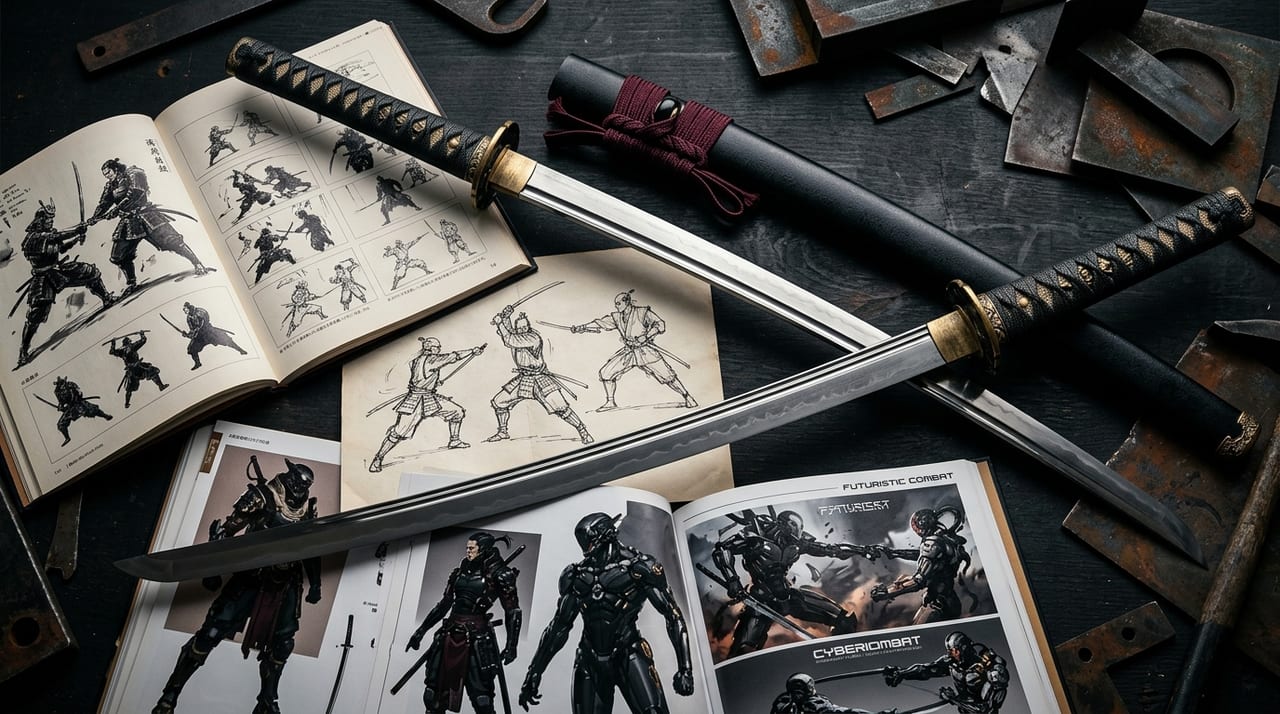
 * Image is for illustrative purposes only.
Samurai 7
SAMURAI 7
A sci-fi anime series by GONZO (2004, 26 episodes) reimagining Akira Kurosawa's film Seven Samurai (1954) in a near-future world. Seven samurai face mechanized warriors (mech-samurai) in an epic battle. The series reinterprets the fundamental beauty and power of the Japanese sword within a setting that fuses classical sword technique with advanced technology.
Description
SAMURAI 7——Reinterpreting Kurosawa's Legacy through Sci-Fi
SAMURAI 7 is a 26-episode science fiction anime produced by GONZO in 2004, based on Akira Kurosawa's "Seven Samurai" (1954), one of cinema's greatest masterpieces. Set in a near future, the story of seven samurai defending farmers against mechanical warriors preserves the essence of the original—samurai duty, sacrifice, and solidarity—while redefining the cultural and spiritual significance of the Japanese sword within a science fiction framework.
### Kurosawa's Film and the Essential Themes of the Japanese Sword
The original "Seven Samurai" is set in an era when the Japanese sword functioned as "the symbol of samurai status and vocation"—the late Sengoku and early Edo periods. SAMURAI 7 inherits this theme while depicting a paradoxical future world where the symbolic value of "the blade" does not fade even as the world becomes mechanized. The seven samurai each possess distinct sword styles, and the world is constructed such that the essential values of the sword—speed, precision, and combative distance—remain effective even against mechanical enemies.
### The Sword Techniques of Characters and Their Historical Backgrounds
The protagonist, Shimada Kanbei (島田勘兵衛), is depicted as a bold swordsman wielding the ōdachi (great sword), corresponding to Kanbei in Kurosawa's film (played by Shimura Shoji). The seven characters collectively symbolize sword techniques from different eras and schools, bringing together the diversity of Japanese swordsmanship—single-draw iaijutsu, sweeping ōdachi technique, multiple-sword styles. This structure serves an excellent educational function in conveying the historical diversity of the Japanese sword and sword techniques to contemporary anime viewers.
### The Fusion of Science Fiction and Sword Culture
One reason SAMURAI 7 is noteworthy lies in the cultural significance of the "sword versus mecha" contrast. The narrative structure in which human skill, spirit, and the sword triumph over mechanically powerful enemies embodies a philosophical inquiry that redefines the value of "the sword as a weapon." This work demonstrates that the traditional Japanese concept—that the sword is not merely an iron implement but an "extension of the wielder's spirit"—remains valid even in a science fiction context.
### A Perspective for Sword Enthusiasts
SAMURAI 7 is an enjoyable work for both those familiar with "Seven Samurai" and those encountering it for the first time. For those interested in the Japanese sword, it functions as an introductory work where one can visually experience the diversity of sword techniques (ōdachi, iaijutsu, multiple-sword styles) and the spiritual aspects of the samurai. This work, in which respect for the original coexists with its own reinterpretation, also contributes to the international promotion of Japanese sword culture.
Real Swords Featured
Ōdachi / Nodachi — Great Swords
Blades over 90 cm (ōdachi or nodachi) were battlefield weapons used for sweeping strikes on horseback or for their overwhelming reach in massed combat. The great sword preserved at Yamazaki Rikkyū Hachimangū in Kyoto measures 221 cm in total length. The protagonist Shimada's oversized blade draws on this cultural tradition.
Dual-Sword and Multi-Blade Techniques
While Miyamoto Musashi codified the two-sword style (Niten Ichi-ryū), various multi-blade techniques existed throughout the Sengoku period. The simultaneous use of uchigatana in the right hand and wakizashi in the left combined offense and defense in practical battlefield conditions. Several Samurai 7 characters embody different multi-sword styles, illustrating the diverse development of Japanese sword technique.
See authentic Japanese swords
See authentic Japanese swordsThis page is intended to introduce Japanese sword culture and is not affiliated with any of the works mentioned.