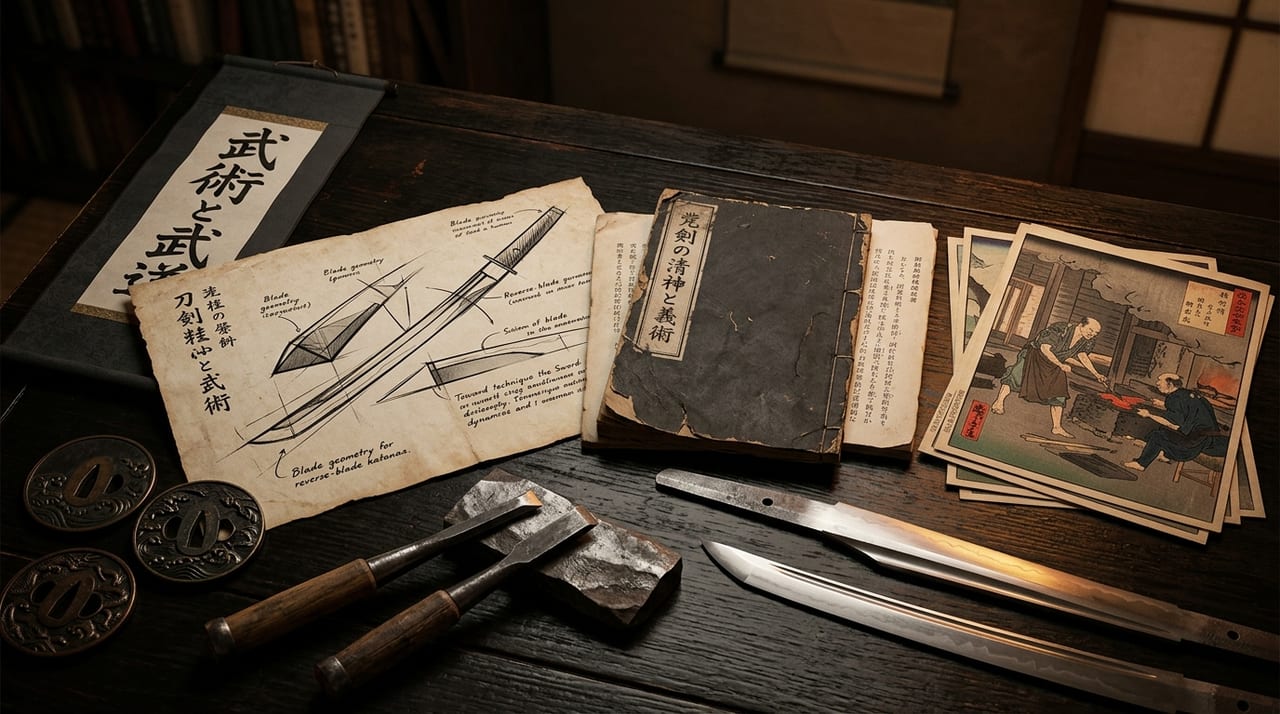
 * Image is for illustrative purposes only.
Rurouni Kenshin
るろうに剣心
A Meiji swordsman romance by Nobuhiro Watsuki. Set in the Bakumatsu period and the Meiji Restoration, a time of great upheaval for the Japanese sword, the work interweaves the fictional sakabatō, reverse-blade sword, which embodies the ideal of fusatsu (vow not to kill), with real Bakumatsu-era swordsmanship schools: Hokushin Ittō-ryū, Shintō Munen-ryū, and Jigen-ryū. The live-action film adaptation became a worldwide hit and brought wide attention to the sword culture of the shinshintō period and the fate of the Japanese sword around the Sword Abolition Edict (Haitōrei).
Description
Reverse-blade sword and philosophy
Rurouni Kenshin is a work that places at its core the most dramatic turning point in the history of the Japanese sword, the Meiji Restoration. The sakabatō, reverse-blade sword, carried by the protagonist Himura Kenshin is a fictional sword that gives form to his fusatsu (vow not to kill) by reversing the edge and the back. Yet swords with reversed blades are also confirmed to have existed in history, and the very idea of entrusting a sword with its owner's philosophy shows clearly that the Japanese sword is not merely a weapon but a spiritual symbol.
Background of the shinshintō period
The historical setting of the work, from the late Edo period to the early Meiji era, falls at the height of the shinshintō period in the history of the Japanese sword. Shinshintō refers to the swords made by late Edo smiths who studied the masterpieces of the Kamakura and Nanboku-chō period koto (old swords) and sought to recreate them. Two smiths representative of this era are Minamoto Kiyomaro and Koyama Munetsugu. Kiyomaro pursued the bold style of the Sōshū tradition and forged powerful swords with deep nie and vigorous jikei/chikei. His fierce temperament and turbulent life are still told together with the epithet 'Yotsuya Masamune', and he is highly regarded as the foremost genius of the shinshintō period. Munetsugu, on the other hand, excelled in the chōji-midare of the Bizen tradition and is known for a splendid, meticulous style. The works of both are still highly valued today and treasured as art swords.
Real schools
Many of the swordsmanship schools in the work are also real. Hiten Mitsurugi-ryū, Himura Kenshin's school, is fictional, but Saitō Hajime's Gatotsu is said to be the author's shōnen-manga-style adaptation of the left-handed one-handed thrust that the historical Saitō Hajime excelled at. The work as a whole strongly reflects real schools that shaped the Bakumatsu period: Hokushin Ittō-ryū, Shintō Munen-ryū, and Jigen-ryū. Hokushin Ittō-ryū, founded by Chiba Shūsaku, was the largest school of the Bakumatsu period, and its achievement in rebuilding swordsmanship, which had tended toward spiritual discipline, into a rational system of technique is great. Tennen Rishin-ryū is a practical school practiced by the core of the Shinsengumi, including Kondō Isami and Hijikata Toshizō, and its robust swordsmanship shook Kyoto during the Bakumatsu period.
Haitōrei and the transition
The era of the Sword Abolition Edict (Haitōrei) of 1876, depicted late in the story, is a historic turning point at which the Japanese sword ended its role as a weapon and began its path as an art object and cultural property. Rurouni Kenshin explores in depth the duality of the Japanese sword (destruction and creation, killing and protection, weapon and art) by overlaying this transition onto Kenshin's own way of life.
Real Swords Featured
Shinshintō
A general term for Japanese swords forged from the late Edo period, around the Kansei era (c. 1789), into the early Meiji era. In this period, smiths who aimed to return to the masterpieces of the koto period studied the traditions of each region and established their own distinctive styles, and it is also called the last flowering of Japanese sword history. Minamoto Kiyomaro, drawn to the Sōshū tradition, was called 'Yotsuya Masamune', and his bold hamon with deep nie and vigorous base steel still captivate many sword enthusiasts. Koyama Munetsugu excelled in the chōji-midare of the Bizen tradition and is known for splendid, meticulous work. Suishinshi Masahide, Taikei Naotane, and Minamoto Kiyomaro are together called the 'Edo Sansaku', the Three Great Edo Smiths.
Hokushin Ittō-ryū
A major swordsmanship school founded in the late Edo period by Chiba Shūsaku, and the largest school of the late Bakumatsu period. Whereas earlier swordsmanship tended to emphasize spiritual training, Chiba Shūsaku systematized technique rationally and established a practical training method centered on striking practice with bamboo swords and protective gear. His dōjō, the Genbukan, was known as 'Gi no Chiba', and many Bakumatsu patriots, including Sakamoto Ryōma, came through its doors. Hokushin Ittō-ryū, which draws on the Ittō-ryū lineage while adding its own rationality, also had a major influence on the establishment of modern kendō after the Meiji era.
Tennen Rishin-ryū
A practical swordsmanship school founded in Edo by Kondō Kuranosuke in the Kansei era and spread through the Tama region of Musashi Province. Its distinguishing features are training with thick, heavy wooden swords and a bold style that emphasizes the power of the cut. Unlike other schools centered on the samurai class, it reached out to neighboring farm villages and also taught the sons of farmers. The fourth head of the school, Kondō Isami, served as commander of the Shinsengumi and worked to maintain order in Kyoto. Together with Hijikata Toshizō and Okita Sōji, both disciples of Tennen Rishin-ryū, he made his name in the Ikedaya incident of 1864 and other events.
Sword Abolition Edict (Haitōrei)
Dajōkan Proclamation No. 38 of Meiji 9, 'Prohibition of Wearing Swords Except with Court Dress or Military, Police and Official Uniforms', issued by the Meiji government in 1876. As a result, ordinary shizoku lost the right to carry swords, and the Japanese sword, regarded as the soul of the samurai, came to the end of its era as a practical tool. However, the Sword Abolition Edict was not the end of the Japanese sword; it was also the beginning of its reappraisal as art and cultural property. From the Meiji era on, the Japanese sword changed its social position from 'weapon' to 'artistic craft', gaining new value as an object of appreciation and preservation. This transition is precisely the historic watershed that makes it possible for us today to love the Japanese sword as art.
See authentic Japanese swords
See authentic Japanese swordsThis page is intended to introduce Japanese sword culture and is not affiliated with any of the works mentioned.