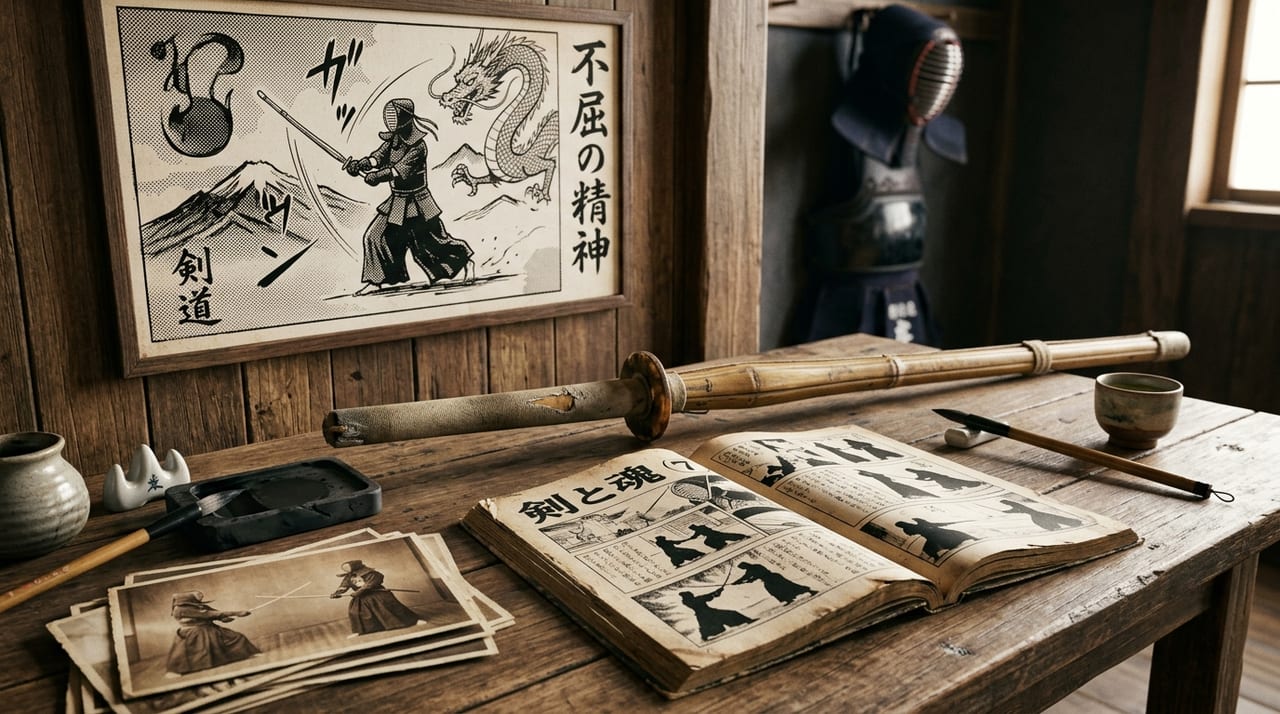
 * Image is for illustrative purposes only.
Musashi no Ken (Sword of Rokusanshi)
六三四の剣
Kendo manga by Murakami Motoka (serialized 1981–1985 in Weekly Shonen Sunday) and anime adaptation (1985–1986). A story of growth following Natsuki Musashi (夏木六三四), the son of a kendo master, as he walks the path of kendo. The series inherits Miyamoto Musashi's philosophical spirit through a contemporary kendo prodigy—popularizing the essential meaning of kendo as "inheriting the Japanese sword's philosophy through the bamboo sword" in the format of boys' manga. An important work and landmark of Japanese kendo manga that contributed to the cultural formation of modern kendo's approximately 1.8 million practitioners.
Description
Musashi no Ken (Sword of Rokusanshi) — The Landmark Kendo Manga That Inherited Miyamoto Musashi's Spirit for the Modern Age
Rokusanshi no Ken (Murakami Motoka, serialized 1981–1985 in Weekly Shonen Sunday; anime adaptation NHK 1984–1985) is the defining kendo manga of Japanese popular culture. Protagonist Natsuki Musashi — named directly after Miyamoto Musashi through a Japanese wordplay (六三四 = mu-sa-shi) — is the son of a kendo master raised to be Musashi's spiritual successor. This naming is not merely clever wordplay: it encodes the series' core theme — that the philosophical legacy of Japan's greatest swordsman is transmitted through modern kendo, that the shinai (bamboo sword) inherits the spirit of the Japanese blade.
### The "Musashi" Name — Inheriting the Sword's Philosophical Legacy
Naming the protagonist Musashi explicitly through a numerical wordplay is a statement of the work's thematic program: the philosophical inheritance of Miyamoto Musashi's swordsmanship — Niten Ichi-ryū's two-blade discipline, the concept of "sen no sen" (pre-emptive initiative), the "water principle" of formlessness — reinterpreted as modern kendo through the growth of a contemporary boy. The series thus functions simultaneously as a kendo coming-of-age story and as an inquiry into the modern transmission of Musashi's sword philosophy.
### Kendo Manga and the Spirit of the Japanese Sword
The series' importance for sword enthusiasts lies in its careful portrayal of how the Japanese sword's philosophy is transmitted through the shinai. Kendo uses bamboo swords and protective equipment rather than live blades, but the technical system — designated striking targets (men, kote, dō, tsuki), the three conditions for valid ippon (ki, posture, sword technique), the theory of ma-ai — is designed as a logical extension of actual sword-fighting logic. The depiction of Musashi's technical growth shows not merely athletic improvement but "approach to the essence of swordsmanship" — making this the most accessible manga portrayal of how kendo embodies Japanese sword philosophy.
### Father and Son — Inheritance of the Way
The series' second major theme is the "inheritance of the sword's way" from father to son. Musashi's father Hikoshirō raises his son with the explicit intention of making him Miyamoto Musashi's spiritual heir — embodying the Japanese martial culture's foundational value of "transmission through the teacher-student relationship." Real sword culture operates through the same principle: the Sōshū, Yamato, and Yamashiro sword traditions were transmitted across generations, just as sword schools transmitted kata (forms) from master to student. Rokusanshi no Ken presents this inheritance culture in the most emotionally direct possible form.
### Contribution to Kendo's Cultural Formation
Japan's current kendo population of approximately 1.7–1.8 million practitioners includes many who were motivated to begin training by this series during its 1980s serialization and NHK anime broadcast. The work's contribution to the cultural formation of modern kendo — broadening the base of practitioners by making the sword's way emotionally compelling for young readers — is its major historical legacy.
### Murakami's Research and Technical Accuracy
Murakami Motoka conducted extensive dojo research and observation during the series' production, achieving a technical accuracy in kendo depiction praised by actual practitioners — the depiction of valid ippon conditions, referee gestures, and match strategy is sufficiently precise that the series functions as an informal kendo primer. This pursuit of realism enabled the work to transcend "shonen entertainment" and serve as a vehicle for popularizing kendo and sword culture.
### Perspective for Sword Collectors
Rokusanshi no Ken is the classic kendo manga for experiencing how the spirit of the Japanese sword lives in contemporary kendo — emotionally and narratively. Through the process of reinterpreting Miyamoto Musashi's sword philosophy as a modern boy's coming-of-age story, the concepts of ikken hissatsu, ma-ai control, and ki cultivation become tangible as they are inherited through the shinai. For Japanese sword collectors seeking to deepen their cultural context by expanding into kendo and swordsmanship, this manga is one of the best entry points for learning the spirit of the blade through emotional story immersion.
See authentic Japanese swords
See authentic Japanese swordsThis page is intended to introduce Japanese sword culture and is not affiliated with any of the works mentioned.