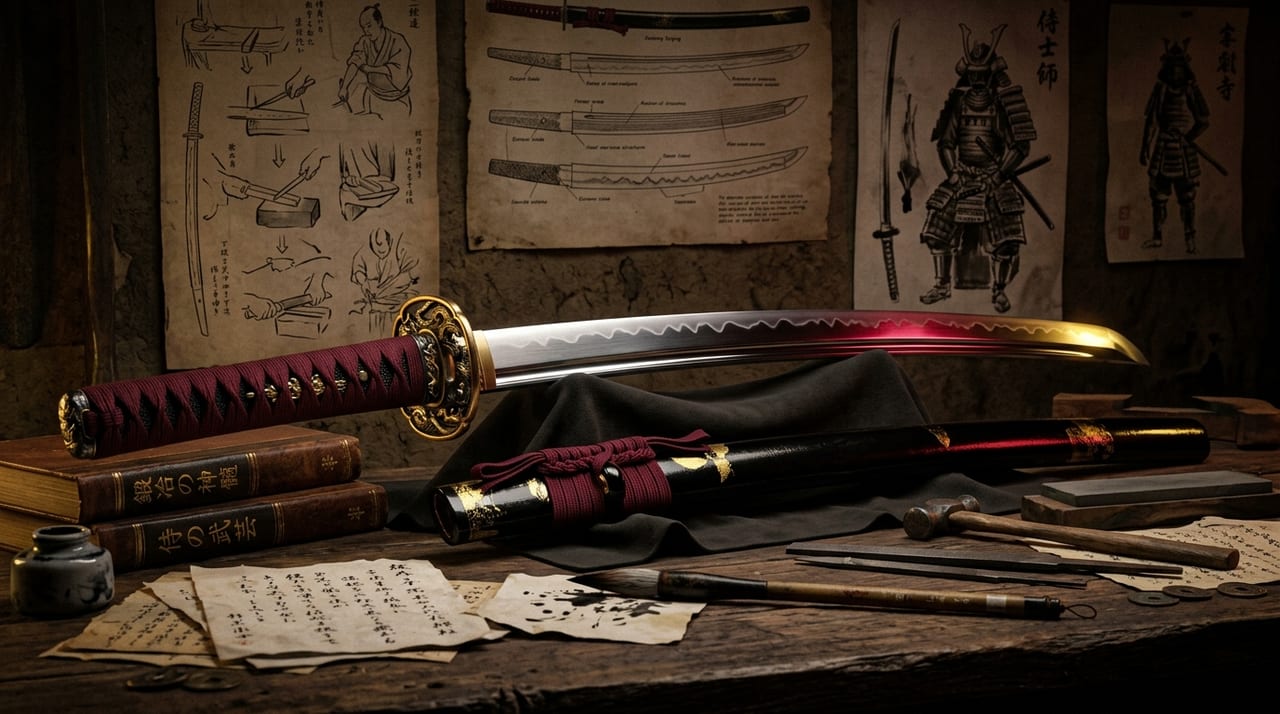
 * Image is for illustrative purposes only.
Rashomon
羅生門
A 1950 Japanese film directed by Akira Kurosawa, set in Heian-era Kyoto, in which a bandit, a samurai's wife, the murdered samurai's spirit, and a woodcutter each give conflicting accounts of the samurai's killing in a forest, with his stolen sword at the center of the mystery. It won the Golden Lion at Venice and an honorary Academy Award, introducing Japanese cinema to the world.
Description
Overview
Rashomon (1950) is a Japanese film directed by Akira Kurosawa, written by Kurosawa and Shinobu Hashimoto. Its central plot is drawn from Ryūnosuke Akutagawa's short story "In a Grove," while its title and framing device — men sheltering from rain and recounting the story — come from Akutagawa's separate story "Rashomon." It stars Toshiro Mifune as the bandit Tajōmaru, Machiko Kyō as the samurai's wife Masago, Masayuki Mori as the samurai Takehiro, and Takashi Shimura as a woodcutter.
The Sword at the Center of Conflicting Testimony
In a forest near Heian-era Kyoto, a samurai is killed. Questioned by magistrates, the bandit Tajōmaru claims he defeated the samurai in a fair sword duel; the samurai's wife confesses to stabbing her husband herself; the samurai's spirit, summoned through a medium, says he took his own life with a dagger in despair over his wife's betrayal; and a woodcutter who witnessed the events gives yet another version. Every account contradicts the others, but all agree on one fact: the samurai's sword is missing from the scene. The question of who held that sword, and how it factored into the killing, sits at the heart of the film's unresolved mystery.
Technique
Kurosawa filmed sunlight filtering directly through the forest canopy into the lens and structured the film as a montage of equally weighted, contradictory testimonies, visualizing the relativity of truth that no single viewpoint can capture. This narrative device gave rise to the term "the Rashomon effect," now used well beyond film criticism — in psychology, law, and media studies — to describe contradictory eyewitness accounts of the same event.
Reception and International Impact
The film won the Golden Lion at the 1951 Venice International Film Festival and received an Honorary Academy Award (for Best Foreign Language Film) at the 24th Academy Awards in 1952. This recognition is widely credited with first drawing serious Western attention to Japanese cinema, laying the groundwork for its subsequent international reputation.
Cultural Impact
The fact that "the Rashomon effect" itself became an enduring term in global scholarship and journalism testifies to the film's outsized cultural reach. The device of a single sword, whose wielder remains unknown, destabilizing the truth of an entire narrative is often cited as an influence on later mystery works and courtroom dramas.
Real Swords Featured
See authentic Japanese swords
See authentic Japanese swordsRelated Content
Nobunaga's Ambition
Game信長の野望
Japan's longest-running historical simulation game series by Koei Tecmo (1983–). Players control Sengoku warlords including Oda Nobunaga in a quest for national unification. The series systematically parameterizes warriors' swords and equipment, providing one of the most comprehensive frameworks for learning about Japanese sword history, distribution, and connections to historical figures.
Seven Samurai
Film七人の侍
Akira Kurosawa's timeless masterpiece that introduced the world to Sengoku-era warriors and swords, influencing all subsequent action cinema.
Legend & Butterfly (Film, 2023)
Filmレジェンド&バタフライ(映画・2023年)
Toei 70th Anniversary commemorative work (directed by Otomo Keishi, screenplay Furusawa Yoshita, released January 2023). Kimura Takuya portrays Oda Nobunaga and Ayase Haruka portrays his primary consort Nōhime (Kicho), depicting the unknown bond between Nobunaga and Nōhime. A large-scale historical film with a total production cost of 2 billion yen and cumulative attendance exceeding 1.8 million. Rooted in the historically documented famous swords of Nobunaga — Sozan Samonji (Yoshimoto Samonji) and Heshikiri Hasebe — this is an important work from the perspective of sword culture, in which Nobunaga's sword aesthetics under the banner of 'Tenka Fubu' (Rule the Realm Through Arms) intersect with Nōhime's strength.
Blue Exorcist
Anime and Manga青の祓魔師
A shonen manga where exorcists who banish demons battle with swords. The protagonist's holy sword is central to the story.
Related Columns
This page is intended to introduce Japanese sword culture and is not affiliated with any of the works mentioned.