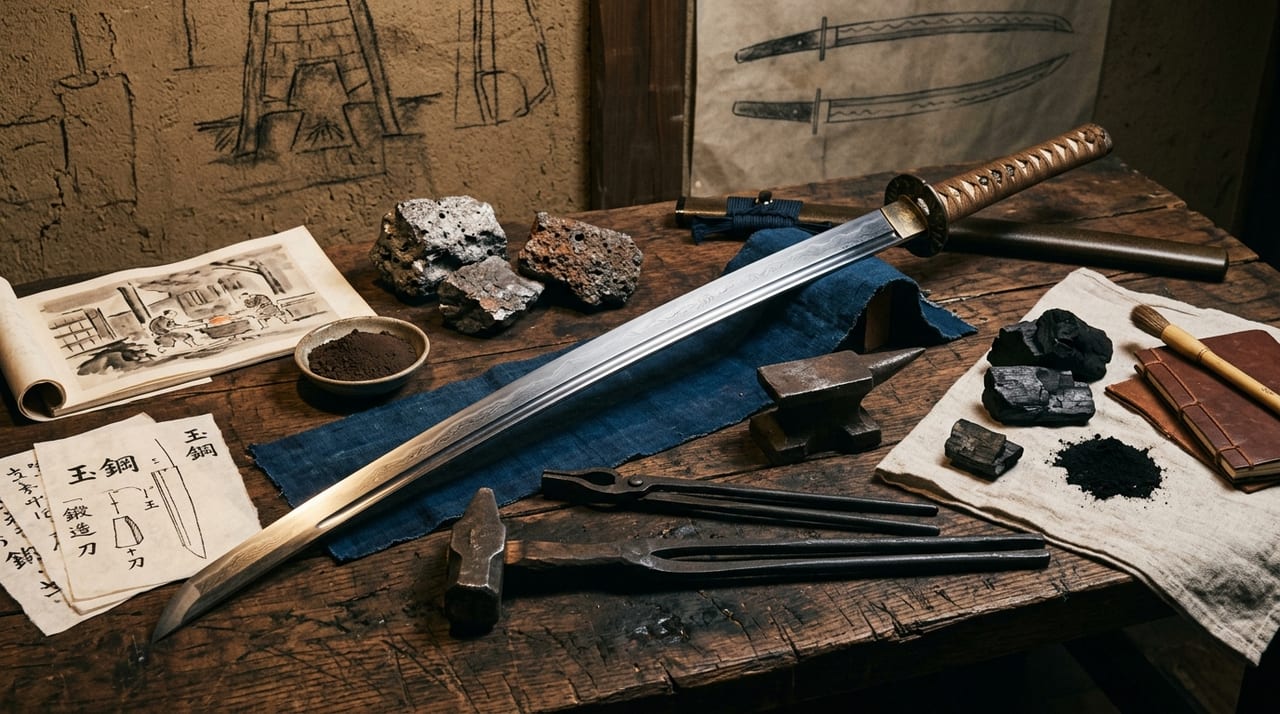
 * Image is for illustrative purposes only.
Princess Mononoke
もののけ姫
Animated film by Hayao Miyazaki (Studio Ghibli, 1997). Set in late-Muromachi-period Japan, the film depicts the conflict between a tatara ironworking village and the gods and beasts defending the forest. Gross: ¥19.3 billion (Japan's all-time box office record at the time). By centering the story on tatara steel production — the process that produces tamahagane, the steel from which Japanese swords are forged — the film is a crucial cultural reference for sword enthusiasts. The film depicts Muromachi-era weapons culture with precision: swords, bows, and firearms.
Description
Princess Mononoke — An Epic of Tatara Ironworking That Forges the Soul of the Japanese Sword
Princess Mononoke (1997, Studio Ghibli) is a masterwork of animated cinema directed by Hayao Miyazaki, set in late-Muromachi Japan. Its box office gross of 19.3 billion yen at release established the all-time record for Japanese film at that time and held the number-one position until Spirited Away (2001) surpassed it. This work, a landmark in Japanese film and animation history, holds special significance from the perspective of sword enthusiasts—for the very heart of this story is "tatara ironworking," which produces "tamahagane" (jeweled steel).
Tatara Ironworking — The Furnace That Creates the Soul of the Japanese Sword
The primary setting of Princess Mononoke, the "Tatara-ba" (ironworks village), is a community centered on tatara iron smelting. "Tatara" refers to a furnace employing Japan's distinctive ironworking technology, in which iron sand and charcoal are burned continuously for three days and nights or more to produce "kera"—blocks of raw iron. Breaking down and refining this kera yields "tamahagane" (jeweled steel)—the highest-quality steel that becomes the raw material for Japanese swords.
The characteristics of tamahagane differ fundamentally from modern steel. Tatara tamahagane, with its complex mixture of high-carbon and low-carbon zones, undergoes repeated folding (orikaeshi tanren) by the swordsmith, which homogenizes the carbon content and transforms it into a unique material that achieves both "hardness and resilience (toughness)." This sequence—"tatara smelting → tamahagane → repeated folding → Japanese sword"—is essential knowledge for understanding the intrinsic value of the Japanese blade, and Princess Mononoke depicts this "first process" of tatara ironworking as the dramatic center of the film.
The Tatara Village — The World of Muromachi-Period Ironworking Laborers
The woman "Lady Eboshi" who leads the Tatara-ba village is depicted as a figure who has built an autonomous society through the technical prowess and military power of tatara ironworking. In the Tatara-ba, people excluded from society—former courtesans, those suffering from occupational diseases (leprosy)—work together, embodying the ideal of "community built on ability and labor."
In preparing the film, Hayao Miyazaki conducted detailed research into actual tatara remains, including the "Suganoya Tatara" in Shimane Prefecture (the only tatara preserved in a state where it can still operate). The depiction of the Tatara-ba village—the structure of the takadono (blast furnace), the operation of the bellows (fuigo), the collection of iron sand—represents a meticulous historical reconstruction based on actual tatara ironworking technology, functioning as "living ethnography" even as an animated film.
Firearms and Swords — The Weapons Transition of Late Muromachi
The time period of Princess Mononoke (late Muromachi, roughly the 16th century) coincides with the arrival of firearms (arquebuses) in Japan (1543, Tanegashima) and the beginning of the transformation of traditional combat forms centered on swords and bows. The narrative depicts a contrast: while the people of the Tatara-ba led by Eboshi use arquebuses, samurai and Ashitaka employ traditional weapons such as sword and bow.
This "coexistence of old and new weapons" reflects the actual weapons-culture transition of the period. From the Eiroku era (1558–1570) onward, daimyo such as Uesugi Kenshin, Takeda Shingen, and Oda Nobunaga began to incorporate firearms on a large scale, and by the Battle of Nagashino in 1575, organized massed-volley arquebus tactics were established. By setting the story at this "moment just before the turning point," Princess Mononoke evokes the atmosphere of the final era when the sword functioned as the "primary weapon."
Ashitaka's Swordcraft — The Use of Bow and Sword
The protagonist, Ashitaka, is a young Emishi (Ainu people of the north), depicted firing arrows of superhuman power due to a curse, as well as engaging in close combat with a steel sword. Ashitaka's archery is depicted with awareness of authentic Japanese archery (yamato yumi) technique—the drawing method from the upper stance with a pushing-pulling motion, the proper posture upon release—reflecting the style of Muromachi-period warrior archery. Combined combat with the sword is also shown, expressing the "practical warrior combat style" that employs bow and sword in combination.
Tatara Ironworking and the Future of the Japanese Sword — Continuity to the Present Day
In the modern era, tamahagane is produced exclusively at the "Nittoho Tatara" in Okuizumo, Shimane Prefecture, with an annual output limited to approximately 4–5 tons. This tamahagane is distributed nationwide to swordsmiths through the "Society for the Preservation of Japanese Art Swords" and serves as the lifeline for maintaining traditional Japanese sword-forging methods. Princess Mononoke made the world of "tatara" visible to a mass audience and presented a visual answer to the question "Where does the material of the Japanese sword come from?"—making it the most significant popular-culture work for understanding this subject.
Perspective for Sword Collectors
Princess Mononoke is essential viewing for understanding the "material and origins" of the Japanese sword. The tamahagane production process, the cultural and social context of tatara ironworking, the weapons culture of the Muromachi period—all of these can be understood viscerally through this film. Particularly noteworthy is that the answer to the question "Why must the material of the Japanese sword be tamahagane?" can be experienced through images of the flames of the Tatara-ba and the labor of craftsmen—a contribution irreplaceable to deepening understanding of the intrinsic value of the sword.
See authentic Japanese swords
See authentic Japanese swordsThis page is intended to introduce Japanese sword culture and is not affiliated with any of the works mentioned.