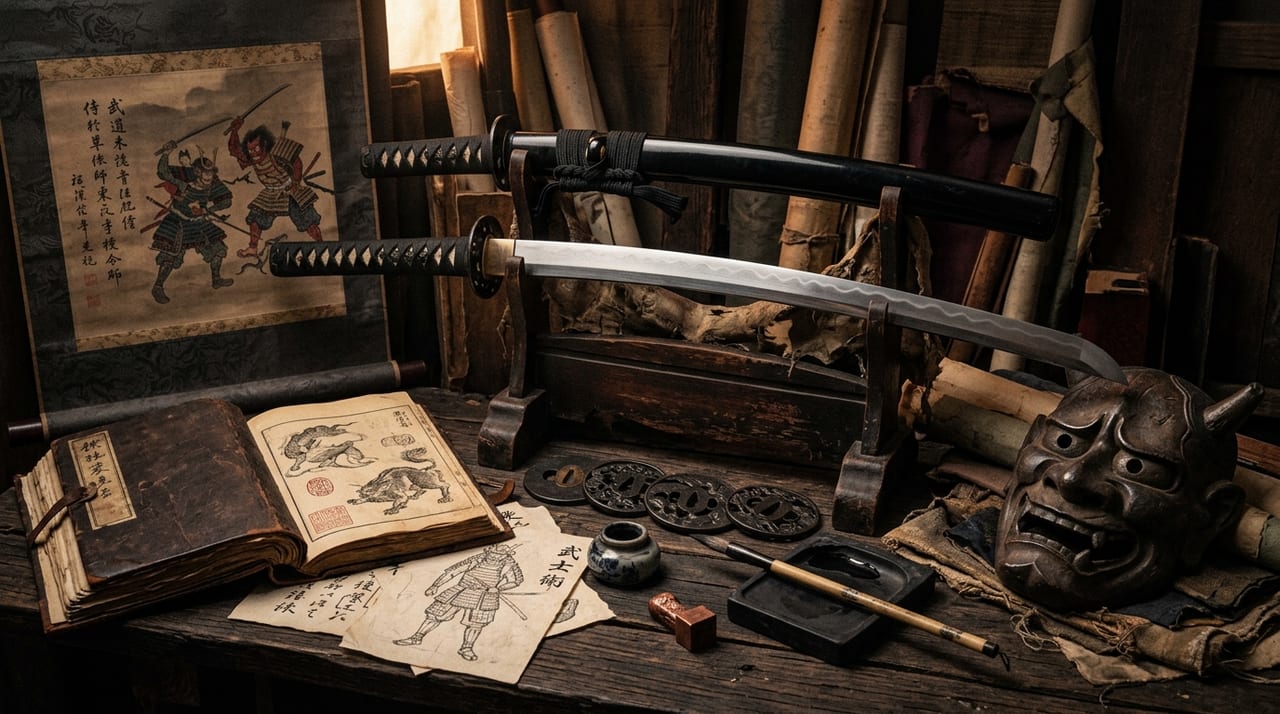
 * Image is for illustrative purposes only.
Onimusha (Capcom)
鬼武者(カプコン)
Capcom action-adventure game released in 2001 (PlayStation 2). Set in the Sengoku period, military commander Samanosuke Akechi, possessed by the power of the oni clan, fights yokai, oni, and evil spirits as an oni warrior. The series has sold approximately 8 million copies worldwide. The character is modeled after the historical military commander Akechi Samanosuke Mitsuaki and possesses a demon arm, the "Demon Hand" (kishi). A pioneering work of Japanese dark fantasy that introduced Japanese swords, armor, and Sengoku culture to game fans worldwide.
Description
The Work and Historical Background
Onimusha is an action-adventure game released by Capcom in 2001 for PlayStation 2 and was highly acclaimed as a pioneering work in the Japanese dark-fantasy genre. The series achieved cumulative sales of approximately 8 million copies worldwide, playing a significant role in conveying Japanese samurai culture—including the Sengoku period, Japanese swords, and armor—to the global market. The protagonist, Samanosuke Akechi, is based on the historical warlord Akechi Samanosuke Mitsuharu, and the story's setting of Azuchi Castle and Oda Nobunaga are grounded in actual history. However, the dark-fantasy setting centered on fictional entities such as the demon race and Genma represents a creative interpretation that significantly deviates from historical fact.
The Expression of Japanese Swords and Sengoku Weapons
The depiction of Japanese swords, armor, and weapons in the Onimusha series is based on a high standard of historical research for a game of that era. The "fatal blades" wielded by Samanosuke Akechi include multiple types such as tachi, uchigatana, and ōdachi, with the differences in form and function of each reflected in the game's combat system. The armor designs are modeled after the tōsei gusoku (contemporary armor) of the Momoyama period, shaped to resemble iron armor as actually worn by Sengoku warlords. This accurate depiction of weapons and armor provided players with an opportunity to develop interest in the actual weapons and defenses of the Sengoku period.
The Oni Hand and Japanese Demon Culture
The iconic element of Onimusha, the "oni hand" (demon hand), is depicted as a prosthetic left arm imbued with the power of demons. By defeating demons and monsters using spirit-absorbing stones, the oni hand absorbs their power and manifests various special abilities. This concept creates a unique worldview that merges Japanese demon and yokai culture with the way of the warrior. In Japanese mythology and folklore, "oni" (demons) are symbols of fear and power, and the concept of a warrior incorporating the power of demons (transformation into a demon spirit) resonates culturally with the actual use of demon motifs on the helmets of Sengoku warlords. The actual designs seen on the helmets of warlords such as Katō Kiyomasa and Fukushima Masanori—demon faces, kuwagata (horn ornaments), and various maedate (helmet crest ornaments)—form the background of the Onimusha worldview.
Series Development and International Influence
The Onimusha series produced entries one through three and derivative works such as "Onimusha Soul," and based on the worldview of the first game, was adapted into an anime series on Netflix (broadcast in 2023 as a new work starring Musashi Miyamoto as the protagonist), receiving international reassessment. The role of the series in promoting Japanese Sengoku history, demons, and samurai culture to the world can be considered the origin point of the genealogy of subsequent games featuring Japanese swords and samurai such as the "Nioh" series (Tecmo Koei) and "Ghost of Tsushima" (Sucker Punch Productions). The image of "warlords wielding Japanese swords in combat" that Onimusha implanted in the minds of gaming fans worldwide has greatly contributed to the international recognition and expanding interest in Japanese swords.
Real Swords Featured
Uchigatana and Tachi — The Principal Swords of the Sengoku Era
The Azuchi-Momoyama period (circa 1568–1600), which serves as the stage for Onimusha, was an era in which the transition from tachi to uchigatana was nearly complete. Tachi were swords hung from the waist with the blade facing downward, suited to mounted warfare of the Heian through Muromachi periods, while uchigatana were the early modern sword style worn with the blade facing upward. During the age of Nobunaga, Hideyoshi, and Tokugawa Ieyasu, the uchigatana dominated, and the sword style wielded by Akechi Samanosuke aligns with the historical accuracy of the era. Many masterworks of the "Keichō-shintō" period remain from this time, and works by master smiths such as Horikawa Kunihiro, Echizen Yasushige, and Shizu Saburō Kanetoshi are housed in museums throughout Japan.
Oda Nobunaga and His Sword Collection
Oda Nobunaga, an important character in the game, was historically renowned as an avid sword collector. Among the swords Nobunaga possessed and bestowed were numerous celebrated blades including "Heshikiri Hasebe" (currently housed in the Fukuoka City Museum) and "Fudō Yukimitsu." Through the collection and bestowal of swords, he demonstrated the authority of a conquerer of the realm. The sword "Ichigo Hitofuri" (forged by Awataguchi Yoshimitsu, currently an Imperial Regalia under the administration of the Imperial Household Agency), known as a favorite sword of Toyotomi Hideyoshi, is also one of the celebrated swords associated with a conquerer. Nobunaga's view of swords combined practicality and ceremonial dignity, which aligns with the depiction of the Oda regime in the world of Onimusha. Swords associated with Nobunaga can be viewed in museums throughout the nation, serving as reference points for understanding the historical background of Onimusha.
Momoyama-Period Tōsei Gusoku (Contemporary Armor)
The tōsei gusoku, which forms the basis for the armor design in Onimusha, is a uniquely Japanese iron-made armor system developed during the Sengoku through Momoyama periods. Unlike traditional armor assembled from kozane (small iron scales) laced with cord, tōsei gusoku employed plate armor construction, an innovative defense structure that developed in response to the proliferation of firearms. Numerous tōsei gusoku associated with Sengoku warlords are housed in major institutions such as the Tokugawa Art Museum in Nagoya, Osaka Castle Keep in Osaka, and the Tokyo National Museum, where the visual sources of Onimusha's design can be confirmed in their original forms. Examples such as the grandly decorated armor traditionally attributed to Katō Kiyomasa and featuring the legendary tiger-slaying episode demonstrate how the individuality and martial identity of actual warlords were crystallized in their armor.
Oni Iconography in Actual Sengoku Helmets
The core concept of Onimusha—"warlords possessed by the power of oni"—resonates deeply with the oni-face iconography found in actual Sengoku helmets. The helmets of Sengoku warlords often featured terrifying motifs such as oni faces (oni-men), large ornamental crests (ōtatemono), and flame ornaments (kaen-tatemono) designed to intimidate enemies. These were not merely decorative; they served as psychological tactics to demoralize the enemy and inspire allies. Examples such as the deer-antler crest (shikatsuno-maedachi) of Honda Tadakatsu, the crescent-moon crest (mikazuki-maedachi) and black single-eye helmet (kurogane hitomi-kabuto) of Date Masamune, demonstrate how warlords expressed their identity and terror through their helmets. Original examples of these helmets are preserved in museums and among the former possessions of daimyo throughout the nation.
See authentic Japanese swords
See authentic Japanese swordsThis page is intended to introduce Japanese sword culture and is not affiliated with any of the works mentioned.