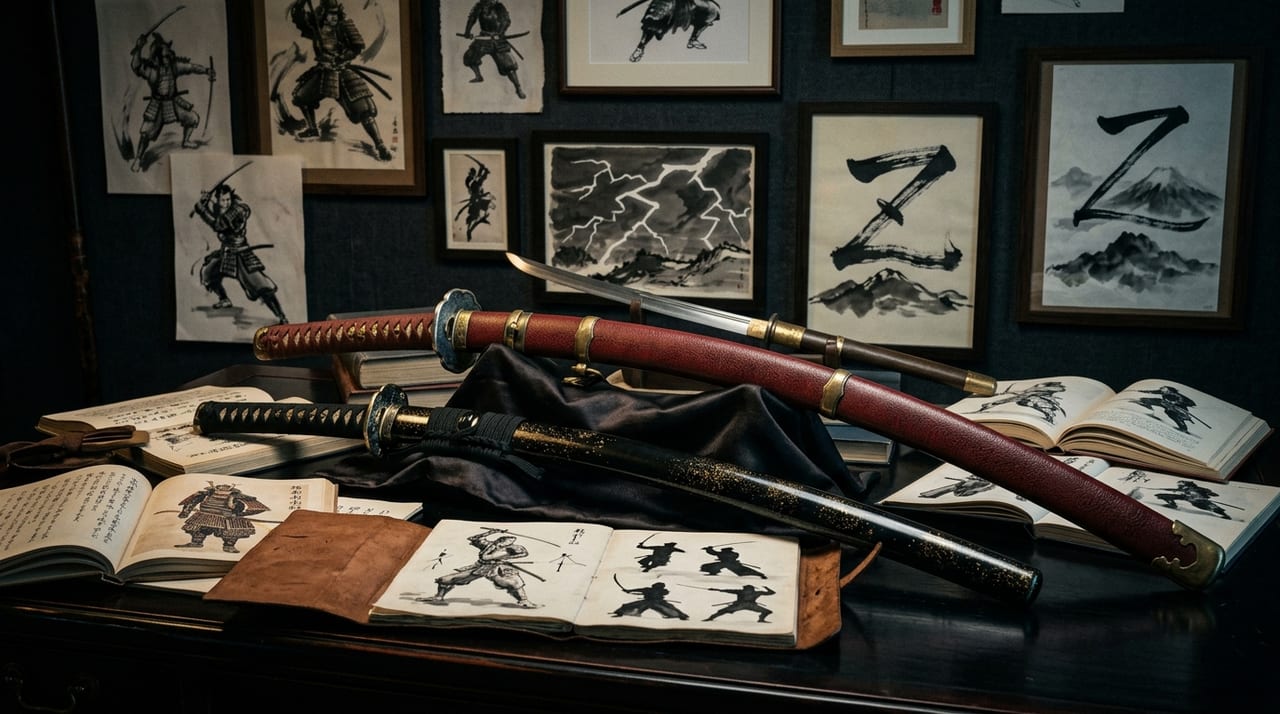
 * Image is for illustrative purposes only.
NARUTO -ナルト-
NARUTO -ナルト-
A masterpiece of ninja manga by Kishimoto Seishi. Orochimaru's Kusanagi sword derives from the Ama no Murakumo no Tsurugi, one of the Three Sacred Treasures of Japanese mythology, and the collection of large swords used by the Seven Swordsmen of the Hidden Mist reinterprets the diverse forms of Japanese swords within the ninja world. Sasuke's 'Chidori' and Kakashi's 'Raikiri' derive from the actual legendary sword of Tachibana Dōsetsu. Through the lens of ninja culture, the series achieved immense success in conveying Japanese mythology and weaponry culture to the world.
Description
Japanese Mythology and Swords
NARUTO by Kishimoto Seishi is a work that has permeated Japanese ninja culture, a distinctly Japanese cultural icon, throughout the world. Yet flowing beneath the narrative is the profound current of Japanese mythology and sword culture. The most symbolic sword in the series is the Kusanagi sword wielded by Orochimaru, which directly derives from the Ama no Murakumo no Tsurugi, one of the Three Sacred Treasures in Japanese mythology. The Ama no Murakumo no Tsurugi is a mythological sword said to have emerged from the tail of the Yamata no Orochi when Susanoo vanquished it. Later, Emperor Yamato Takeru (Yamato Takeru no Mikoto) used this sword during his eastern campaign to cut through grass and escape a fire attack, earning it the alternate name 'Kusanagi' (grass-cutting sword). Today it is enshrined at the Atsuta Shrine in Nagoya as a sacred object, and serves an important role in the imperial accession ceremony as evidence of the emperor's succession to the throne.
The Seven Swordsmen of the Mist
The seven large swords wielded by the Seven Swordsmen of the Mist are an excellent example of reinterpreting the diversity of Japanese weaponry within the ninja world. The massive blade of the Decapitating Carving Knife evokes the ōdachi that became popular during the Nanboku-chō period; the sharkskin-patterned blade suggests the actual practice of using sharkskin for sword fittings; and the Large Sword Tetsu references the kanasaibō, a blunt weapon. Japanese weaponry extends far beyond tachi and uchi-katana, encompassing naginata, spears, nagamaki, kanasaibō, tessen, and jittē—a remarkably diverse arsenal. NARUTO skillfully incorporates this diversity into the ninja worldview.
Connection to Tachibana Dōsetsu
The names of Uchiha Sasuke's 'Chidori' and Hatake Kakashi's 'Raikiri' derive from the beloved sword of Tachibana Dōsetsu (Bekki Kagenori), a Sengoku-period warlord. Dōsetsu was a senior retainer of Ōtomo Sōrin, the great lord of Bungo. One day, while resting beneath a large tree, he was struck by lightning; with the sword he carried, he cut through the lightning bolt—an extraordinary feat from which that sword earned the name 'Raikiri' (lightning-cutting). The sword's original name was 'Chidori' (thousand birds), and NARUTO adopted both names of this real legendary sword as his technique names. Despite the lightning strike leaving his lower body disabled, Dōsetsu continued to command battles from a palanquin, eventually leaving behind a legend of thirty-seven consecutive victories—a formidable commander.
The Ōdachi and Naginata
The ōdachi that became popular during the Nanboku-chō period is a magnificent sword with a blade length exceeding three shaku (approximately 90 cm), deployed in battle to exploit its intimidating presence and extended reach. The naginata is a long-hafted weapon with a curved blade, and was one of the primary weapons of the warrior class from the late Heian through Kamakura periods. The tradition that Minamoto no Yoshitsune was a master of the naginata is well-known; in later eras, it was widely practiced as a defensive art among women of the samurai class. At Tōken-za, we provide authentic Japanese swords that serve as the wellspring of such mythology and legend, transcending era and school of origin.
Real Swords Featured
Ama no Murakumo no Tsurugi (Kusanagi)
One of three imperial regalia symbolizing the imperial throne of Japan, and a sacred sword at the spiritual heart of Japanese sword culture. According to the Kojiki and Nihon Shoki, it emerged from the tail of the eight-headed great serpent Yamata no Orochi when Susanoo no Mikoto defeated it in Izumo. Later, when Yamato Takeru found himself under enemy fire attack in Suruga, he wielded this sword to sweep away grass and escape—thus earning the additional name "Kusanagi" (Grass-Cutting Sword). Today it is enshrined as the sacred treasure at Atsuta Shrine in Nagoya and remains hidden from public view. The three regalia are proof of imperial succession, and the Ama no Murakumo no Tsurugi represents martial prowess, standing alongside the Yata no Kagami (symbol of wisdom) and Yasakani no Magatama (symbol of benevolence). The Japanese understanding that the sword is not merely a weapon but a sacred entity fundamental to the state traces its roots to this myth.
Raikiri (Lightning-Cutting Sword)
The beloved blade of Tachibana Dōsetsu, a fierce warlord of the Sengoku period (also known as Bekki Kagetsura). Originally named "Chidori" (Thousand Birds), it earned the name "Raikiri" when Dōsetsu, resting beneath a large tree, was struck by lightning and instinctively swung this sword to cut the bolt. Despite suffering lower-body disability from that lightning strike, Dōsetsu continued to command the front lines from a palanquin and achieved the remarkable record of 37 consecutive victories without defeat. A devoted retainer of Ōtomo Sorin of Bungo, he was feared as the "Avatar of the Thunder God." This legend exemplifies Japanese belief in the supernatural power of the sword, and it became globally renowned through NARUTO's adoption of the concept for Hatake Kakashi's advanced technique, with Sasuke's related technique also called "Chidori."
Ōdachi (Great Sword)
A large tachi with a blade exceeding three shaku (approximately 90 cm), most prevalent during the Namboku-chō period (1336–1392). This was an age of turmoil when the imperial house split into Northern and Southern courts, and nationwide warfare continued. To meet battlefield demands for intimidation and extended reach, tachi proportions grew progressively larger. The "Hashaya no Otachi" enshrined at Kumano Shrine, with a blade of approximately 2.2 meters, is known as the largest existing Japanese ōdachi. In actual combat, mounted warriors wielded these from horseback to break enemy formations, and the great sword also served a symbolic role in rallying troops at the front lines. The majestic form of the ōdachi embodies the spirit of the Namboku-chō period, and swords from this age are unmatched in their combination of power and dynamic beauty.
Naginata
A Japanese-unique polearm with a long shaft (typically 120–150 cm) fitted with a curved blade (30–60 cm). It flourished as a primary weapon of the samurai from the late Heian period through the Kamakura period, and is remembered as one of the Seven Tools of Benkei during the Genpei War era. The tactic of using overwhelming reach to sweep the feet of mounted warriors was highly effective, and the very action of "nagu" (sweeping) is the source of its name. After the Sengoku period, it yielded its place as a primary weapon to the spear, but it became widely practiced among samurai women as a martial art for self-defense. In the late Edo period, the female warrior Nakano Takeko is remembered for wielding the naginata in battle. Today it continues to be transmitted as a competitive martial art under the auspices of the All Japan Naginata Federation.
See authentic Japanese swords
See authentic Japanese swordsThis page is intended to introduce Japanese sword culture and is not affiliated with any of the works mentioned.