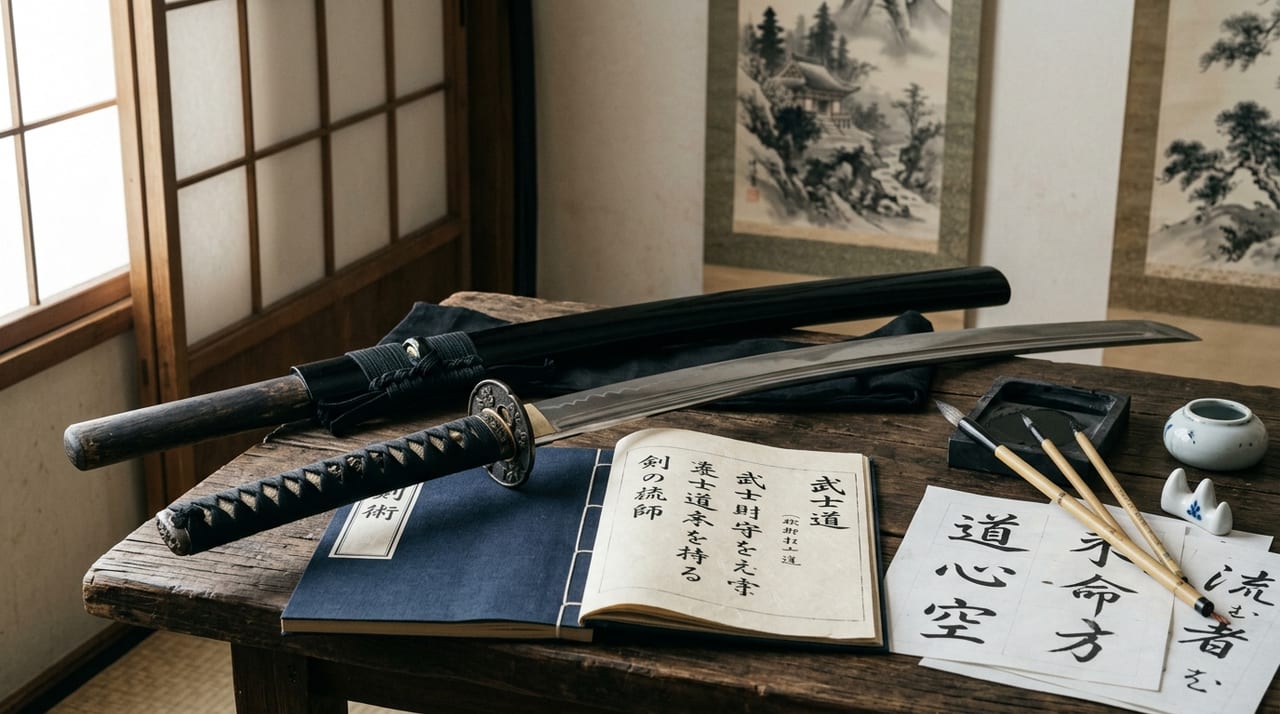
 * Image is for illustrative purposes only.
Miyamoto Musashi (Inagaki Hiroshi Director Trilogy)
宮本武蔵(稲垣浩監督三部作)
A film trilogy produced from 1954 to 1956 based on Yoshikawa Eiji's epic novel, directed by Inagaki Hiroshi and starring Mifune Toshiro. This work, depicting the life of swordmaster Miyamoto Musashi, won the Academy Award for Best Foreign Language Film (1955), establishing a landmark achievement that brought Japanese cinema and the name of Miyamoto Musashi to the world.
Description
Yoshikawa Eiji and the Legend of Miyamoto Musashi
Miyamoto Musashi (c. 1584–1645) was a historical swordmaster who flourished around the time of the Battle of Sekigahara and is known as the founder of the two-sword technique (Nitou Ichiryu). His work, the Book of Five Rings (Gorin no Sho), continues to be read today as a classic of sword philosophy and enjoys worldwide readership as a business and management guide. Yoshikawa Eiji's novel 'Miyamoto Musashi,' serialized in the Asahi Shimbun from 1935 onward, reimagined Musashi as 'a seeker of the Way who refined his character through the path of the sword,' while enriching historical fact with generous fiction. This Yoshikawa interpretation of Musashi formed the standard image of 'Miyamoto Musashi' in modern Japan and has been repeatedly featured across countless media—film, manga, games, theater, and more. It is said that Musashi engaged in over sixty serious duels throughout his life and never suffered defeat, though much about his true figure remains enigmatic and continues to be debated among scholars. The five-volume structure of the Book of Five Rings—'Earth, Water, Fire, Wind, and Sky'—represents an attempt to systematize sword technique from a cosmological perspective, transcending a mere technical manual to remain a philosophical work that continues to captivate modern readers.
Director Inagaki Hiroshi and Mifune Toshiro's Miyamoto Musashi
The 1954 film 'Miyamoto Musashi' directed by Inagaki Hiroshi and starring Mifune Toshiro is hailed as the finest adaptation of Yoshikawa Eiji's work. The remarkable transformation of Musashi as portrayed by Mifune—from a rough-hewn young man of overwhelming vitality into a seeker refined through the sword—is striking, and Mifune's own rare physical prowess and expressive power lend it conviction. The film received the Honorary Award (Best Foreign Language Film) at the 28th Academy Awards (1956), a triumph that elevated the international standing of Japanese cinema. This award not only enhanced the global reputation of Japanese film overall but also served to introduce Miyamoto Musashi and Japanese sword culture to the world. The trilogy consists of 'Miyamoto Musashi' (1954), 'Miyamoto Musashi: Duel at Ichijo Temple' (1955), and 'Miyamoto Musashi: The Final Duel at Ganryu Island' (1956), each standing as a complete and accomplished film in its own right. Mifune's Musashi remained a 'wall that must be overcome' in the minds of later filmmakers and actors, becoming the benchmark for all subsequent film adaptations of Miyamoto Musashi.
The Reality of Two-Sword Technique and Nitou Ichiryu
The 'Nitou Ichiryu' (One-School Two-Sword technique) founded by Miyamoto Musashi is a school of sword technique employing two swords—a long blade and a short blade (or tachi and katana)—wielded simultaneously. In the film, Musashi's dual-sword technique colors memorable scenes, leaving a strong visual imprint on the audience. The actual Nitou Ichiryu has been transmitted to the present day, with training conducted primarily in Kumamoto. Musashi's methods of strategy are systematized in the 'Dokkodo' (Way of Walking Alone) and the 'Book of Five Rings,' remaining highly valued today not merely as sword technique but as life philosophy and strategic doctrine. The philosophy of Nitou Ichiryu, condensing wisdom for maximizing the use of the Japanese sword as a weapon, provides an essential perspective for understanding sword technique history and the history of sword culture.
The Duel at Ganryu Island and Related Blades
One of the film's finest moments is the duel between Musashi and Sasaki Kojirou on Ganryu Island. The 'Washidoshi' (clothesline) said to have been used by Kojirou was reputedly a great sword (odachi) with a blade exceeding three shaku in length. The episode of Musashi carving a wooden sword to face this long-bladed swordsman symbolizes the essence of Musashi's sword philosophy—victory through spirit rather than adherence to technique or tools. The site of Ganryu Island (present-day Shimonoseki, Yamaguchi Prefecture) stands marked by a memorial, remaining a place of pilgrimage for many, connected to the legend of the swordmaster.
The Global Impact of Yoshikawa Eiji's Literature and Inagaki's Cinema
The Academy Award for Inagaki's Miyamoto Musashi was a watershed moment in Japanese film and cultural history. Released the same year as Kurosawa Akira's 'Seven Samurai' (1954), this work imprinted the image of the 'Japanese swordsman' vividly upon the world. Many of the subsequent stereotypes of 'samurai' and 'swordsmen' in Hollywood films and Western culture spring from the image presented to the world by Japanese cinema of that era. The Jedi of Star Wars, the kung fu swordsmen of The Matrix, and the DNA flowing through countless swordsman characters of the twenty-first century bear the strong influence of Inagaki's films and Mifune's Musashi.
The Book of Five Rings and Japanese Sword Philosophy—Connection with Toukenza
Miyamoto Musashi's 'Book of Five Rings' is also a work of worldview seen through the eyes of one who mastered the sword. Rather than emphasizing the quality of the tool, Musashi taught the importance of elevating the spirit and technique of the wielder to master the sword as the ultimate instrument. Toukenza handles blades of the Keicho, Genwa, and Kanei eras—both koto and shinto—crafted during the early Edo period when Musashi lived, as well as swords of the same lineage as those said to have been wielded by Musashi himself, offering collections that transmit the essence of the 'Way of the Sword' to the modern age. For those who have developed an interest in Japanese swords through the figure of Miyamoto Musashi, we invite you to view the actual blades of that era. The swords of the early Edo period, in which Musashi lived, fought, and philosophized, many of which survive into the present day, speak to us with the weight of authentic history.
Real Swords Featured
Washidoshi: The Legendary Odachi of Sasaki Kojirou
The 'Washidoshi' (clothesline) said to have been wielded by Sasaki Kojirou, Miyamoto Musashi's rival, is transmitted as a great sword (odachi) with an exceptionally long blade exceeding three shaku (approximately 90+ cm). This unusual length far exceeded the typical katana and enabled Kojirou's distinctive technique, the 'Tsubame Gaeshi' (Swallow Cut), which sought to control opponents through superior reach. While no extant example of the original 'Washidoshi' has been confirmed, a monument to Sasaki Kojirou stands near Kintai Bridge in Iwakuni City, preserving the legend as a regional swordmaster tale. Odachi with exceptionally long blades were produced abundantly during the Muromachi through Sengoku periods and remain a popular collecting category.
Keicho-period Shinto: Celebrated Blades of Early Edo
The Keicho to Genwa eras (1596–1624), during which Miyamoto Musashi flourished, marked the opening of the Shinto (new sword) period. This period coincides with the emergence of legendary smiths such as Horikawa Kunihiro, acknowledged as the founder of Shinto craftsmanship, and master craftsmen active in Kyoto and Echizen, with most swords Musashi encountered being Shinto of this age. Keicho-period Shinto developed distinctive hamon styles—such as vibrant gunome midare and all-hardening—differing from the classical koto, and gained high esteem as practical blades for sword technique. Though Musashi himself reportedly preferred wooden or bamboo swords, in earnest combat swordsmen selected highly reliable blades such as Keicho-period Shinto.
Echizen Yasushige: Master Smith of the Keicho-Genwa Period
Echizen Yasushige was a smith of Echizen active during the Keicho through Kanei eras (1596–1643), an accomplished craftsman authorized to use the Tokugawa mon (family crest) as official smith to Tokugawa Ieyasu. A contemporary of Miyamoto Musashi, his blades circulated widely throughout early Edo samurai society. Yasushige's swords, which inherited the traditions of the Soshu lineage while establishing a distinctive Echizen style, combined practicality with refinement, representing first-rank examples of swords worthy of actual use by swordsmen.
Horikawa Kunihiro: Pioneer of the Shinto Age
Horikawa Kunihiro, active during the Tensho through Keicho eras (1573–1615), is honored as 'founder of the Shinto.' Favored by samurai of both the Toyotomi and Tokugawa regimes, Kunihiro's blades inherited the techniques of classical smithing while embodying the aesthetics of a new age. Around the time of the Battle of Sekigahara, when Musashi intensified his sword training, works by Kunihiro-school smiths were widely used by swordsmen of the Kamigata region and Kinai, with Miyamoto Musashi himself among those who experienced the spirit of swords from that era. Surviving examples of Kunihiro's work command premium prices in the blade market and are uniformly recognized masterpieces.
Higo Dota Tetsuguuni: The Pragmatist's Blade
The Dota Tetsuguuni school of Higo Province (Kumamoto) is known as the byword for 'blades that cut'—practical swords favored by Sengoku warlords exemplified by Kato Kiyomasa. In Higo (Kumamoto), where Musashi spent his final years, Dota Tetsuguuni represents blades rooted in local sword culture, maintaining deep ties with Kumamoto as the seat of the Nitou Ichiryu dojo. In tameshigiri records, Dota Tetsuguuni achieved high marks, remaining popular with modern collectors as symbols of 'blades that truly cut.'
See authentic Japanese swords
See authentic Japanese swordsThis page is intended to introduce Japanese sword culture and is not affiliated with any of the works mentioned.