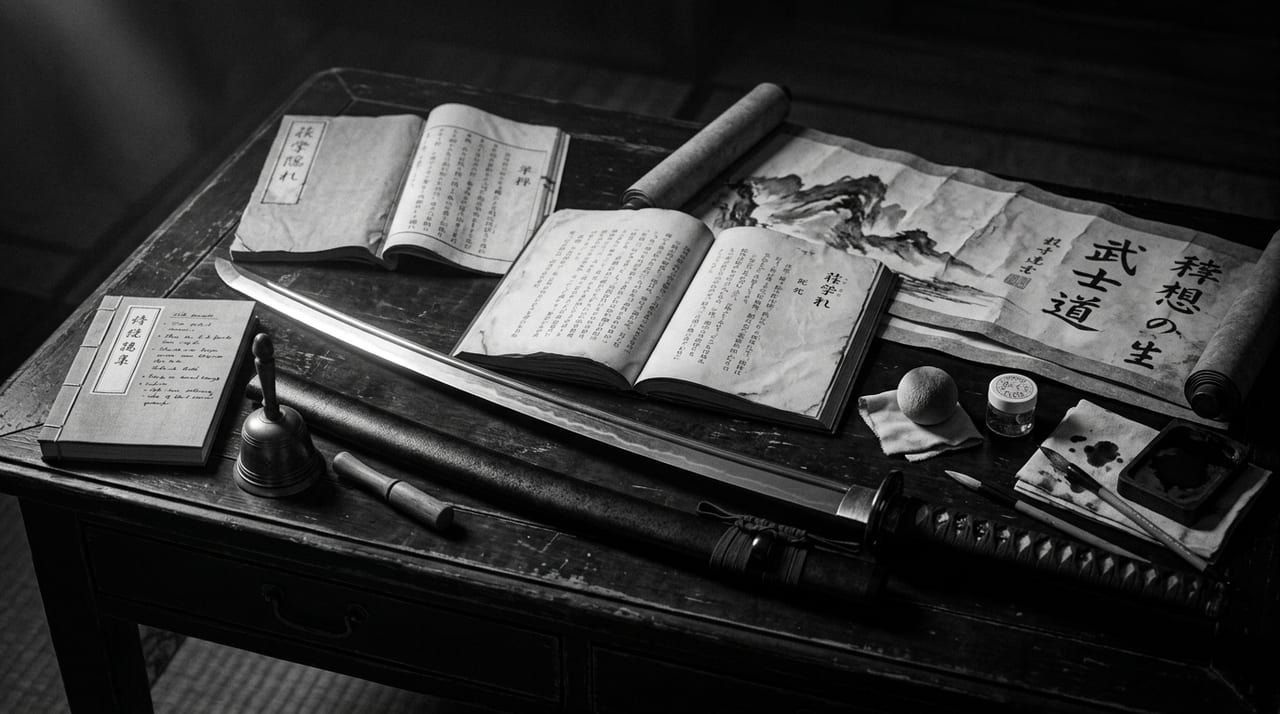
 * Image is for illustrative purposes only.
Lone Wolf and Cub
子連れ狼
The legendary gekiga manga (1970–1976) by writer Kazuo Koike and artist Goseki Kojima. Itto Ogami, former official executioner to the shogunate, pushes his infant son Daigoro in a cart down the road to hell — seeking vengeance for his wife's murder. Approximately 85 million copies sold worldwide. Its unflinching depiction of the sword as a tool of death and its meditation on bushidō philosophy have influenced generations of storytellers.
Description
Gekiga and Bushidō
Lone Wolf and Cub was serialized in Futabasha's manga magazine "Manga Action" from 1970 to 1976, standing as a masterpiece of gekiga manga. Created by writer Kazuo Koike and gekiga master Goseki Kojima, this work achieved approximately 85 million cumulative copies sold domestically in Japan and has been widely translated and introduced internationally. The protagonist of the story, Ittō Ogami, is a samurai with a unique profession: official kaishakunin (the role responsible for capital punishment—official executioner to the Tokugawa shogunate). Stripped of everything after being falsely accused and his wife murdered, Ittō sets out on a journey through the "meifū madō" (path of purgatory) with his young son Daigoro. This journey is depicted not merely as a tale of revenge, but as a profound spiritual inquiry centered on the philosophy of death, samurai resolve, and the bond between father and child.
The Japanese Sword and the Philosophy of Death
The depiction of the Japanese sword in Lone Wolf and Cub stands as one of the most philosophically profound examples among works featuring the Japanese sword. Ittō's cherished blade, the "Dōta Nuki," embodies the act of cutting as pure function—devoid of anger or emotion, striking solely as pure mechanism. This state of emptiness (mu), swordsmanship stripped of feeling, is depicted as the attainment of "enlightenment" in moral and religious terms, and is highly valued as a philosophical expression that deepens the relationship between Zen and the blade. Moreover, the baby cart that Ittō uses is equipped with numerous concealed weapons, demonstrating the strategic breadth of the vision that "the sword is not the warrior's only weapon." The power and precision of Goseki Kojima's brushwork in sword-fighting scenes remain overwhelming even today, occupying a unique position as an expression that directly confronts the reality of the blade—from the trajectory of movement to blood spray to the collapse of the body.
Yagyū Retsudō and Historical Context
The depiction of the "Yagyū clan," exemplified by the villain Yagyū Retsudō in the work, is deeply connected to the historical setting of Lone Wolf and Cub (mid-Edo period). The Yagyū Shinkagetsu-ryū, having served as sword instructor to the Tokugawa shoguns and portrayed as an organization deeply entwined with political conspiracy, presents a critically framed perspective on the relationship between power and swordsmanship—one of the important themes of this work. The manner of samurai death—the Edo period's penal system, the decapitation ritual, and seppuku—is depicted in detail, serving as a valuable reference point for understanding the relationship between Japanese perspectives on life and death and blade culture.
International Influence
Los Angeles-based comic publisher First Comics released an English translation in the 1980s, exerting enormous influence on North American comic creators. Frank Miller has publicly acknowledged the influence of this work, and the influence of Lone Wolf and Cub is evident in the noir aesthetic and depictions of violence in his representative works such as "Sin City" and "The Dark Knight Returns." The film adaptations (a six-film series starring Tomisaburo Wakayama) were also screened at the Cannes Film Festival, playing a major role in shaping the international image of samurai cinema.
Real Swords Featured
Kaishakunin Blades and Execution Swords
The specialized swords of the kaishakunin (official ritual decapitator) required exceptional cutting ability for a clean single stroke. Surviving examples attributed to execution use tend toward wider mihaba (blade width) and thinner kasane (spine thickness) optimized for cutting efficiency. Shogunate-issued swords for public officials were subject to separate standards from personal samurai blades.
Mid-Edo Period Swords (Genroku–Kyōhō, c. 1690–1735)
Lone Wolf and Cub is set during the transition from Shintō (New Sword) to the era just before the Shin-shintō (New-New Sword) revival. An age of peace where swords served ceremony and status more than battlefield use, yet kenjutsu schools flourished and bamboo-sword training with protective equipment began spreading. Representative blades of this period are held in museums nationwide.
Unsigned (Mumei) Practical Swords
The unsigned, workaday blades used by ordinary samurai — the real tool of Ogami's trade — are as historically important as famous named swords. Most Edo-period samurai carried provincial or unsigned blades valued for sharpness, durability, and handling, not artistic pedigree. These workday swords are held in local municipal museums and private collections throughout Japan.
See authentic Japanese swords
See authentic Japanese swordsThis page is intended to introduce Japanese sword culture and is not affiliated with any of the works mentioned.